 English
 中文简体
中文简体 日本語
日本語 Español
 عربى
عربى
Search
Categories
Recommend
Categories
 Lin Yuxi — International Product Sales Manager
Recommend
-
 Industry news
 -
 Industry news
 -
 Industry news
 -
 Industry news
Oct 02, 2026 - By admin
Why Pure Titanium Vacuum Flasks Are Redefining Premium Everyday Drinkware
Content
- 1 1. A New Standard for Everyday Vacuum Drinkware
- 2 2. The Material Advantage of TA1 Pure Titanium
- 3 3. Lightweight Portability Without Sacrificing Durability
- 4 4. Double-Wall Vacuum Insulation for Daily Temperature Management
- 5 5. A Refined Lid and Filter System
- 6 6. Coating-Free Surface Treatment and Long-Term Appearance
- 7 7. Comparison with Common Drinkware Alternatives
- 8 8. Manufacturing Strengths Behind the Product
- 9 9. Support for Custom Drinkware Programs
- 10 10. Sustainability and Product Life
- 11 11. Recommended Use and Care
- 12 12. Applications in Daily Life
- 13 13. Frequently Asked Questions
- 13.1 What material is used for the bottle body?
- 13.2 What are the available capacities?
- 13.3 How much does each model weigh?
- 13.4 Can the flask hold beverages other than water?
- 13.5 Does titanium affect beverage taste?
- 13.6 Is the flask insulated?
- 13.7 Is the flask leak resistant?
- 13.8 What is the filter made from?
- 13.9 Why does the inner lid have grooves?
- 13.10 Does the exterior use spray paint?
- 13.11 Is the product suitable for corporate or private-label programs?
- 13.12 What manufacturing capabilities support the product?
- 13.13 Does the antibacterial test mean cleaning is unnecessary?
- 14 14. Why This Product Stands Out in Premium Drinkware
- 15 Conclusion
- 16 References
- 17 Product: Pure Titanium Office Vacuum Flask
Drinkware has evolved from a simple container into an important part of daily comfort, mobility, health-conscious living, and professional presentation. Consumers today expect a bottle to do more than hold a beverage. They want reliable heat retention, dependable sealing, low weight, easy cleaning, material safety, attractive design, and long service life. Businesses and procurement teams have additional requirements, including stable quality, scalable manufacturing, consistent specifications, and the ability to support customized drinkware programs.
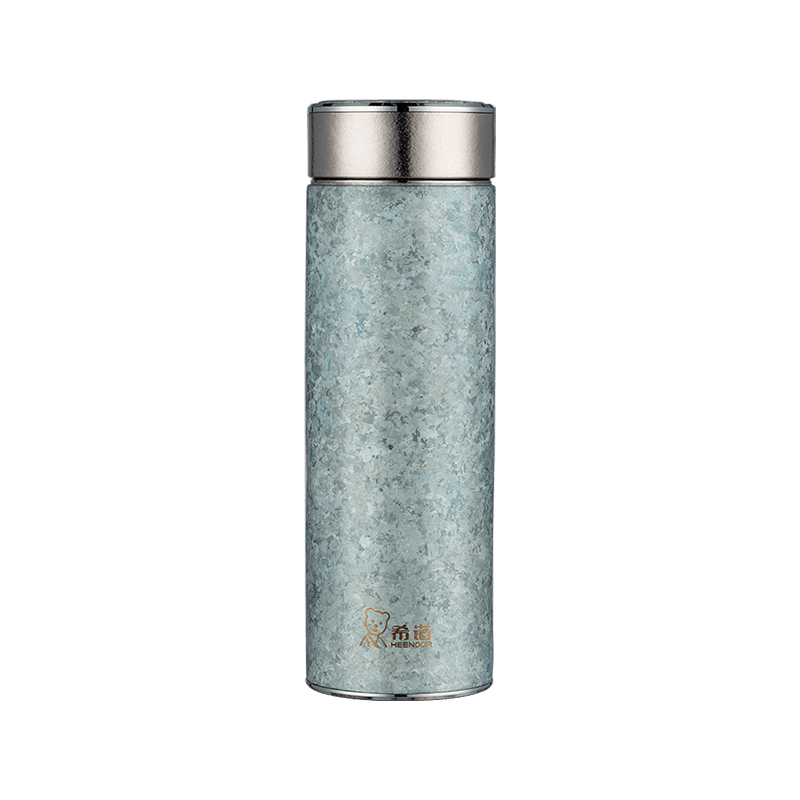
The Pure Titanium Office Vacuum Flask has been developed to meet these expectations through a combination of high-purity TA1 titanium, double-wall vacuum insulation, precision component design, and controlled manufacturing processes. Available in 345 ml and 435 ml capacities, this compact flask is intended for office use, commuting, business travel, and outdoor activities. Its design combines a pure titanium bottle body, pure titanium inner lid, and titanium lotus-shaped filter with a carefully engineered sealing system.
Compared with conventional stainless steel drinkware, the flask offers a distinctive material profile. Titanium is lightweight, corrosion resistant, durable, and naturally protected by a dense oxide film. The result is a premium drinking vessel that is easy to carry while offering a refined tactile experience and broad beverage compatibility.
1. A New Standard for Everyday Vacuum Drinkware
Traditional vacuum flasks are commonly produced from stainless steel, plastic, glass, or combinations of these materials. Each material has advantages, but each also involves trade-offs. Stainless steel is strong and widely available, yet it may feel heavy in compact products. Plastic is light, but it may not provide the same premium perception, thermal stability, or long-term durability. Glass offers a neutral surface for beverages, but it is vulnerable to impact and is less suitable for mobile use.
Pure titanium occupies a distinctive position among these materials. It combines low density with strong mechanical performance and excellent resistance to corrosion. For a portable flask, this balance is especially valuable. A user can carry a durable, insulated container without the unnecessary weight often associated with metal drinkware.
The 345 ml model weighs approximately 0.21 kg, while the 435 ml model weighs approximately 0.24 kg. This makes the flask comparable in weight to many everyday smartphones. The practical effect is significant. A bottle that adds less weight to a work bag, backpack, or travel case is more likely to be carried consistently, used throughout the day, and selected for longer journeys.
Portability is only one part of the product concept. The flask is also designed for beverages that require a dependable, clean-contact interior. Tea, coffee, fruit juice, milk, traditional Chinese medicine, and other common drinks can be held in the container without the material reacting under normal room-temperature conditions. The titanium surface is designed to resist acid and alkali corrosion, helping preserve the natural character of the beverage.
For users who pay close attention to taste, the absence of a strong metallic flavor is another important benefit. The product is designed to minimize the possibility of unwanted odor or taste transfer. This is particularly relevant for tea drinkers, coffee users, and consumers who alternate between water and flavored beverages.
2. The Material Advantage of TA1 Pure Titanium
The bottle body, inner lid, and lotus-shaped filter are made from TA1 pure titanium with a titanium content above 99.6 percent. TA1 is recognized for its high purity and useful combination of corrosion resistance, low density, and structural reliability. In drinkware, material selection affects not only durability but also taste, maintenance, appearance, and user confidence.
2.1 Dense Oxide Protection
Titanium naturally forms a dense oxide film on its surface when exposed to air. This passive layer is one of the material’s most important properties. It helps protect the underlying metal from corrosion and supports stable performance during ordinary use.
Because of this surface protection, the flask is suitable for a wide range of everyday drinks. It can hold beverages that may be mildly acidic or alkaline under normal conditions, including fruit juice, coffee, tea, milk, and traditional herbal preparations. Users should still follow ordinary drinkware hygiene practices, such as rinsing the flask after use and avoiding prolonged storage of highly perishable beverages at unsafe temperatures.
2.2 Neutral Taste and Clean Beverage Contact
The internal surface of a drink container has a direct relationship with the drinking experience. A material that absorbs odors, reacts with beverages, or transfers a noticeable taste can reduce product satisfaction. High-purity titanium is valued for its stable contact characteristics and low tendency to affect the flavor profile of ordinary beverages.
This feature is especially helpful for multi-purpose use. A person may use the flask for unsweetened tea in the morning, coffee during a commute, water during a workout, and fruit juice while traveling. A neutral internal material makes it easier to switch between beverages without persistent odor or flavor concerns.
2.3 Resistance to Heavy-Metal Leaching
The product concept emphasizes the avoidance of heavy-metal leaching from the main titanium components. This is an important consideration in premium drinkware because the bottle is repeatedly exposed to liquids and may be used every day for years. The use of high-purity TA1 titanium provides a clear material story for buyers who want a durable container with a simple, transparent composition.
For commercial procurement, material clarity is equally important. Product developers and purchasing teams can evaluate the stated materials, component structure, and intended applications with greater confidence when the bottle body, inner lid, and filter materials are clearly specified.
2.4 Antibacterial Performance Under Photocatalytic Action
Testing by the Guangdong Provincial Center for Microbial Analysis and Testing reported an antibacterial rate of 99 percent after 24 hours under photocatalytic action for the material described in the product information. This result adds another dimension to the material profile.
The reported result should be understood in its specified testing context. It does not eliminate the need for regular cleaning, drying, or proper beverage handling. Nevertheless, it demonstrates that the material system has been evaluated for antibacterial performance and supports the product’s positioning as a hygienic option for repeated daily use.
For users, the main practical value is confidence in the contact material. For manufacturers and brands, independently tested performance can provide useful technical support when developing product literature, procurement documentation, and quality files.
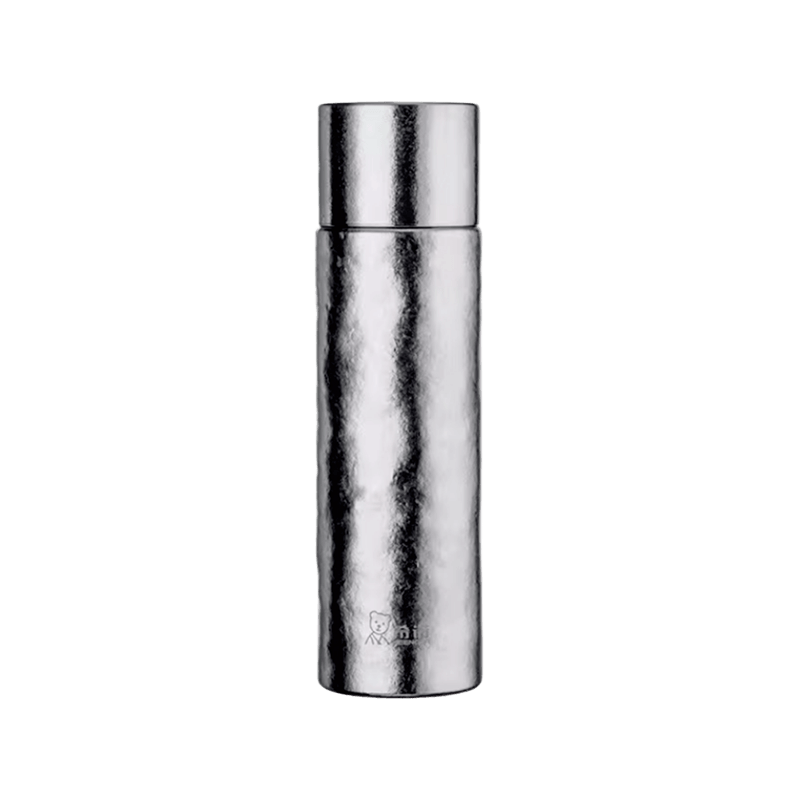
Pure Titanium Office Vacuum Flask
3. Lightweight Portability Without Sacrificing Durability
A portable bottle must balance several competing requirements. It must be light enough to carry, strong enough for daily handling, stable enough to retain heat, and durable enough to withstand repeated opening, closing, washing, and transportation. The Pure Titanium Office Vacuum Flask addresses this balance through the physical characteristics of titanium and the structure of a double-wall vacuum body.
The lower density of titanium compared with stainless steel allows the product to reduce weight while maintaining a solid, premium feel. This is not simply a numerical advantage. Weight influences behavior. A heavy bottle may be left at home, while a lighter bottle can remain in a handbag, briefcase, desk drawer, or vehicle throughout the day.
The 345 ml capacity is suitable for short commutes, espresso-based beverages, concentrated tea, and moderate hydration. The 435 ml capacity offers additional volume while preserving a compact footprint. Providing two capacities allows brands, distributors, and end users to select the appropriate balance between portability and beverage quantity.
| Specification | 345 ml Model | 435 ml Model |
|---|---|---|
| Model Number | XN-T3011 | XN-T3012 |
| Capacity | 345 ml | 435 ml |
| Approximate Weight | 0.21 kg | 0.24 kg |
| Bottle Body and Inner Liner | TA1 Pure Titanium | TA1 Pure Titanium |
| Filter Screen | TA1 Pure Titanium and Silicone Rubber | TA1 Pure Titanium and Silicone Rubber |
| Cup Lid | TA1 Pure Titanium and PP | TA1 Pure Titanium and PP |
Both models maintain the same core material concept and component structure. This creates a consistent product family for retailers and institutional buyers. It also simplifies product presentation, packaging development, quality control, and inventory planning.
4. Double-Wall Vacuum Insulation for Daily Temperature Management
Heat retention is one of the most important performance expectations for a vacuum flask. A user may fill the bottle with hot tea before leaving home and expect it to remain enjoyable during a morning commute, a work shift, or a trip. A cold beverage may likewise need to remain refreshing over several hours.
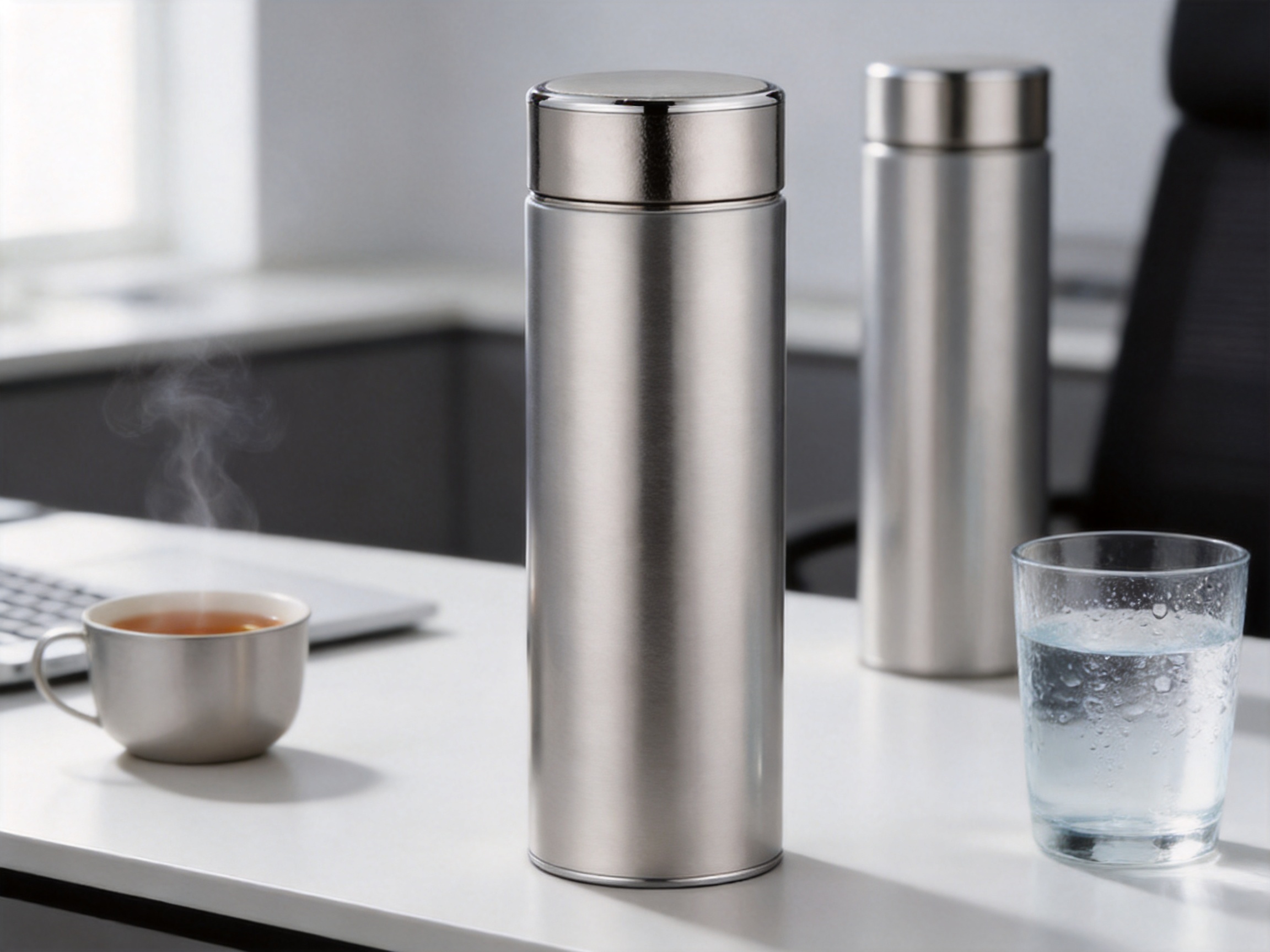
The flask uses a double-wall vacuum construction and a multi-step heat-retention process. The vacuum space between the walls reduces heat transfer through air, helping slow the movement of thermal energy between the beverage and the surrounding environment. The result is a more stable internal temperature than a single-wall container can normally provide.
Vacuum insulation also allows the outside of the bottle to remain more comfortable to hold when the contents are hot. It can reduce the formation of external condensation when the contents are cold, helping protect desks, bags, documents, and other nearby items.
Thermal performance depends on several factors, including the starting temperature of the beverage, the amount of liquid, the ambient temperature, how frequently the lid is opened, and whether the flask is preheated or precooled. The product’s vacuum structure provides the foundation for heat retention, while correct use helps users achieve the best practical results.
For office users, thermal stability can make the difference between enjoying a carefully prepared beverage and needing to replace it repeatedly. For travel users, it can reduce dependence on disposable cups and support a more organized daily routine.
4.1 The Role of the Lid in Thermal Efficiency
A vacuum body cannot deliver reliable performance if the lid leaks air or liquid. The lid therefore performs several functions at once: it closes the drinking opening, supports thermal retention, prevents leakage, and provides a convenient opening and closing experience.
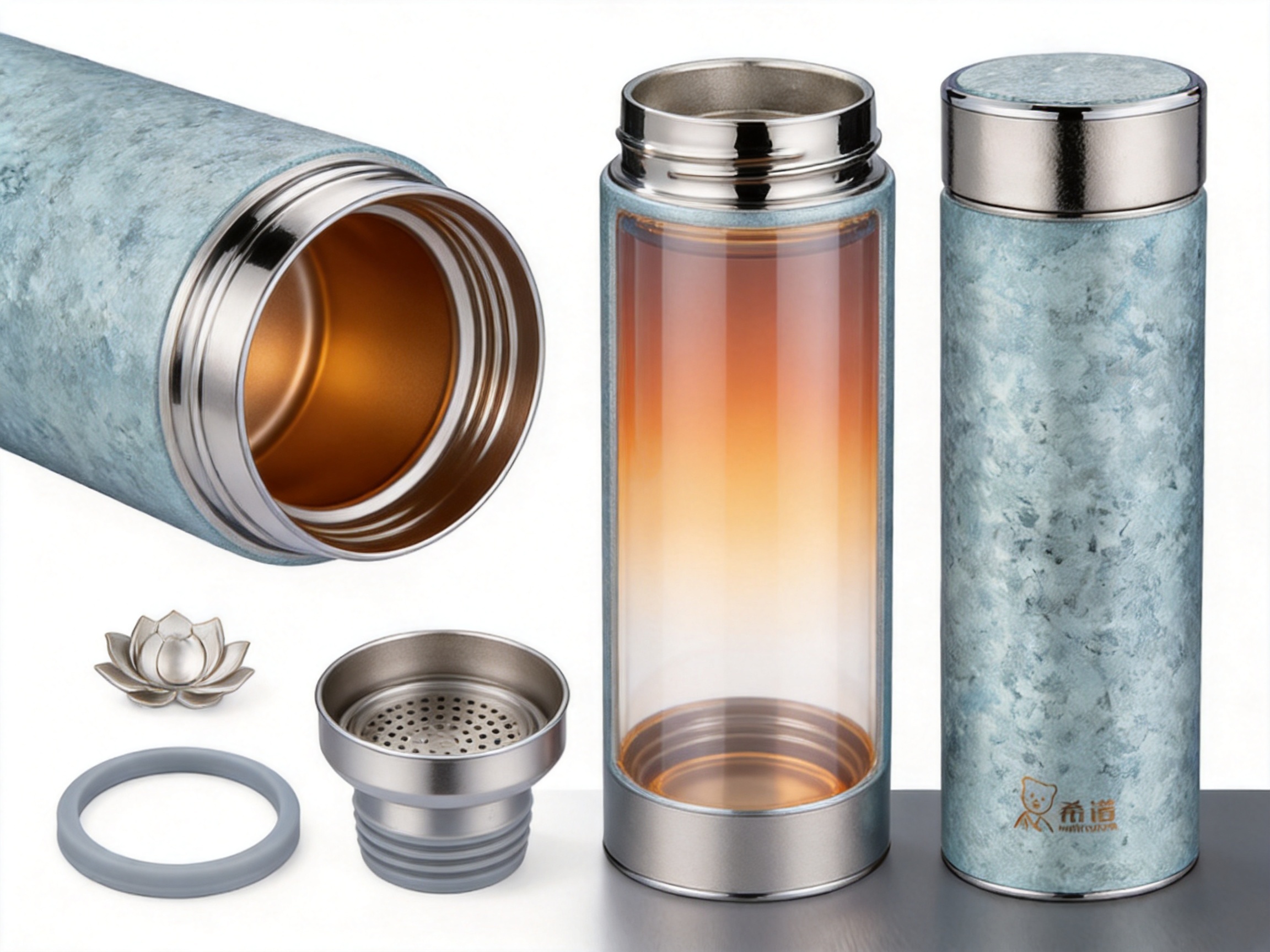
The Pure Titanium Office Vacuum Flask uses a heat-resistant silicone rubber sealing ring inside the lid. Silicone rubber is suited to this application because it can maintain flexibility across a broad range of ordinary beverage temperatures. When properly seated, the sealing ring helps form a strong closure and prevents leakage even when the bottle is inverted.
A secure seal is particularly valuable during commuting. A bottle placed in a laptop bag or briefcase may be exposed to movement, pressure, and changing orientation. Leakage prevention helps protect personal belongings and allows the flask to be transported with greater confidence.
5. A Refined Lid and Filter System
The lid and filter are not secondary accessories. They have a direct impact on how the flask performs in real use. The product incorporates a pure titanium inner lid, a titanium lotus-shaped filter, silicone rubber protection, and a water-contact surface designed for improved handling.
5.1 The Lotus-Shaped Filter
The lotus-shaped filter is made from TA1 pure titanium and paired with a silicone rubber protective ring. Its primary purpose is to separate loose tea leaves, herbal ingredients, fruit pieces, or other particles from the beverage while allowing liquid to pass smoothly.
The filter’s protective ring helps reduce direct contact between the filter and the bottle wall. This is a thoughtful detail for a reusable metal product because repeated insertion and removal can otherwise create friction, noise, or surface marks. The silicone component helps soften contact and supports a smoother user experience.
The design is suitable for consumers who prepare tea directly in the flask. It can also support users who prefer to steep selected ingredients during travel or office hours. By integrating filtration into the lid system, the product avoids the need for a separate loose strainer that could be misplaced.
5.2 Grooved Inner Lid Design
The water-contact surface of the inner lid has been upgraded with a grooved design intended to reduce dripping when the lid is opened. This feature addresses a common inconvenience in vacuum bottles. Condensation or residual liquid can collect around a flat lid surface and then run onto a desk, hand, or clothing when the cap is removed.
Grooves can guide residual liquid toward controlled areas rather than allowing it to spill unpredictably. This improves cleanliness during use and is especially helpful in office environments, where a small amount of liquid can damage documents, electronics, or work surfaces.
5.3 A Smooth, Rounded Mouth
The bottle mouth is finely polished with a smooth, rounded profile. This contributes to both comfort and perceived quality. A rounded drinking edge feels more natural against the lips, while fine polishing reduces roughness and supports easier cleaning.
The mouth geometry also influences how the bottle is filled and washed. A well-finished opening allows more convenient access for rinsing and helps reduce areas where residue may accumulate. In premium drinkware, these small contact details can distinguish a carefully engineered product from a basic container.
6. Coating-Free Surface Treatment and Long-Term Appearance
Many drinkware products rely on spray-painted or coated exterior finishes to create color, texture, or branding effects. These finishes can offer attractive visual variety, but they may also be vulnerable to scratching, peeling, chipping, and gradual wear under heavy use.
The Pure Titanium Office Vacuum Flask abandons traditional spray-painting technology. Instead of depending on an external coating that may separate from the base material, the product presents the natural character and texture of pure titanium. This creates a restrained, professional appearance appropriate for office desks, executive gifting, business travel, and premium lifestyle applications.
The coating-free approach offers several potential advantages. It removes the risk of paint peeling from the exterior surface, reduces concerns about coating fragments, and supports a more durable visual identity. It also aligns with consumer interest in products that use fewer unnecessary surface layers.
A natural titanium finish has a distinctive tactile quality. It feels refined without being overly decorative, and it can remain visually appropriate across different environments. Unlike bright promotional colors that may appear dated, a simple titanium surface can support a long product life and a broad customer demographic.
For brands and procurement teams, this design approach may also simplify product positioning. The flask can be presented as a technical, premium, and environmentally responsible item without relying solely on decorative coatings to communicate value.
7. Comparison with Common Drinkware Alternatives
The advantages of titanium become clearer when the flask is compared with other common materials. These comparisons should be understood as general material distinctions rather than absolute judgments. Product performance varies according to design, manufacturing quality, and intended use.
7.1 Compared with Stainless Steel
Stainless steel is a familiar and dependable material for vacuum drinkware. It offers strength, established manufacturing methods, and a competitive cost structure. However, stainless steel products can be heavier than titanium products of similar volume and construction.
The titanium flask’s lower weight provides a practical advantage for users who carry a bottle every day. Its high-purity material also supports a premium story based on neutral taste, corrosion resistance, and a clean component structure. The natural titanium exterior avoids the possibility of paint peeling associated with some coated stainless steel products.
Stainless steel remains a strong choice for many applications, particularly where price, high-volume availability, or impact resistance is the primary concern. Titanium becomes more compelling when portability, premium material identity, and refined appearance are equally important.
7.2 Compared with Plastic
Plastic bottles are generally lightweight and economical. They can be produced in many shapes and colors and are widely used for sports, events, and promotional programs. However, plastic may not provide the same premium perception or long-term heat-handling characteristics as a metal vacuum flask.
The titanium flask provides a more substantial and durable product experience while remaining lightweight. Its double-wall vacuum construction is suited to hot and cold beverages, and its titanium beverage-contact components support a neutral taste profile. For office, travel, and premium gifting applications, this combination can offer greater perceived value than basic plastic alternatives.
7.3 Compared with Glass
Glass is valued for its transparency and generally neutral beverage contact. It allows users to see the contents and can be easy to clean. Its main limitations are weight, fragility, and reduced suitability for rough transportation.
The titanium flask offers greater mobility and impact tolerance for commuting and outdoor activities. It does not provide transparency, but it compensates with low weight, vacuum insulation, and a more travel-ready structure.
7.4 Compared with Coated Metal Bottles
Coated metal bottles can provide strong visual branding opportunities, but their exterior finish may be affected by repeated impact or abrasive contact. The coating-free titanium surface reduces dependence on paint adhesion and gives the product a more authentic material identity.
For users who prefer understated design and long-term appearance, the titanium approach can be more attractive. For companies developing a premium drinkware line, it also offers a way to differentiate products through material rather than decoration alone.
8. Manufacturing Strengths Behind the Product
A technically advanced material does not automatically result in a high-quality finished product. The performance of a vacuum flask depends on engineering decisions, tooling accuracy, welding or forming control, sealing assembly, surface finishing, inspection, and consistency across production batches.
Heenoor Co., Ltd. was founded in 1999 and has developed into a large-scale drinkware manufacturer focused on product development and industrial manufacturing. Its capabilities integrate product design, engineering validation, tooling development, standardized production, and quality management.
This integrated structure is valuable because drinkware development involves multiple connected stages. A design that looks attractive in a drawing may be difficult to manufacture consistently. A material that performs well in laboratory testing may require special forming or joining processes. A lid that seals effectively in a prototype may need improved tolerances before mass production.
8.1 Product Design and Engineering Validation
Product design begins with understanding the use environment. For this flask, key design targets include low weight, compact capacity, stable heat retention, leak resistance, comfortable drinking contact, filtration performance, and a refined appearance.
Engineering validation can evaluate the interaction between these targets. For example, reducing wall thickness may lower weight but could affect rigidity. Enlarging the mouth may improve cleaning but require changes to the lid and sealing ring. Increasing filter openings may improve flow but reduce particle separation. A mature product development process examines these relationships before tooling is finalized.
Validation may include dimensional checks, assembly trials, vacuum performance assessment, leakage tests, thermal evaluation, material verification, and repeated-use simulations. These activities help identify design weaknesses and reduce the risk of costly changes after production begins.
8.2 Tooling Development
Tooling is a central part of drinkware manufacturing. Precise tools influence the shape, wall consistency, fit, and repeatability of components. For a compact titanium flask, tooling must support clean forming, accurate alignment, and reliable assembly of the bottle body, inner liner, lid, and filter.
Well-developed tooling also contributes to production efficiency. Stable tools reduce variation between units and make it easier to maintain consistent appearance across large orders. This is especially important for brands and procurement teams that need predictable performance across multiple shipments.
8.3 Standardized Production
Standardized production converts a validated design into a repeatable manufacturing program. Standard operating procedures can define material handling, forming conditions, component inspection, cleaning, assembly sequence, sealing-ring installation, and finished-product testing.
For a multi-component flask, standardized assembly is essential. A sealing ring installed incorrectly can affect leak resistance. A filter ring fitted with uneven pressure may affect smooth operation. A lid with inconsistent thread or closure alignment may reduce user confidence. Process discipline helps prevent these problems.
8.4 Quality Management
Quality management covers more than final inspection. It begins with incoming material control and continues through production, assembly, testing, packaging, and shipment. The stated composition of TA1 pure titanium and other materials should be supported by appropriate supplier documentation and internal verification procedures.
Quality controls may include dimensional inspection, visual examination, weight checks, vacuum integrity evaluation, sealing tests, component fit checks, and packaging review. When a product is intended for international programs, clear records and consistent specifications can simplify communication between the factory, brand, distributor, and end customer.
8.5 Manufacturing Across Multiple Materials
Heenoor has experience with stainless steel, titanium, plastic, and glass drinkware. This multi-material background is useful because it enables the manufacturer to select manufacturing methods according to product requirements rather than relying on a single material category.
Experience across materials can also support hybrid products. The flask itself combines titanium, silicone rubber, and PP components. Understanding how these materials interact during assembly helps improve fit, sealing, durability, and user comfort.
9. Support for Custom Drinkware Programs
Although the Pure Titanium Office Vacuum Flask is presented as a defined product, its structure is also suitable for discussion in custom and private-label drinkware programs. Brands may evaluate the model for corporate gifts, executive merchandise, travel collections, premium retail, hospitality programs, or wellness-oriented product lines.
Customization can involve packaging, product documentation, capacity selection, labeling, color or finish strategy, accessory configuration, and order planning. Because the flask uses a restrained natural titanium appearance, branding can be applied through packaging or carefully selected marking methods without compromising the material-focused design concept.
For procurement teams, the availability of two capacities can help create a coordinated product range. The 345 ml version may be positioned as a compact office or commuting flask, while the 435 ml version may suit longer travel, larger beverages, or users who prefer additional capacity.
Reliable customization depends on more than visual branding. Buyers should consider minimum order quantities, sample approval, production lead times, packaging requirements, inspection standards, shipment documentation, and after-sales support. A manufacturer with integrated design, engineering, tooling, production, and quality functions can coordinate these details more efficiently than a fragmented supply chain.
10. Sustainability and Product Life
Reusable drinkware can contribute to more responsible consumption by reducing dependence on disposable cups and single-use bottles. The environmental value of a reusable flask depends on how often it is used, how long it remains functional, and whether it is maintained properly.
The titanium flask is designed for repeated use. Its corrosion resistance, durable material structure, and coating-free exterior support a long service life. Avoiding traditional spray painting may also reduce reliance on an additional surface layer that could wear away over time.
Light weight can provide a further sustainability benefit during transportation. A lighter product may require less energy to move than a heavier equivalent, although the full environmental impact also depends on raw material extraction, processing, manufacturing energy, packaging, shipping distance, and end-of-life handling.
Responsible product communication should therefore focus on durability, reuse, long-term ownership, and appropriate maintenance rather than presenting a single feature as a complete environmental solution. The product’s strongest sustainability contribution is its potential to remain useful over many beverage cycles and many years of normal ownership.
11. Recommended Use and Care
To achieve the best performance, users should rinse the flask after each use and clean the bottle, lid, filter, and sealing ring according to suitable drinkware practices. Tea leaves, milk residue, fruit pulp, and herbal ingredients should not be left inside for extended periods.
The filter should be removed and cleaned separately so that particles do not remain around the openings or silicone ring. The sealing ring should also be checked periodically. If it becomes displaced, damaged, or contaminated with residue, it may not seal correctly.
Users should avoid striking the mouth or forcing the lid into an incorrect position. Although titanium is durable, the sealing system relies on accurate contact between several components. Closing the lid gently and evenly helps preserve the threads, seal, and filter structure.
Hot beverages should be handled carefully. Users should allow sufficient space below the lid, avoid overfilling, and open the flask carefully if the beverage is very hot. The product’s leak-resistant seal is intended to prevent liquid escape during normal handling, but no closed hot-liquid container should be shaken unnecessarily or opened toward the face.
Proper care supports both hygiene and service life. A reusable product achieves its greatest value when it is cleaned regularly, transported responsibly, and used according to its intended purpose.
12. Applications in Daily Life
12.1 Office Use
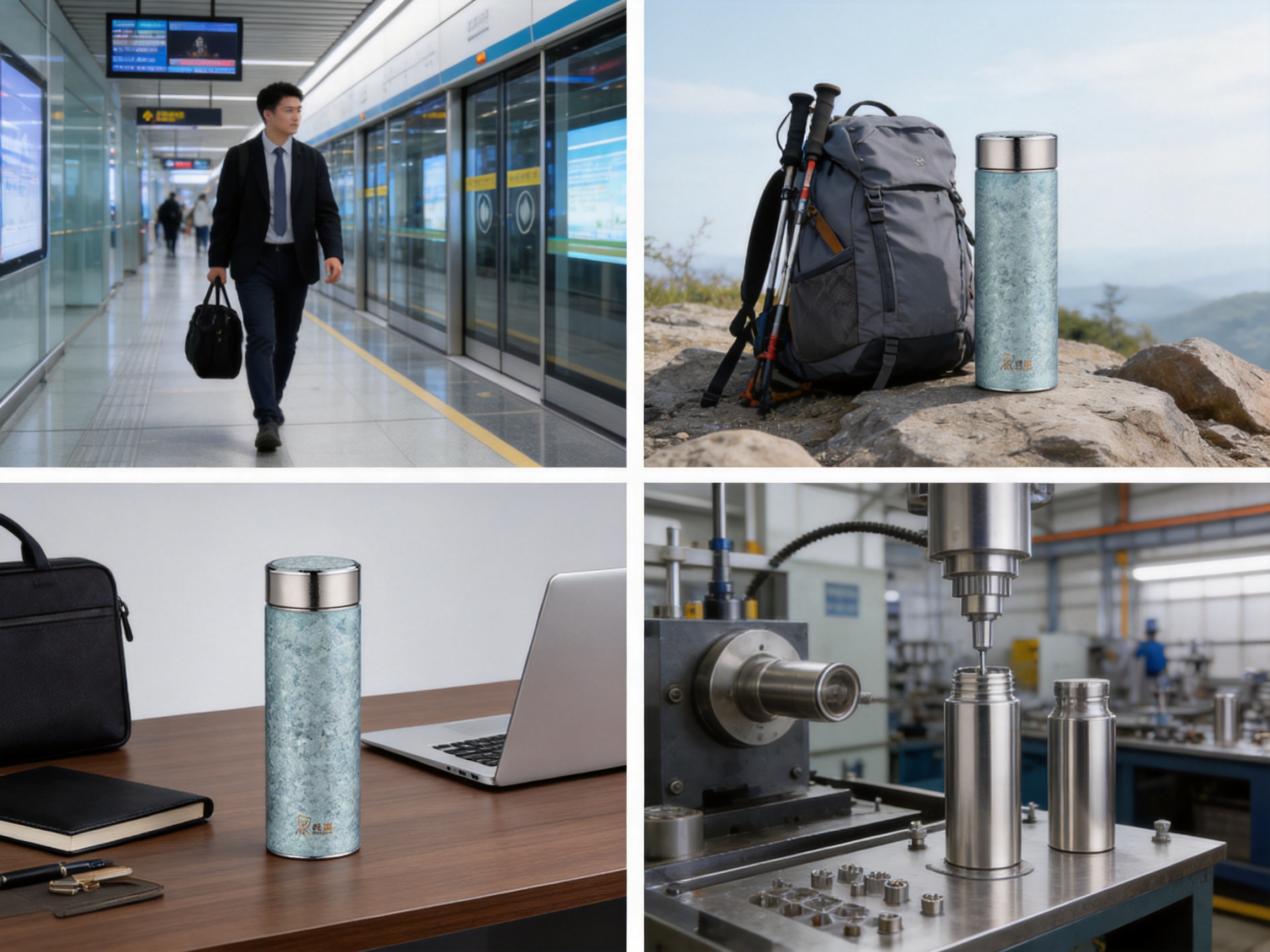
The compact capacities and understated titanium appearance make the flask suitable for office environments. It can hold tea, coffee, water, or other beverages while fitting comfortably beside a computer, notebook, or document folder.
The grooved inner lid can help reduce drips when opening the bottle, while the secure silicone seal supports safer placement in a work bag. The natural metal surface also communicates a professional and technical character suitable for business settings.
12.2 Commuting
Commuters benefit from the low weight and compact format. A 345 ml flask can be carried on public transportation, stored in a small shoulder bag, or placed in a vehicle cup holder where compatible. The 435 ml model offers more beverage volume while remaining relatively light.
Vacuum insulation helps maintain beverage temperature during the journey, reducing the need to purchase disposable drinks along the way.
12.3 Business Travel
Business travelers often need products that are compact, reliable, and visually refined. Titanium’s lightweight structure helps conserve luggage space and weight. The leak-resistant lid provides confidence when the flask is placed in a travel bag, while the durable exterior is suited to repeated movement between hotels, offices, meetings, and transportation hubs.
12.4 Outdoor Activities
The flask can also support light outdoor activities, short hikes, sightseeing, and day trips. Its low weight is helpful when every additional item contributes to carrying fatigue. The titanium body and vacuum structure provide a practical combination of mobility and thermal performance.
12.5 Tea and Infused Beverage Preparation
The lotus-shaped filter makes the flask particularly suitable for loose-leaf tea, herbal ingredients, and other beverages that require separation of particles. The filter can help users prepare a drink directly in the container without carrying an additional strainer.
13. Frequently Asked Questions
What material is used for the bottle body?
The bottle body and inner liner are made from TA1 pure titanium with a titanium content above 99.6 percent.
What are the available capacities?
The flask is available in 345 ml and 435 ml versions. The corresponding model numbers are XN-T3011 and XN-T3012.
How much does each model weigh?
The 345 ml model weighs approximately 0.21 kg, and the 435 ml model weighs approximately 0.24 kg.
Can the flask hold beverages other than water?
Yes. The product is designed for tea, coffee, fruit juice, milk, traditional Chinese medicine, and other ordinary beverages. Users should clean the flask after holding milk, juice, herbal preparations, or other residue-forming drinks.
Does titanium affect beverage taste?
High-purity titanium is selected for its stable beverage-contact characteristics and low tendency to create a metallic taste under normal use. This makes it suitable for users who want to preserve the natural flavor of tea, coffee, juice, and water.
Is the flask insulated?
Yes. It uses double-wall vacuum construction and a multi-step heat-retention process designed to reduce heat loss and help maintain beverage temperature.
Is the flask leak resistant?
The lid includes a heat-resistant silicone rubber sealing ring that provides a strong closure and is designed to prevent leakage when the bottle is inverted under normal conditions.
What is the filter made from?
The filter screen is made from TA1 pure titanium and silicone rubber. Its lotus-shaped design supports smooth filtration and helps protect the bottle wall from direct contact.
Why does the inner lid have grooves?
The grooved water-contact surface is designed to reduce dripping when the lid is opened by helping control residual liquid around the inner lid.
Does the exterior use spray paint?
No. The product abandons traditional spray-painting technology and uses the natural texture of pure titanium. This eliminates the risk of exterior coating peeling.
Is the product suitable for corporate or private-label programs?
It can be evaluated for premium retail, corporate gifting, business travel, hospitality, and other drinkware programs. Buyers should discuss packaging, marking, order quantity, inspection, and delivery requirements with the manufacturer.
What manufacturing capabilities support the product?
The manufacturer integrates product design, engineering validation, tooling development, standardized production, and quality management. It also has experience working with stainless steel, titanium, plastic, and glass drinkware.
Does the antibacterial test mean cleaning is unnecessary?
No. The reported antibacterial rate of 99 percent after 24 hours was measured under photocatalytic action in the stated testing context. Regular cleaning, drying, and safe beverage handling remain essential.
14. Why This Product Stands Out in Premium Drinkware
The Pure Titanium Office Vacuum Flask differentiates itself through a carefully coordinated set of features rather than a single isolated specification. High-purity TA1 titanium provides corrosion resistance, low weight, a neutral contact surface, and a distinctive natural appearance. Double-wall vacuum insulation supports thermal performance. The silicone sealing ring improves leak resistance. The lotus-shaped filter adds practical value for tea and infused beverages. The grooved inner lid addresses dripping, while the polished mouth improves comfort.
Its advantages over conventional competitors are most apparent when the product is evaluated as a complete user experience. Compared with heavier metal bottles, it offers a lighter carrying burden. Compared with coated products, it avoids dependence on paint adhesion. Compared with plastic containers, it provides a more durable and premium material profile. Compared with glass, it is better suited to mobile use and impact-prone environments.
Behind the product is an integrated manufacturing structure that combines material knowledge, product development, tooling, production standardization, and quality management. This is important for buyers who need more than an attractive sample. Commercial customers require repeatability, documentation, communication, and dependable supply support.
The result is a compact flask designed for modern routines: an office desk, a morning commute, a business trip, a short outdoor journey, or a quiet tea break. It brings together technical performance and understated design in a format that is easy to carry and simple to use.
Conclusion
Premium drinkware is increasingly defined by the relationship between material, engineering, comfort, and long-term value. The Pure Titanium Office Vacuum Flask responds to this trend with a high-purity TA1 titanium body, titanium inner lid, titanium filter, double-wall vacuum construction, silicone sealing technology, and coating-free surface treatment.
Its lightweight structure makes daily carrying easier, while its corrosion resistance and neutral taste profile support a broad range of beverages. The filter, polished mouth, and grooved inner lid improve practical usability. The leak-resistant closure and vacuum insulation make the product appropriate for office work, commuting, travel, and outdoor activities.
For brands, distributors, and procurement teams, the product is supported by a manufacturer with experience in product design, engineering validation, tooling development, standardized manufacturing, and quality management across multiple drinkware materials. That combination gives the flask value not only as a finished consumer product but also as a potential component of a stable, premium drinkware program.
As consumers seek reusable products that are lighter, cleaner, more durable, and more refined, pure titanium offers a compelling path forward. This flask demonstrates how advanced material selection and disciplined manufacturing can transform a familiar everyday item into a more capable and satisfying product.
References
1. Product technical information for Pure Titanium Office Vacuum Flask, models XN-T3011 and XN-T3012.
2. Material specification for TA1 pure titanium components used in drinkware.
3. Guangdong Provincial Center for Microbial Analysis and Testing, antibacterial performance test information supplied for the product material.
4. General engineering principles of double-wall vacuum insulation and thermal-loss reduction in reusable drinkware.
5. General technical information concerning titanium corrosion resistance, passive oxide-film formation, and low-density metal construction.
6. Manufacturer-provided company information concerning product design, engineering validation, tooling development, standardized production, and quality management.
Product: Pure Titanium Office Vacuum Flask

You may also like…
Copyright © 2025 Heenoor Co., Ltd. All Rights Reserved.
 Custom Stainless Steel Drinkware Manufacturers
BACK TOP