Surface Finishing and Its Effect on How Stainless Chopsticks Feel in Hand
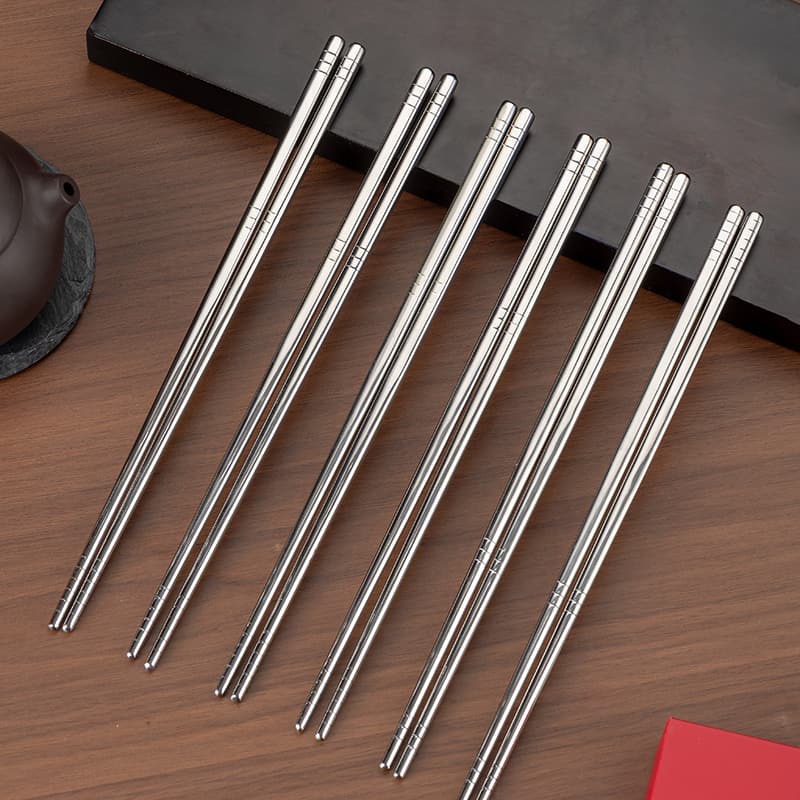
A pair of Stainless Chopsticks with the same diameter and the same steel grade can still feel completely different once picked up, and the reason usually traces back to how the surface was finished rather than the metal composition itself. Brushing, sandblasting, mirror polishing, and matte etching all leave distinct micro-textures on the surface, and each one changes friction, thermal sensation, and how food residue behaves during use.
Why Mirror Polish Is Not Always the Right Choice
A high-gloss mirror finish is achieved by passing the chopstick body through a series of buffing wheels with progressively finer abrasive compounds, sometimes finishing with a felt wheel and polishing paste. The result looks clean on a retail shelf, but a fully mirrored surface reduces the microscopic roughness that fingers rely on for grip. Combined with moisture from food or condensation, a mirror-finished shaft can slip inside the hand more easily than a brushed one, particularly for users eating foods with oil or sauce. This is a recurring point of feedback from foodservice buyers who prioritize function over shelf appearance.
Brushed and Sandblasted Textures Change Friction Coefficient
Brushing creates parallel micro-grooves along the shaft using abrasive belts, typically running in the 180 to 400 grit range depending on how fine the texture needs to be. Sandblasting, by contrast, produces a random, non-directional texture by propelling fine media particles at the surface under pressure. Both methods raise the surface roughness value compared to polishing, and that roughness is what increases the friction coefficient between skin and metal. In tests comparing grip stability, sandblasted samples tend to hold small, smooth objects — a peanut, a slice of fish — with less slippage than polished samples, though the trade-off is a slightly duller visual appearance that some retail buyers still prefer to avoid.
| Finish Type |
Surface Characteristic |
Typical Use Case |
| Mirror polish |
Low roughness, high gloss |
Gift sets, premium retail display |
| Brushed (linear) |
Moderate roughness, matte sheen |
Household and hospitality sets |
| Sandblasted |
Higher roughness, non-reflective |
Foodservice, catering, non-slip demand |
| Etched/textured grip zone |
Localized roughness at the grip point only |
Ergonomic or premium branded lines |
Some manufacturers apply a hybrid approach, keeping the upper portion of the shaft polished for appearance while adding a textured or knurled section near the grip point where fingers actually make contact. This localized treatment addresses the slip concern without giving up the visual finish buyers associate with a higher-end product. Heenoor Co., Ltd. has worked with this kind of dual-zone finishing on Stainless Chopsticks intended for hospitality clients who want a set that photographs well on a table setting but still performs reliably during actual meal service.
Thermal Sensation Is Part of the Grip Conversation Too
Surface finish also affects how quickly heat transfers from hot food to the hand. A polished surface tends to feel cooler to the touch initially due to how light and heat reflect off it, while a textured surface can feel warmer because of the increased surface contact area. For chopsticks used with hot pot or freshly steamed dishes, this thermal perception factors into customer comfort even though it has little to do with the actual thermal conductivity of the steel, which remains constant regardless of finish.
What Procurement Teams Actually Check Before Committing to a Supplier
Sourcing Stainless Chopsticks in volume is different from a one-off retail purchase, and procurement teams evaluating a long-term manufacturing partner tend to look past the sample pair on the table and into the systems behind it.
Material Traceability and Batch Consistency
One of the first things a procurement team asks about is whether raw material can be traced back to a mill certificate, confirming the actual chromium and nickel content rather than relying on a supplier's verbal claim of "304 grade." Batch-to-batch consistency matters just as much — a buyer running a multi-year program does not want the third production run to feel different in weight or finish from the first. This is typically checked through incoming material inspection records and retained samples from prior shipments.
Production Capacity Against Realistic Lead Times
A factory's stated capacity means little without evidence it can be sustained across concurrent orders. Procurement teams often ask for a breakdown of tooling count, shift patterns, and how a factory handles overlapping deadlines from multiple clients. Lead time reliability, not just the shortest quoted number, tends to carry more weight in supplier scoring than headline pricing.
| Evaluation Area |
What Buyers Look For |
Common Verification Method |
| Material sourcing |
Traceable steel grade and origin |
Mill certificates, spectrometer testing |
| Process stability |
Consistent finish and dimensions across runs |
Retained samples, in-line inspection logs |
| Compliance documentation |
Food-contact safety records |
Third-party lab reports |
| Communication and change control |
Clear handling of design or spec revisions |
Sample approval history, revision logs |
Documentation and Communication Discipline
Beyond the physical product, buyers increasingly weigh how a factory documents changes — whether a revised chopstick tip radius or a new packaging spec gets recorded and confirmed in writing before production, rather than communicated loosely over a phone call. Heenoor Co., Ltd. approaches this stage as part of its integrated framework, where design, tooling, and production sit under one operational structure, which reduces the gap between what a buyer approves in a sample and what actually reaches the production floor. For procurement teams managing multi-year programs, this kind of documentation trail often matters more during an audit than the unit price listed on the initial quotation.
Responsiveness During Non-Standard Requests
Long-term supplier relationships are also tested by how a factory responds to requests that fall outside a standard catalog — a custom length, a modified grip texture, or packaging suited to a specific retail channel. Heenoor Co., Ltd. has found that buyers place particular weight on whether a factory can walk through the technical implications of such a change, including tooling adjustments or finishing line reconfiguration, rather than simply agreeing to the request without addressing what it involves on the production side.

 English
 中文简体
中文简体 日本語
日本語 Español
 عربى
عربى Vacuum Flask/Water Bottle