What One Production Line Producing Three Utensil Types Actually Tells You About a Supplier
A procurement manager once asked a supplier why the same order quote for a matched flatware set came in noticeably lower per-unit than three separate quotes for chopsticks, spoons, and forks sourced from different specialist shops. The answer had nothing to do with margin-cutting and everything to do with shared tooling infrastructure — a single anodizing bath, one polishing line, and forming dies designed around a common wall-thickness range can serve all three utensil types without re-tooling between runs. That kind of integration reveals more about a supplier's actual capability than any single product sample can, and it connects directly to a separate technical question worth understanding: why the handle-to-head transition on a titanium spoon or fork is one of the harder zones to get right in the first place.
Why Making All Three Utensils In-House Signals Something Real
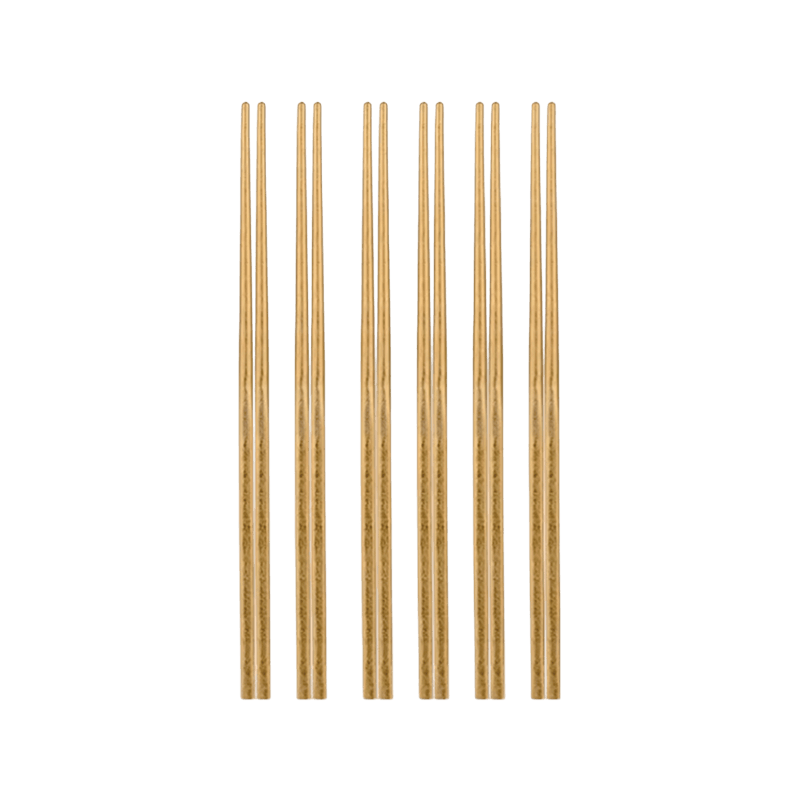
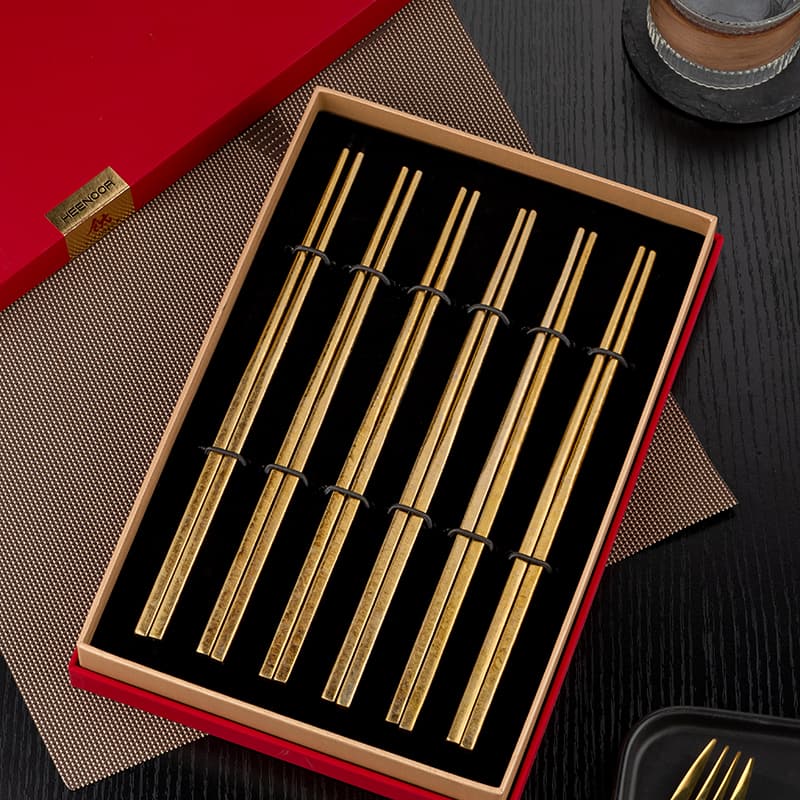
Titanium Chopsticks, Titanium Spoon, and Titanium Fork products share more production overlap than their different shapes suggest. All three typically start from the same grade of titanium sheet or rod stock, go through similar surface preparation before anodizing, and rely on the same color-control parameters during the electrochemical coloring stage. A supplier running all three through one integrated process avoids the color-matching problem that comes up when a buyer sources chopsticks from one factory and a matching fork from another — anodized titanium color is sensitive enough to bath temperature and voltage that even nominally identical settings across two separate facilities rarely produce an exact match.
There's also a die-development efficiency that shows up when one supplier handles the full utensil range. Forming dies for a titanium fork's tine section and a spoon's bowl section require different geometry, but both draw on the same base knowledge of how titanium responds to stamping pressure and springback at a given wall thickness — knowledge that a facility producing only chopsticks, where the shaft is a simple extrusion or straight-forged piece, wouldn't necessarily have developed. A supplier capable of producing Titanium Chopsticks, Titanium Spoon, and Titanium Fork items under one roof has usually already solved the forming-parameter puzzle across a wider range of geometries, which reduces the trial-and-error period when a buyer requests a new shape variation.
Heenoor Co., Ltd. treats this kind of cross-utensil tooling knowledge as a practical asset rather than a marketing point, since a die calibration learned from producing spoon bowls at scale often transfers usefully to solving a fork-tine forming issue that would otherwise require starting from scratch.
| Production Element |
Single-Category Supplier |
Integrated Multi-Utensil Supplier |
| Anodizing color matching across a set |
Difficult if sourced separately |
Consistent, since all pieces share one bath run |
| Forming-parameter knowledge transfer |
Limited to one geometry type |
Broader, drawing on multiple shape experiences |
| Sampling turnaround for a full set |
Slower, coordinating across vendors |
Faster, managed within one production schedule |
The Transition Zone That Causes Most Spoon and Fork Forming Problems
The point where a handle narrows into the head — the bowl of a spoon or the base of a fork's tines — is where material stress concentrates most during stamping, and it's a zone that doesn't exist on a chopstick at all, which is part of why spoon and fork tooling requires separate development from chopstick production even within an integrated facility. As titanium sheet gets drawn from a flat blank into a curved bowl shape, the metal at the transition has to stretch in two directions simultaneously rather than one, and titanium's relatively high springback compared to stainless steel means the die has to overcompensate the bend angle to land at the correct final geometry once the metal relaxes after forming.
Wall thickness tends to thin unevenly at this exact zone if the draw ratio isn't calibrated carefully — the bowl of a spoon can end up slightly thinner right at the point where it meets the handle, which is also the point that experiences the most repeated flex during normal use, scooping and lifting food. A fork faces a related but distinct version of this problem: the tine base, where four narrow prongs converge back into a single handle width, concentrates stress differently than a spoon's smooth curve, and inconsistent forming here can leave one or two tines slightly shorter or misaligned if the blank wasn't centered precisely before the press cycle.
The common fix isn't a single adjustment but a combination of slower press speed through the transition zone, incremental multi-stage forming rather than a single deep draw, and periodic die inspection to catch wear at the transition radius before it starts producing visible thin spots. A die that's held up fine for months can develop enough wear at this specific radius to start showing thinning defects that weren't present in earlier production runs, which is why some facilities schedule transition-zone thickness checks as a routine part of ongoing quality monitoring rather than a one-time qualification step.
| Transition Zone Issue |
Root Cause |
Typical Mitigation |
| Uneven wall thinning at spoon bowl base |
Draw ratio not matched to titanium's stretch behavior |
Multi-stage forming instead of single deep draw |
| Tine misalignment at fork base |
Blank centering error before press cycle |
Tighter fixture tolerance and periodic die inspection |
| Springback deviation from target angle |
Titanium's higher elastic recovery vs. stainless steel |
Overcompensated bend angle in die design |
Why These Two Points Matter Together for a Buyer
A supplier's ability to produce Titanium Chopsticks, Titanium Spoon, and Titanium Fork items as an integrated set is really a proxy for whether that supplier has already worked through problems like the handle-to-head transition zone across multiple geometries rather than just one. Heenoor Co., Ltd. approaches its flatware tooling development this way, treating a die adjustment learned from spoon-bowl forming as relevant knowledge for fork-tine calibration rather than as an unrelated production line, since both challenges trace back to the same underlying material behavior — titanium's springback and stretch response under stamping pressure — even though the visible defect shows up differently on each utensil type.

 English
 中文简体
中文简体 日本語
日本語 Español
 عربى
عربى Vacuum Flask/Water Bottle