 English
 中文简体
中文简体 日本語
日本語 Español
 عربى
عربى
Search
Categories
Recommend
Categories
 Lin Yuxi — International Product Sales Manager
Recommend
-
 Industry news
 -
 Industry news
 -
 Industry news
 -
 Industry news
Sep 26, 2026 - By admin

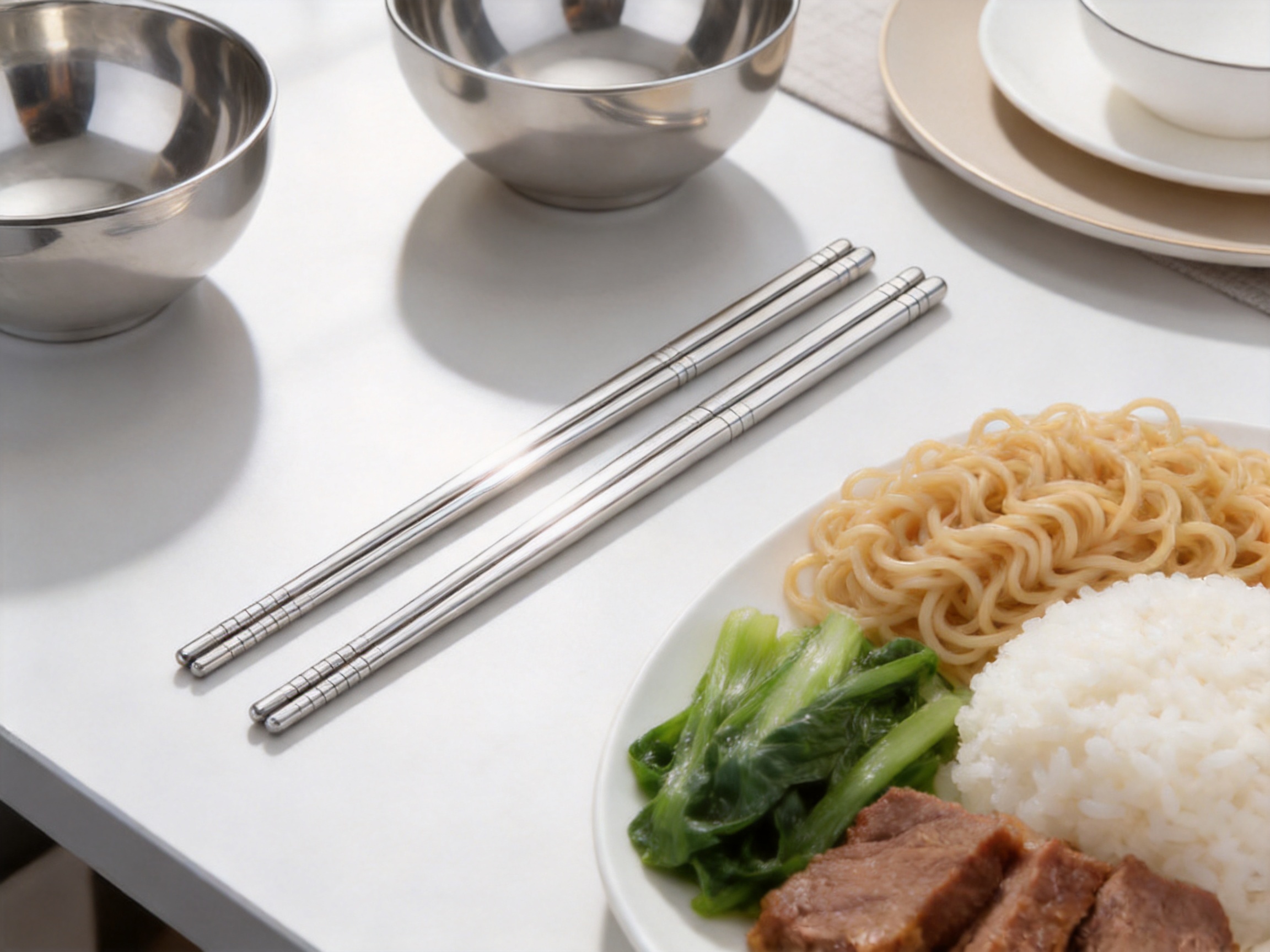
304 Stainless Steel Chopstick Sets: Durable, Hygienic, and Manufacturing-Ready Tableware
Content
- 1 1. The Role of Material Selection in Chopstick Performance
- 2 2. Product Design and User Experience
- 3 3. Surface Finishing and Appearance
- 4 4. Hygiene, Cleaning, and Maintenance Advantages
- 5 5. Comparison with Common Chopstick Materials
- 6 6. Manufacturing Capabilities Supporting Product Quality
- 7 7. From Raw Material to Finished Chopstick Set
- 8 8. Applications Across Different Markets
- 9 9. Wholesale and Customization Considerations
- 10 10. Sustainability and Long-Term Value
- 11 11. Quality Checklist for Buyers
- 12 12. Frequently Asked Questions
- 12.1 12.1 What material are the chopsticks made from?
- 12.2 12.2 What is the length of the chopsticks?
- 12.3 12.3 Do the chopsticks contain paint or wax?
- 12.4 12.4 Are the chopsticks easy to clean?
- 12.5 12.5 Can the chopsticks be cleaned in a dishwasher?
- 12.6 12.6 Are the chopsticks suitable for high-temperature disinfection?
- 12.7 12.7 Why are grooves added to the tips?
- 12.8 12.8 How do stainless steel chopsticks compare with bamboo chopsticks?
- 12.9 12.9 Are stainless steel chopsticks suitable for restaurants?
- 12.10 12.10 Can the product be customized?
- 12.11 12.11 What manufacturing capabilities support the product?
- 12.12 12.12 What should buyers confirm before ordering?
- 13 Conclusion
- 14 References
- 15 Product: Stainless Steel Chopstick Sets
Stainless steel chopsticks have become an increasingly practical choice for households, restaurants, hospitality groups, catering services, institutional dining facilities, and outdoor users. They combine the familiar shape of traditional chopsticks with the durability, cleanability, and long service life expected from modern tableware. Among available materials, 304 stainless steel is especially valued because it offers a balanced combination of corrosion resistance, strength, heat tolerance, and attractive appearance.
The stainless steel chopstick set discussed in this article is designed around those qualities. Each chopstick uses high-quality 304 stainless steel and a solid one-piece construction. Its surface is polished through multiple grinding and finishing stages to create a smooth metallic luster. The tips feature anti-slip grooves that help users hold food more securely, while the carefully developed length and weight support comfortable daily use.
Beyond the finished product itself, a reliable chopstick set depends on disciplined engineering and manufacturing. Material selection, forming, dimensional control, grinding, polishing, inspection, cleaning, packaging, and production consistency all influence the user experience. Heenoor Co., Ltd. applies its broader experience in stainless steel, titanium, plastic, and glass drinkware manufacturing to support the development and production of tableware products such as stainless steel chopsticks.
This article examines the product’s material advantages, structural design, surface treatment, hygiene benefits, use scenarios, quality considerations, customization potential, and the manufacturing capabilities that support stable supply for wholesale and commercial customers.
1. The Role of Material Selection in Chopstick Performance
The material used for chopsticks directly affects durability, hygiene, maintenance, appearance, and suitability for different dining environments. Traditional wood and bamboo chopsticks can offer a warm, natural feel, but they may require more careful maintenance. Ceramic chopsticks can provide a distinctive appearance, yet they may be vulnerable to impact and accidental breakage. Plastic chopsticks are lightweight and economical, although their heat resistance and long-term surface stability depend heavily on the specific polymer used.
304 stainless steel provides a strong alternative for users who want reusable chopsticks with a stable structure and easy cleaning. It is widely used in food-contact products, kitchen equipment, medical-related applications, and commercial utensils. Its corrosion resistance helps protect the surface during repeated exposure to water, food residues, washing agents, and normal kitchen conditions.
The use of 304 stainless steel also supports a long product lifecycle. Unlike porous natural materials, a properly finished stainless steel surface does not readily absorb moisture or food odors. It is not easily affected by ordinary dining residues, and it can be washed repeatedly without the material becoming soft, splintered, or swollen. These characteristics make stainless steel particularly suitable for environments where tableware is used frequently and cleaned many times each day.
Material consistency is equally important. A professional manufacturer must control the incoming raw material, verify specifications, maintain traceability where required, and ensure that the selected steel is appropriate for the intended application. The use of a consistent stainless steel grade allows the production team to establish stable forming, grinding, polishing, cleaning, and inspection parameters.
1.1 Corrosion resistance and everyday reliability
Corrosion resistance is one of the most important advantages of stainless steel chopsticks. Dining utensils come into contact with water, sauces, soup, salt, acidic foods, oils, and cleaning agents. A material that is vulnerable to corrosion may develop discoloration, rough spots, or surface deterioration over time.
304 stainless steel is designed to resist ordinary atmospheric and food-related corrosion. While no metal should be exposed carelessly to highly aggressive chemicals or neglected after use, 304 stainless steel performs reliably under normal dining, washing, and storage conditions. This helps the chopsticks retain their clean appearance and structural integrity through repeated use.
1.2 Resistance to deformation
Wooden chopsticks can become bent, cracked, or swollen when exposed to moisture and heat. Bamboo chopsticks may split if they dry out, are poorly finished, or experience repeated stress. Stainless steel chopsticks have a solid structure that is less likely to warp during normal use.
The metal body also provides a stable grip. Users can apply moderate pressure when picking up noodles, vegetables, meat, rice, and other foods without the chopsticks flexing excessively. This stability is useful in both household dining and commercial food-service environments, where utensils must withstand frequent handling.
1.3 Heat resistance
Stainless steel is naturally more heat-resistant than many wood, bamboo, and plastic alternatives. This makes the chopsticks suitable for use with hot meals and for cleaning processes involving elevated temperatures, provided that the complete use and care instructions are followed.
The solid one-piece structure also reduces the risk of separation between bonded or assembled sections. In products made from multiple pieces, joints can become weak, absorb moisture, or collect residue. A unified stainless steel body avoids many of these potential issues and contributes to a more durable product architecture.
2. Product Design and User Experience
A good chopstick is not defined only by its material. Length, weight, balance, surface texture, tip geometry, edge treatment, and overall roundness all influence how easy it is to use. The stainless steel chopstick set has a length of approximately 23.9 centimeters, a size suitable for everyday dining and many commercial table settings.
The product retains a classic Chinese chopstick design. Its proportions are intended to provide a familiar grip while reflecting the traditional concept of “round heaven and square earth.” The rounded body and carefully finished edges create a refined appearance, while the functional tip design supports better control when handling food.
2.1 Length and balance
A chopstick that is too short may feel cramped, while one that is too long can be difficult to control, particularly for inexperienced users. A length of 23.9 centimeters offers a practical compromise between reach, control, and portability. It works well for standard dining tables, lunch settings, restaurant service, and outdoor meals.
Weight distribution is also important. If the center of gravity is too close to the rear end, the chopsticks may feel unstable. If too much weight is concentrated at the tips, the user may experience hand fatigue. A well-developed stainless steel chopstick should provide enough mass to feel stable without becoming unnecessarily heavy.
For commercial buyers, consistent length and weight help create a uniform dining experience. Matching sets look more professional in table settings and make replacement inventory easier to manage. Consistency also helps brands and hospitality operators maintain standardized presentation across different locations.
2.2 Smooth edges and rounded finishing
Multiple polishing and grinding operations are used to smooth the edges and corners of the chopsticks. This is an important safety and comfort feature. Unfinished metal edges can feel sharp, scratch surfaces, or create an unpleasant grip. A rounded, carefully polished finish improves handling and demonstrates attention to detail.
The smooth surface also helps reduce the accumulation of food residues. Although all reusable tableware must be washed properly, a refined surface is easier to rinse and wipe than a rough or irregular one. Fewer surface imperfections can also support more consistent cleaning and reduce the likelihood of residue remaining in small grooves or scratches.
2.3 Anti-slip grooves at the tips
One of the practical design features of these chopsticks is the anti-slip groove pattern at the tips. Smooth metal can sometimes feel slippery when used with noodles, vegetables, tofu, or other moist foods. The grooves create additional texture where it is most useful: at the food-contact end.
The goal is not to make the tip abrasive. Instead, the grooves provide controlled contact and improve the user’s ability to hold food securely. This is especially helpful when eating dishes with sauces or when using chopsticks for ingredients that have smooth surfaces.
Tip design must be balanced carefully. Grooves that are too deep may become more difficult to clean, while grooves that are too shallow may offer little practical benefit. Appropriate forming, machining, grinding, and polishing controls help maintain a useful texture without compromising hygiene or comfort.
Stainless Steel Chopstick Sets
3. Surface Finishing and Appearance
The visual quality of stainless steel tableware depends heavily on surface finishing. A raw or poorly treated surface may appear dull, uneven, or rough. In contrast, a well-polished surface provides a clean metallic luster that communicates quality and supports a premium table setting.
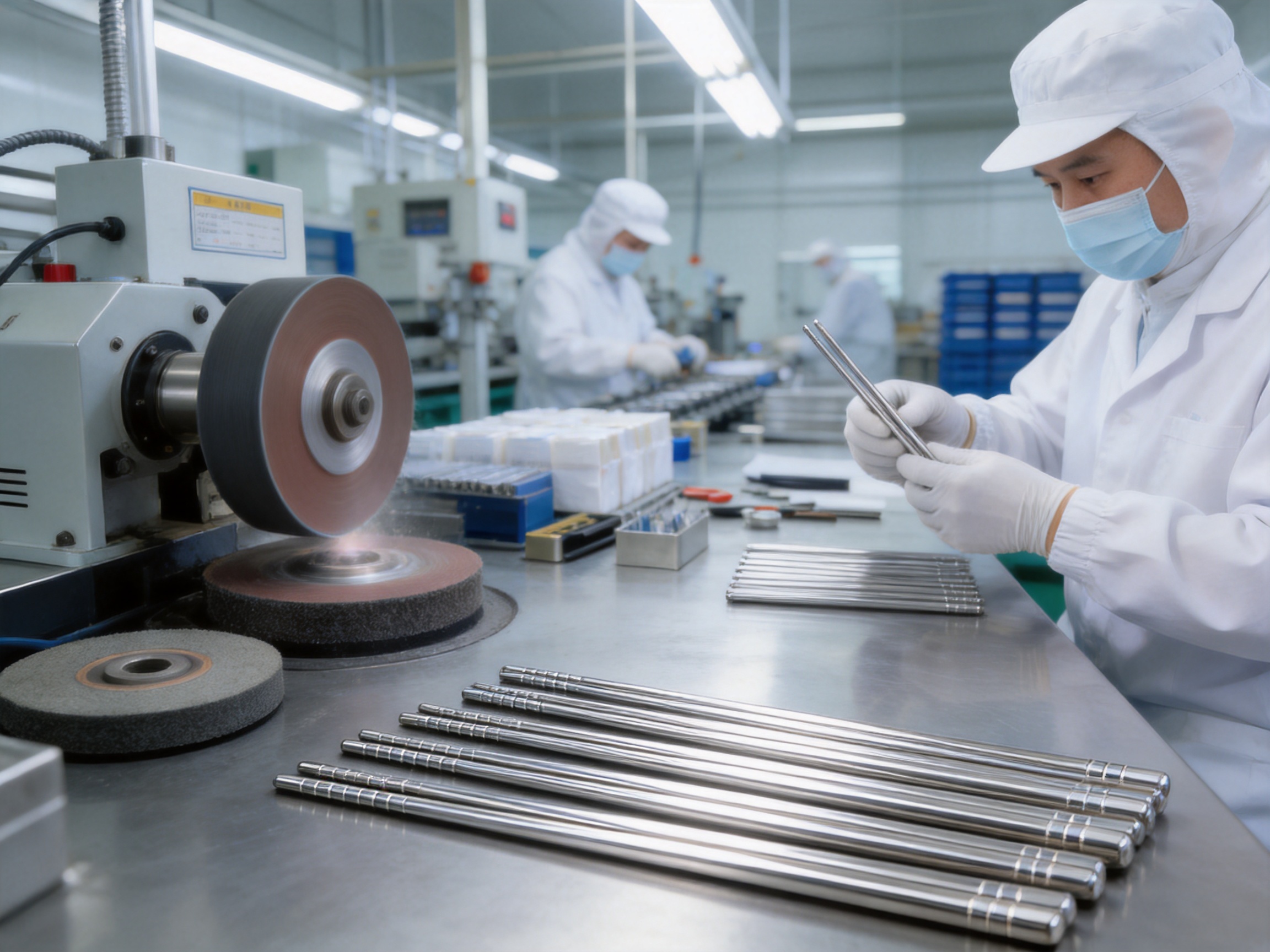
The chopsticks undergo precise polishing and multiple grinding processes. These operations help remove irregularities left by forming, refine the edges, and create a consistent appearance along the length of the product. The final finish is designed to be smooth, shiny, and resistant to ordinary dirt and food residue.
3.1 Grinding as a preparation process
Grinding is used to refine the geometry and remove unwanted surface irregularities. Depending on the production stage, different abrasives and process parameters may be applied to address seams, edges, tool marks, or uneven areas. Proper grinding requires control over pressure, speed, contact time, and abrasive condition.
Inconsistent grinding can create visible lines, uneven gloss, localized thinning, or changes in the shape of the chopstick. Professional production therefore requires operators, equipment, and inspection procedures that work together. The objective is to achieve a uniform surface while protecting the dimensional stability of the product.
3.2 Polishing for luster and smoothness
Polishing follows grinding as a finer finishing stage. It improves the reflectivity and tactile quality of the stainless steel. A consistent polish gives the chopsticks a refined appearance and helps them coordinate with stainless steel bowls, spoons, forks, serving trays, and other tableware.
Polishing must be performed with attention to cleanliness. Abrasive particles, compounds, and metal dust should be removed through suitable cleaning procedures before packaging. Any remaining residue could affect the appearance or user experience. A controlled post-polishing cleaning stage is therefore an essential part of the overall process.
3.3 Clean appearance without paint or wax
The product is described as free from paint and wax, allowing the natural metallic character of the 304 stainless steel to remain visible. This approach supports a clean, simple, and durable aesthetic. It also avoids the possibility of a decorative coating wearing away through repeated washing or exposure to heat.
A coating-free metallic surface is particularly appropriate for users who prefer minimal-material tableware. Instead of relying on a surface color layer, the product’s appearance comes from the underlying stainless steel and its finishing quality. This can contribute to a longer-lasting visual identity and easier maintenance.
4. Hygiene, Cleaning, and Maintenance Advantages
Reusable tableware must be designed with cleaning in mind. Chopsticks are exposed to saliva, food oils, sauces, starches, protein residues, and hot or cold liquids. If the surface is difficult to clean, users may experience odor, discoloration, or residue buildup.
Stainless steel is widely recognized for its cleanable surface. Its non-porous character means it does not readily absorb liquids or food odors. When the surface is properly polished and the chopsticks are washed after use, everyday residues can be removed efficiently.
Compared with wooden or bamboo chopsticks, stainless steel chopsticks are less likely to retain moisture within the body. Natural materials may develop mold or unpleasant odors when stored while damp. They may also crack or split after repeated washing and drying. Stainless steel avoids these material-specific concerns and is therefore attractive for users who want low-maintenance utensils.
4.1 Suitability for dishwasher cleaning
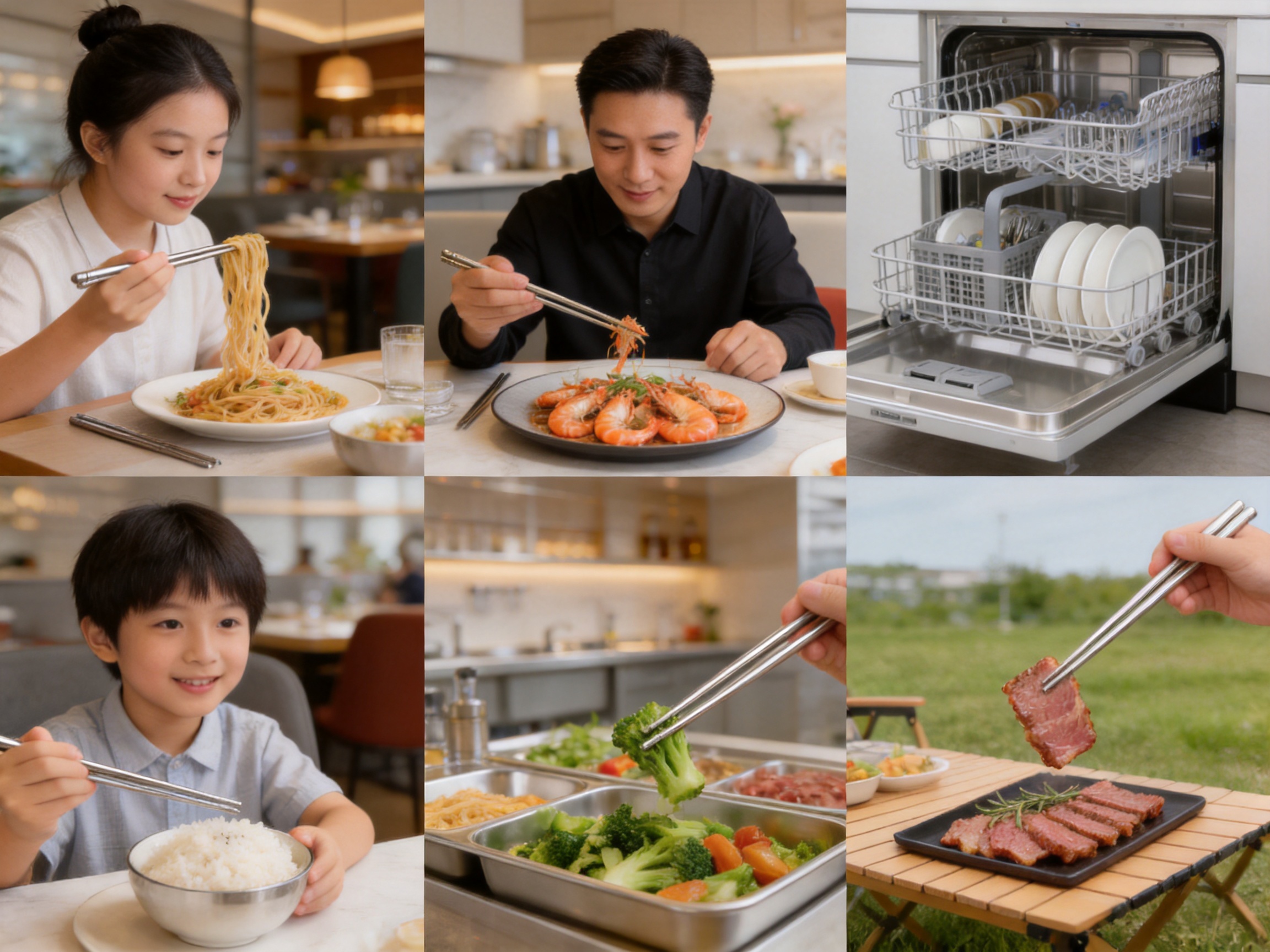
The chopsticks are suitable for environments that require dishwasher cleaning, subject to the operating instructions of the specific dishwasher and cleaning system. Their solid stainless steel construction is well suited to repeated washing cycles because there are no wooden fibers to swell and no painted exterior that may peel.
For commercial kitchens, dishwasher compatibility can reduce labor and simplify sanitation procedures. It also supports standardized cleaning across large quantities of utensils. Restaurants, hotels, cafeterias, schools, hospitals, and catering companies may benefit from a product that can be integrated into existing tableware management systems.
Users should still avoid prolonged contact with harsh chemicals that are not intended for stainless steel. After washing, proper drainage and drying are recommended, particularly in environments where water contains high mineral content. Appropriate care helps preserve the polished appearance and extends the service life of the chopsticks.
4.2 High-temperature disinfection environments
Stainless steel chopsticks are especially suitable for environments that use high-temperature disinfection or other controlled sanitation procedures. The material’s heat resistance and one-piece construction provide advantages over some natural and coated alternatives.
Institutions that serve many people often require utensils to move through repeated cleaning and disinfection cycles. Stable materials reduce replacement frequency and support predictable operational costs. The use of stainless steel also allows operators to maintain a consistent appearance across large quantities of tableware.
Disinfection systems vary, so purchasers should confirm temperature, duration, detergent compatibility, and equipment requirements before establishing a cleaning protocol. Product performance depends not only on the material but also on the complete sanitation process.
5. Comparison with Common Chopstick Materials
Different chopstick materials serve different preferences and applications. The following comparison summarizes the practical characteristics of several common options.
Material |
Main Advantages |
Common Limitations |
Typical Suitability |
304 stainless steel |
Durable, corrosion-resistant, heat-resistant, easy to clean, reusable |
May feel cooler or heavier than natural materials |
Homes, restaurants, institutional dining, outdoor use |
Wood |
Warm touch, lightweight, natural appearance |
May absorb moisture, stain, crack, or develop mold if poorly maintained |
Traditional dining and short-term household use |
Bamboo |
Lightweight, renewable material image, familiar feel |
May split, discolor, or require careful drying and storage |
Household and casual dining |
Ceramic |
Decorative appearance, distinctive tactile feel |
Can chip or break when dropped; often heavier |
Decorative dining and selected table settings |
Plastic |
Lightweight, economical, available in many colors |
Heat resistance and long-term stability depend on the polymer |
Casual dining, promotional programs, and selected food-service uses |
Compared with these alternatives, 304 stainless steel offers a strong balance rather than a single isolated advantage. It is more robust than many natural materials, easier to clean than porous materials, less fragile than ceramic, and more heat-stable than many ordinary plastics. These qualities make it suitable for customers seeking a practical, long-term tableware solution.
5.1 Advantages over wooden chopsticks
Wooden chopsticks offer a warm and natural tactile experience, but they may absorb water and odors. Repeated exposure to moisture can contribute to swelling, cracking, staining, or mold growth. Stainless steel does not have the same porous structure, so it is less vulnerable to these issues when properly cleaned and stored.
Stainless steel also provides greater dimensional stability. It is less likely to bend or deform during normal exposure to hot food. For high-use environments, this can result in fewer replacements and more consistent appearance.
5.2 Advantages over bamboo chopsticks
Bamboo is lightweight and familiar, but bamboo chopsticks can crack or split, especially when they are washed frequently or stored in unsuitable conditions. Cracks can become difficult to clean and may create an uneven grip.
The solid stainless steel body avoids splitting and supports a smooth, continuous surface. This makes the product more appropriate for commercial operations that need tableware to tolerate repeated handling and cleaning.
5.3 Advantages over ceramic chopsticks
Ceramic chopsticks can be attractive, but their rigidity and brittleness make them vulnerable to impact. A drop onto a hard floor may cause chipping or breakage. Stainless steel is far more resistant to this type of everyday accident.
The lower breakage risk is beneficial for restaurants, hotels, outdoor users, and institutional dining facilities. It also reduces the risk of sharp fragments entering the dining area after an accident.
5.4 Advantages over plastic chopsticks
Plastic chopsticks vary widely in quality. Some are designed for heat resistance, while others may soften or discolor under high temperatures. Their long-term performance depends on the resin, additives, molding quality, and cleaning conditions.
304 stainless steel provides a more established solution for customers who prioritize metal durability and repeated sanitation. Its solid appearance also supports a more premium presentation than many low-cost plastic alternatives.
6. Manufacturing Capabilities Supporting Product Quality
A successful stainless steel chopstick program requires more than access to raw material. It requires an integrated manufacturing system capable of translating a design into repeatable products. Heenoor Co., Ltd. was founded in 1999 and has developed into a large-scale drinkware manufacturer with capabilities in product development and industrial manufacturing.
The company integrates product design, engineering validation, tooling development, standardized production, and quality management. Although its broader product portfolio includes drinkware, the same manufacturing disciplines are relevant to stainless steel tableware. These disciplines help control dimensions, surface quality, assembly structure, production efficiency, and delivery consistency.
6.1 Product design and engineering review
Product development begins with a clear understanding of the intended use. For chopsticks, the engineering team must consider length, diameter, balance, tip shape, groove design, edge radius, surface finish, packaging, and cleaning requirements.
Engineering review also helps identify potential manufacturing risks before mass production. For example, a tip groove that looks attractive in a drawing may be too deep to clean efficiently, while an edge radius that is too small may feel sharp. Reviewing these details early can improve both the user experience and production stability.
Design for manufacturing is especially valuable for wholesale and customized orders. A design that is easy to form, grind, polish, inspect, and package is more likely to achieve consistent quality at scale. It can also reduce unnecessary process variation and improve production efficiency.
6.2 Engineering validation
Engineering validation allows a manufacturer to evaluate prototypes or initial samples before full-scale production. The process may include dimensional checks, visual inspections, handling trials, cleaning evaluations, and packaging assessments.
For stainless steel chopsticks, validation can focus on whether the product feels balanced, whether the anti-slip tips provide useful grip, whether the edges are comfortable, whether the surface remains consistent after washing, and whether the chopsticks fit the planned packaging configuration.
Validation is also an opportunity to confirm that the selected production method can achieve the required appearance. A polished sample may look excellent, but mass production must reproduce that result across many pieces and batches. The manufacturing team must therefore connect sample approval with process instructions and inspection criteria.
6.3 Tooling development
Tooling supports repeatable forming and accurate geometry. Proper tooling helps maintain consistent length, diameter, tip profile, groove position, and overall shape. It also reduces variation between production runs.
Tooling development should account for material behavior, forming pressure, wear, maintenance, and replacement requirements. Stainless steel is durable, but the tools used to shape and process it must be selected and maintained appropriately. Stable tooling contributes directly to product consistency.
6.4 Standardized production
Standardized production transforms approved designs into repeatable manufacturing instructions. It may include documented work procedures, process parameters, inspection checkpoints, equipment maintenance schedules, and training requirements.
For a stainless steel chopstick set, standardized production can cover raw material preparation, forming, groove processing, grinding, polishing, cleaning, inspection, counting, and packing. Each stage should have clear acceptance criteria so that quality is not determined only by final visual inspection.
Standardization is particularly important for wholesale buyers. Large orders may be delivered in multiple batches, and customers need confidence that later shipments will match earlier samples. Controlled processes help maintain uniformity in appearance, dimensions, and performance.
6.5 Quality management
Quality management combines prevention, inspection, corrective action, and continuous improvement. A mature system does not rely solely on discovering defects at the end of production. It aims to reduce the causes of defects throughout the process.
Quality checkpoints may include incoming material verification, in-process dimensional checks, surface inspections, edge checks, cleaning confirmation, and final packing audits. Records from these checks can help identify patterns and support corrective actions when necessary.
For international customers, quality management also supports communication. Clear specifications, inspection standards, sample approvals, and production records help ensure that the manufacturer and buyer share the same expectations.
7. From Raw Material to Finished Chopstick Set
The manufacturing route for stainless steel chopsticks may vary depending on the exact design and production equipment, but it generally includes several important stages. Each stage contributes to the final product’s strength, comfort, appearance, and cleanliness.
7.1 Raw material preparation
Production begins with suitable 304 stainless steel material. The material must be received, identified, and prepared according to the product specification. Surface condition, thickness, dimensions, and material consistency are important considerations.
Good raw material preparation reduces the risk of downstream problems such as uneven forming, excessive grinding, visible surface defects, or inconsistent polish. It also provides a stable foundation for efficient production.
7.2 Forming and shaping
The stainless steel is shaped into the required chopstick profile. The production method must create a straight, stable body with consistent dimensions. Forming conditions should be controlled to avoid excessive distortion or marks that would later require aggressive grinding.
The shape must also support the intended grip. A body that is too thin may feel weak, while one that is too thick may become uncomfortable or heavy. The selected geometry should provide a balance between strength, appearance, and ease of use.
7.3 Tip and groove processing
The anti-slip grooves are formed or machined at the food-contact end. Their spacing, depth, and location should remain consistent across the product. After groove processing, the surrounding surface may require additional finishing to remove burrs and maintain a smooth transition.
This stage demonstrates why engineering and manufacturing must work together. The grooves must provide enough texture to improve grip while remaining easy to clean. The design should also avoid sharp edges that could affect comfort or safety.
7.4 Grinding and edge treatment
Grinding removes irregularities and refines the surface. Particular attention is given to the ends, edges, tip area, and any locations affected by forming or machining. The goal is a smooth, rounded, and consistent profile.
Grinding must be controlled carefully. Excessive material removal can affect dimensions, while insufficient grinding may leave roughness or burrs. A combination of equipment control and operator inspection helps maintain the desired result.
7.5 Polishing
Polishing creates the final metallic luster and improves tactile smoothness. Multiple polishing stages may be used to obtain the specified appearance. The process should be consistent along the full length of the chopstick and between individual pieces.
Uniform polishing is important for sets. If one chopstick is noticeably duller or more reflective than its partner, the set may appear inconsistent. Commercial customers often require visual uniformity because tableware contributes to the overall presentation of a restaurant or hospitality brand.
7.6 Cleaning and inspection
After polishing, the chopsticks should be cleaned to remove processing residues. Final inspection can evaluate surface appearance, edge smoothness, tip condition, straightness, dimensions, and packaging readiness.
Inspection standards should be established before production begins. This allows the manufacturer and customer to agree on acceptable variation and reduces uncertainty during order fulfillment.
7.7 Packing and shipment preparation
Packaging protects the polished surface during storage and transportation. It may also support set counting, retail presentation, barcode management, branding, and distribution requirements. Proper packing prevents scratches, contamination, and mixing of different specifications.
For wholesale orders, packaging can be designed around carton efficiency, warehouse handling, and destination requirements. Buyers should communicate preferred quantities, labeling, inner packaging, outer carton specifications, and documentation needs during the quotation and development stages.
8. Applications Across Different Markets
The versatility of stainless steel chopsticks makes them suitable for several market segments. Their durability and cleanability support both individual consumers and professional operators.
8.1 Household dining
For households, the chopsticks provide a long-lasting alternative to disposable or frequently replaced utensils. Their resistance to mold, cracking, and deformation can simplify daily maintenance. The polished finish also gives ordinary meals a more refined table setting.
Families may use them for rice, noodles, vegetables, seafood, meat, snacks, and other foods. Because the product is reusable, it can support efforts to reduce reliance on disposable chopsticks.
8.2 Restaurants and catering businesses
Restaurants need tableware that looks presentable, performs consistently, and withstands repeated cleaning. Stainless steel chopsticks meet these needs by combining a polished appearance with a durable body.
Catering businesses can also benefit from their resistance to breakage. During transport and event service, tableware may be handled frequently and exposed to crowded operating conditions. Durable chopsticks can reduce the likelihood of replacement caused by accidental drops or rough handling.
8.3 Hotels and hospitality venues
Hotels, resorts, and hospitality venues often use tableware as part of their overall guest experience. Matching stainless steel chopstick sets can complement modern dining rooms, buffet areas, room-service programs, and banquet operations.
Their professional appearance can be coordinated with stainless steel spoons, forks, bowls, serving utensils, and other products. Consistent finishing across a tableware collection helps create a unified visual identity.
8.4 Institutional dining
Schools, hospitals, company cafeterias, public dining facilities, and other institutions require utensils that can be cleaned and reused efficiently. Stainless steel chopsticks are suitable for these settings because they are durable and compatible with organized sanitation systems.
Institutional buyers may also value the ability to standardize procurement. A consistent product specification simplifies inventory, replacement, cleaning procedures, and staff training.
8.5 Outdoor dining and travel
Outdoor users often need utensils that are durable, compact, and easy to clean. Stainless steel chopsticks are suitable for picnics, camping, travel, workplace lunches, and mobile food service. They are less vulnerable to cracking than ceramic and less sensitive to moisture than wood or bamboo.
Their reusable nature can also support lower-waste dining habits. Users can carry them in a case or pouch and wash them after use, making them a practical long-term alternative to disposable utensils.
9. Wholesale and Customization Considerations
Wholesale customers evaluate more than the appearance of a sample. They also consider minimum order quantities, production capacity, quality consistency, packaging, lead times, communication, and long-term supply stability.
Heenoor’s experience in product development and industrial manufacturing provides a foundation for supporting these requirements. The company works with brands, organizations, and procurement teams that value technical clarity, manufacturing discipline, and dependable international project support.
9.1 Product specification control
Before placing a large order, buyers should confirm the product length, material grade, surface finish, tip design, packaging format, and acceptable tolerances. The specified length for this product is approximately 23.9 centimeters, but buyers should verify final production details through approved samples or technical documents.
Clear specifications reduce misunderstandings and help the manufacturer prepare suitable process controls. They also make incoming inspection easier for the customer.
9.2 Packaging and retail presentation
Packaging can be customized for different markets. Options may include individual sleeves, pair packaging, multi-piece boxes, bulk cartons, gift packaging, or hospitality packs. The appropriate format depends on whether the product is sold through retail, distributed as a promotional item, or supplied directly to a commercial kitchen.
Packaging should protect the polished surface and present the product clearly. It should also support warehouse handling and transportation. Buyers may request printed information, product labels, barcodes, cartons, or other documentation according to their sales channels.
9.3 Brand and project support
Customers may seek a long-term manufacturing partner rather than a one-time supplier. In such cases, communication during design review, sampling, production, inspection, and delivery is essential.
A manufacturing partner should be able to discuss feasibility, explain process limitations, recommend suitable design adjustments, and maintain consistency across repeat orders. The combination of engineering validation and standardized production can help customers develop a reliable supply program.
9.4 Production scalability
Scalability means more than producing a large quantity once. It means maintaining quality, capacity, and delivery performance as demand changes. A manufacturer with integrated product development and industrial production capabilities is better positioned to support repeat orders and expanding programs.
Heenoor’s experience across stainless steel, titanium, plastic, and glass products supports a broad understanding of materials, finishing, tooling, and quality management. This cross-material experience can be valuable when a customer is developing a wider tableware or drinkware collection.
10. Sustainability and Long-Term Value
A reusable stainless steel chopstick set can contribute to long-term value by reducing the need for frequent replacement. Its durability allows the product to remain in service through many dining cycles, provided that it is used and maintained appropriately.
The product’s resistance to mold, cracking, and deformation can reduce waste associated with damaged utensils. Its reusable design also offers an alternative to single-use chopsticks in homes, restaurants, offices, and outdoor dining situations.
Long-term value should be evaluated through the complete product lifecycle. A durable product may have a higher initial cost than a disposable or low-cost alternative, but its service life, cleaning compatibility, and reduced replacement frequency can improve overall cost efficiency.
Manufacturing discipline also contributes to responsible resource use. Stable production reduces scrap, rework, and rejected items. Process improvement, efficient tooling, controlled material usage, and careful packaging can all support a more efficient manufacturing program.
11. Quality Checklist for Buyers
Buyers evaluating stainless steel chopstick sets can use the following checklist during product development and supplier assessment.
Evaluation Area |
Questions to Consider |
Material |
Is the product made from the specified 304 stainless steel? Is material documentation available when required? |
Dimensions |
Is the length consistent? Are the diameter, weight, and balance suitable for the intended users? |
Surface |
Is the metallic finish smooth, clean, and visually consistent? Are there scratches, pits, or excessive polishing marks? |
Edges |
Are the ends and edges rounded and comfortable? Are there any burrs or sharp areas? |
Tips |
Do the anti-slip grooves improve grip without becoming difficult to clean? |
Cleaning |
Is the product compatible with the customer’s washing and sanitation procedures? |
Packaging |
Does the packaging prevent scratches and support storage, shipping, and retail presentation? |
Supply |
Can the manufacturer support consistent repeat production and international project communication? |
12. Frequently Asked Questions
12.1 What material are the chopsticks made from?
The chopsticks are made from 304 stainless steel. This material is selected for its durability, corrosion resistance, heat tolerance, cleanability, and suitability for reusable tableware applications.
12.2 What is the length of the chopsticks?
The listed length is approximately 23.9 centimeters. Buyers requiring strict dimensional control should confirm the final tolerance and approved sample before mass production.
12.3 Do the chopsticks contain paint or wax?
The product is described as free from paint and wax. Its appearance comes from the natural metallic surface of the stainless steel and the multiple grinding and polishing processes applied during manufacturing.
12.4 Are the chopsticks easy to clean?
Yes. The smooth stainless steel surface is designed to resist ordinary dirt and food residue. The solid one-piece structure also avoids joints where moisture and residue could collect. Proper washing and drying are still necessary after every use.
12.5 Can the chopsticks be cleaned in a dishwasher?
They are suitable for environments that require dishwasher cleaning, subject to the operating conditions of the specific dishwasher and detergent system. Buyers should confirm compatibility with their own sanitation procedures before implementation.
12.6 Are the chopsticks suitable for high-temperature disinfection?
Stainless steel is well suited to many high-temperature sanitation environments. However, the exact temperature, cycle length, detergent, and equipment should be evaluated before establishing a formal disinfection process.
12.7 Why are grooves added to the tips?
The anti-slip grooves improve contact between the chopstick tips and food. They help users hold noodles, vegetables, meat, and other foods more securely, particularly when the food surface is moist or covered with sauce.
12.8 How do stainless steel chopsticks compare with bamboo chopsticks?
Stainless steel chopsticks are more resistant to cracking, mold, moisture absorption, and deformation. Bamboo chopsticks may provide a lighter and warmer natural feel, but they generally require more careful drying, storage, and replacement management.
12.9 Are stainless steel chopsticks suitable for restaurants?
Yes. Their durability, polished appearance, cleaning compatibility, and resistance to breakage make them suitable for restaurants, catering services, hotels, cafeterias, and institutional dining facilities.
12.10 Can the product be customized?
Customization may be possible depending on the project requirements. Buyers can discuss dimensions, tip patterns, surface finish, packaging, labeling, and other production details with the manufacturer during the design and quotation stages.
12.11 What manufacturing capabilities support the product?
Heenoor integrates product design, engineering validation, tooling development, standardized production, and quality management. These capabilities support consistent development and manufacturing for stainless steel and other drinkware and tableware products.
12.12 What should buyers confirm before ordering?
Buyers should confirm the material grade, length, dimensional tolerances, surface finish, tip design, cleaning requirements, packaging, order quantity, inspection standards, delivery schedule, and documentation requirements.
Conclusion
The 304 stainless steel chopstick set combines a traditional chopstick profile with the practical advantages of modern metal tableware. Its solid one-piece construction provides stability and resistance to deformation. Its multiple grinding and polishing processes create a smooth, bright, and comfortable surface. Its anti-slip tip grooves help improve food control, while the 23.9-centimeter length offers a practical balance for everyday dining.
Compared with wooden, bamboo, ceramic, and many plastic alternatives, stainless steel provides a strong combination of durability, corrosion resistance, heat tolerance, cleanability, and long-term value. These characteristics make it suitable for homes, restaurants, hotels, catering services, institutions, outdoor dining, and commercial sanitation environments.
The product’s quality also depends on the manufacturing system behind it. Heenoor Co., Ltd. supports product development through design, engineering validation, tooling development, standardized production, and quality management. Its experience with stainless steel, titanium, plastic, and glass products enables it to serve brands, organizations, and procurement teams seeking dependable manufacturing support.
For buyers evaluating reusable tableware, the most important considerations are material consistency, surface quality, edge safety, tip functionality, cleaning compatibility, packaging, and supply reliability. When these factors are managed together, stainless steel chopsticks can deliver a durable and professional dining solution with lasting value across a wide range of markets.
References
1. ASTM International. Standard Specification for Stainless Steel Bars and Shapes.
2. International Organization for Standardization. Stainless Steels: Technical Delivery Conditions and General Product Requirements.
3. International Organization for Standardization. Materials and Articles in Contact with Food: General Requirements for Food-Contact Products.
4. Food and Agriculture Organization of the United Nations. Guidance on Food Hygiene and Safe Food Handling.
5. International Organization for Standardization. Quality Management Systems: Fundamentals and Vocabulary.
6. International Organization for Standardization. Quality Management Systems: Requirements for Manufacturing Organizations.
7. American Society of Mechanical Engineers. General Principles of Surface Finishing and Metal Processing.
8. Heenoor Co., Ltd. Product and Company Materials for Stainless Steel Tableware and Drinkware Manufacturing.
Product: Stainless Steel Chopstick Sets

You may also like…

Copyright © 2025 Heenoor Co., Ltd. All Rights Reserved.
 Custom Stainless Steel Drinkware Manufacturers
BACK TOP