 English
 中文简体
中文简体 日本語
日本語 Español
 عربى
عربى
Search
Categories
Recommend
Categories
 Lin Yuxi — International Product Sales Manager
Recommend
-
 Industry news
 -
 Industry news
 -
 Industry news
 -
 Industry news
Oct 12, 2026 - By admin
Advanced 316L Stainless Steel Vacuum Kettle for Everyday Hydration
Content
- 1 Product Overview and Core Specifications
- 2 316L Stainless Steel Inner Liner
- 3 Six-Layer Thermal Construction
- 4 How the Vacuum and Copper Layers Work Together
- 5 One-Press Inner Lid for Convenient Pouring
- 6 Removable Outer Lid That Doubles as a Cup
- 7 1350 ml Capacity for Extended Use
- 8 Floral Shadow Blue and Traditional Jiangnan Inspiration
- 9 Hygiene, Cleaning, and Long-Term Use
- 10 Manufacturing Capabilities Behind the Product
- 11 Material and Process Advantages for B2B Buyers
- 12 Customization and Product Development Potential
- 13 Competitive Positioning
- 14 Applications in Work, School, Exercise, and Travel
- 15 Responsible Use and Care Considerations
- 16 Why Integrated Manufacturing Matters
- 17 Evaluation Points for Buyers
- 18 Q&A
- 18.1 What type of product is this kettle?
- 18.2 Why is 316L stainless steel used for the inner liner?
- 18.3 Does the product have an antibacterial feature?
- 18.4 How does the kettle retain temperature?
- 18.5 Can the outer lid be used for drinking?
- 18.6 What is the purpose of the one-press inner lid?
- 18.7 Is the kettle suitable only for water?
- 18.8 What does the Floral Shadow Blue design represent?
- 18.9 Who can benefit from this product?
- 18.10 What makes the product different from a basic vacuum bottle?
- 18.11 What manufacturing capabilities support the product?
- 18.12 Can the product be customized for brands or organizations?
- 18.13 What should buyers verify before ordering?
- 19 Conclusion
- 20 References
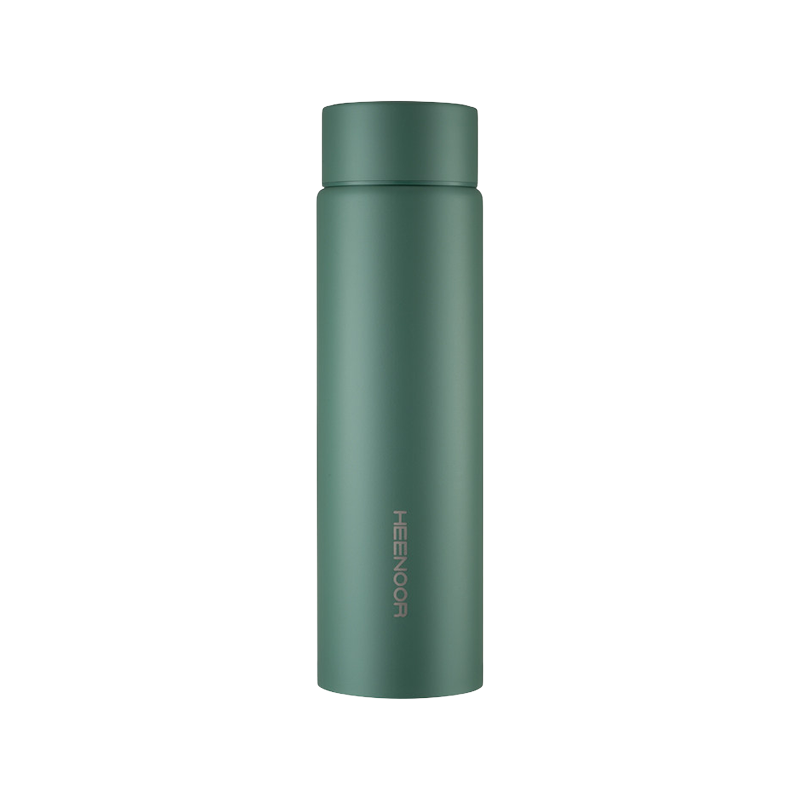
- 21 Product: Xinyao Handheld Kettle
Modern drinkware is expected to do much more than contain a beverage. A dependable kettle or vacuum bottle must preserve temperature, resist corrosion, remain comfortable to handle, support hygienic daily use, and withstand the demands of work, school, exercise, travel, and outdoor activity. It must also offer a practical capacity without becoming difficult to carry or operate. The Xinyao Handheld Kettle has been developed around these expectations, combining a 316L stainless steel inner liner, a multilayer vacuum insulation structure, a one-press pouring mechanism, a removable cup lid, and a decorative finish inspired by traditional Jiangnan blue calico.
With a 1350 ml capacity, the kettle is designed for users who need enough water or other beverages to last through extended periods away from a kitchen or water dispenser. Its interior material is suitable for a wide range of drinks, including coffee, floral tea, lemonade, and other beverages that may challenge less resistant metals. The exterior construction combines a 304 stainless steel shell with a copper-plated reflective layer and a high-vacuum insulation layer. Together, these elements help reduce heat transfer and support long-lasting hot and cold retention.
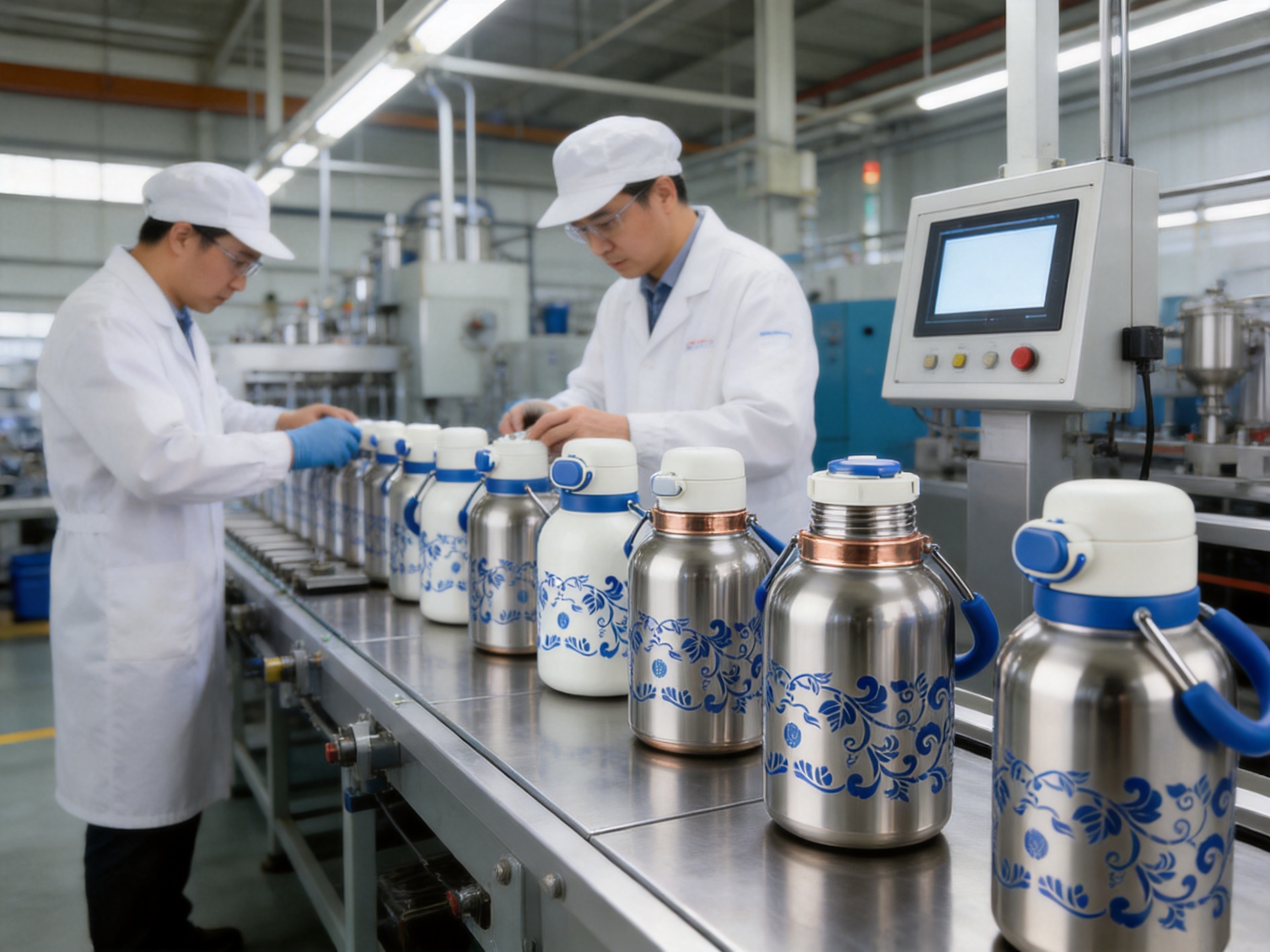
Beyond the product itself, the manufacturing capabilities behind the kettle are important to buyers seeking stable quality and scalable supply. Heenoor Co., Ltd. has operated in the drinkware sector since 1999, integrating product design, engineering validation, tooling development, standardized manufacturing, and quality management. Its experience with stainless steel, titanium, plastic, and glass drinkware allows it to address a wide range of technical and commercial requirements, from everyday consumer products to premium and professional applications.
This article examines the kettle’s material system, thermal performance, user-oriented design, decorative development, manufacturing advantages, customization potential, and suitability for different markets. It also compares the product’s practical strengths with common limitations found in simpler vacuum bottles and kettles.
Product Overview and Core Specifications
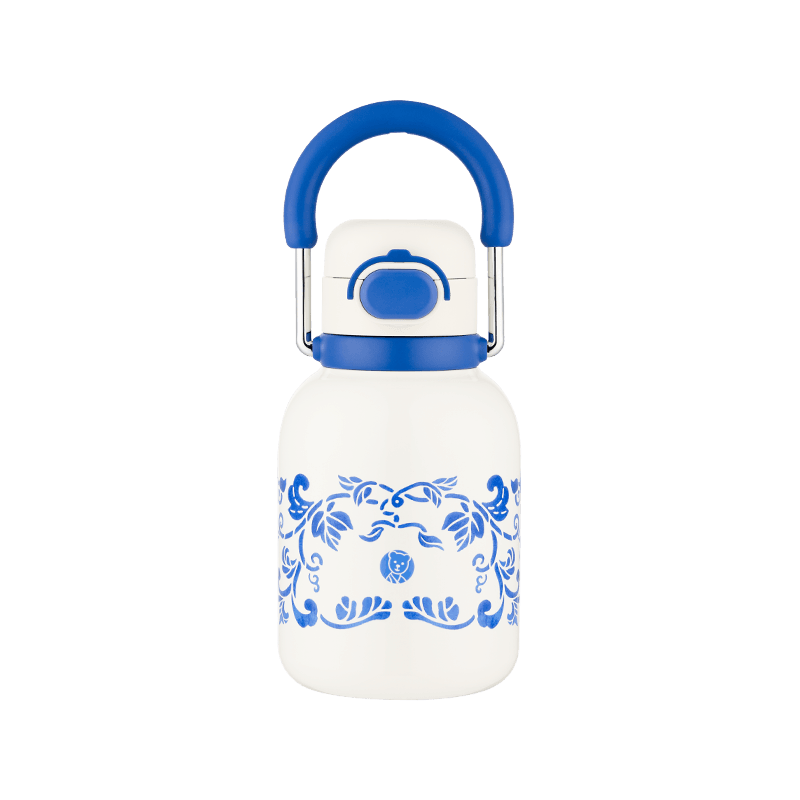
The product is a stainless steel vacuum kettle intended for convenient, extended beverage use. Its principal specifications are summarized below.
| Specification | Details |
|---|---|
| Product name | Xinyao Handheld Kettle |
| Category | Stainless Steel Vacuum Kettle |
| Model number | XN-861Y-1 |
| Capacity | 1350 ml |
| Inner liner | 316L stainless steel with antibacterial treatment |
| Outer shell | 304 stainless steel |
| Insulation structure | High-vacuum insulation with a 12-micron copper-plated isolation layer |
| Color | Floral Shadow Blue |
| Lid functions | Removable outer cup lid and one-press inner lid |
| Typical applications | Work, school, exercise, commuting, travel, and daily hydration |
The 1350 ml capacity places the kettle between a personal bottle and a larger shared beverage container. This format is useful for consumers who prefer to prepare a substantial amount of water, tea, coffee, or another drink in advance. It reduces the need for frequent refilling while remaining more manageable than a large household thermos.
The combination of stainless steel, vacuum insulation, and a functional lid system gives the product a clear position in the market. It is not limited to simple water storage. Instead, it is designed as a multipurpose beverage vessel that addresses thermal performance, material compatibility, convenience, visual appeal, and long-term usability in one product platform.
316L Stainless Steel Inner Liner
The inner liner is one of the most important components in any drinkware product because it comes into direct contact with the beverage. The kettle uses upgraded 316L stainless steel for this area. Compared with more basic stainless steel grades, 316L is widely recognized for its strong corrosion resistance and suitability for demanding environments. The material is particularly valuable when the container is used for beverages with acidity, salts, natural compounds, or other ingredients that can affect less resistant surfaces over time.
The supplied product information identifies the 316L inner liner as resistant to corrosion from acids and alkalis. This characteristic supports the use of beverages such as coffee, floral tea, and lemonade. While beverage compatibility should always be considered according to the specific recipe, temperature, storage duration, and cleaning practice, the material provides a robust foundation for varied everyday use.
A 316L liner can offer an advantage over products that use lower-grade metal or poorly protected interior surfaces. In simpler drinkware, repeated contact with acidic drinks, mineral deposits, or cleaning residues may contribute to staining, taste retention, or surface degradation. A corrosion-resistant liner helps reduce these concerns and supports a cleaner, more stable beverage-contact environment.
The inner liner is also treated with an antibacterial process. According to the provided testing information, the treated surface achieved an antibacterial rate of 99.9 percent. This performance statement should be understood in relation to the applicable testing method and conditions, but it demonstrates the product’s emphasis on hygiene-oriented design. For a vessel that may be used for many hours at a time, the ability to combine a corrosion-resistant metal with an antibacterial treatment is a meaningful benefit.
Material selection also affects maintenance. Stainless steel does not absorb beverage flavors in the same way as many porous materials, and it can be cleaned repeatedly without the fragility associated with some glass products. The product information further describes the interior and exterior system as stain-resistant and easy to clean. These characteristics are useful for users who alternate between water, tea, coffee, and flavored drinks.
Benefits for Beverage Variety
Many consumers use one bottle only for water because they are concerned about odor, discoloration, or the effect of acidic drinks on the inner surface. The 316L liner helps broaden the kettle’s practical range. Coffee can be prepared for a commute, floral tea can be carried to work, and lemonade can be taken to exercise or outdoor activities. The kettle is therefore positioned as a flexible drinkware solution rather than a single-purpose water bottle.
For procurement teams and brands, a versatile internal material can also simplify product positioning. The same basic model can be marketed for office use, school use, fitness, travel, and general household hydration. A broad application profile may support more efficient product planning and reduce the need to maintain separate containers for different beverage categories.
Six-Layer Thermal Construction
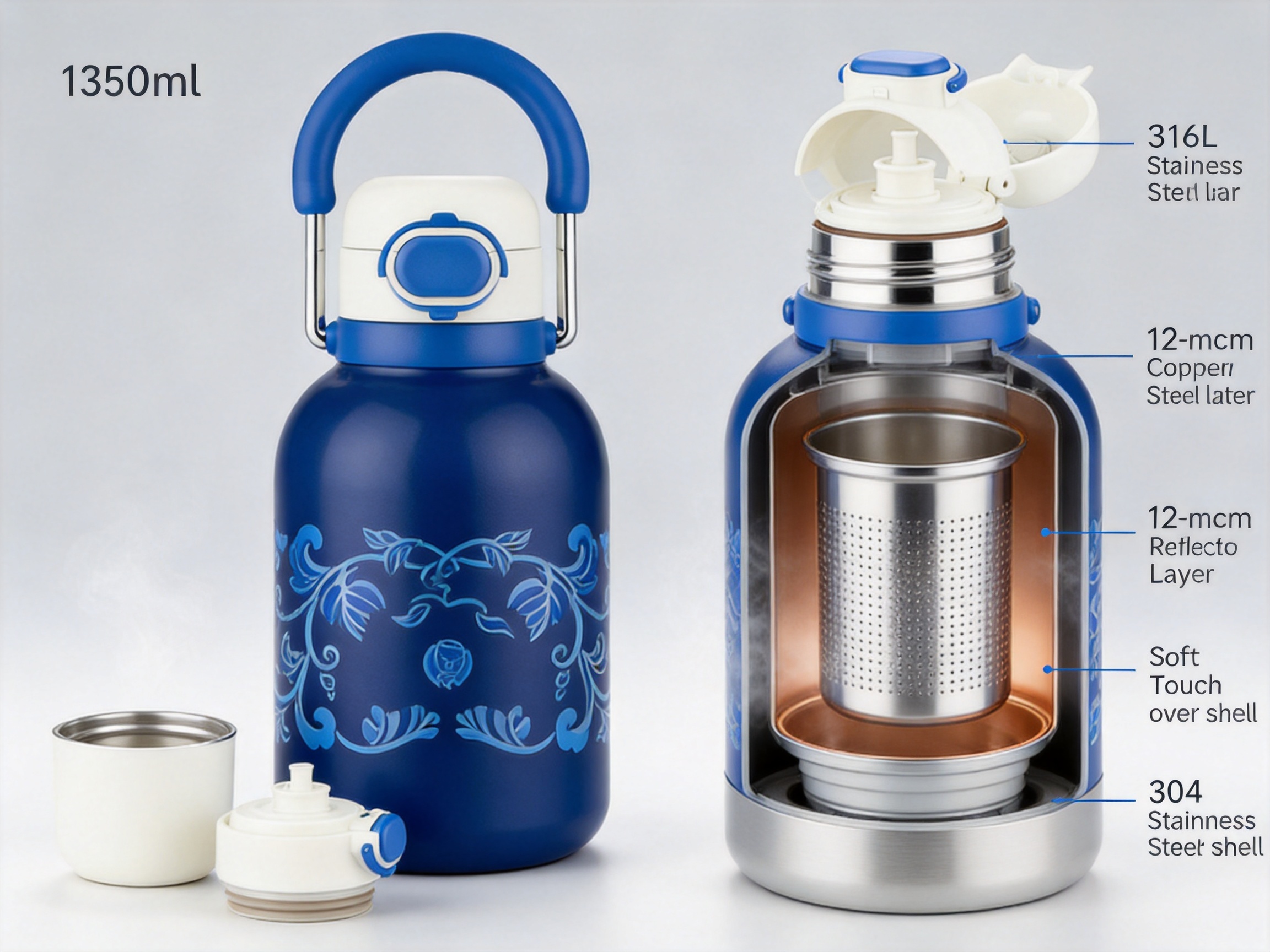
The kettle’s thermal performance comes from the interaction of several structural layers rather than from one material alone. The described body construction includes a 316L stainless steel inner liner, a 12-micron copper-plated isolation layer, a high-vacuum insulation layer, a stain-resistant soft-touch coating layer, and a 304 stainless steel outer shell. The product information refers to a six-layer body structure; depending on manufacturing terminology, some functional surfaces or sublayers may be counted separately within the complete assembly.
Each layer has a different role. The inner stainless steel layer provides the beverage-contact surface and contributes to corrosion resistance. The copper-plated layer helps reflect radiant heat. The vacuum layer reduces heat transfer through conduction and convection. The soft-touch coating supports a more comfortable and visually refined exterior finish. The 304 stainless steel shell provides structural protection and helps maintain the shape of the vessel during normal use.
Thermal insulation is affected by conduction, convection, and radiation. In a conventional single-wall container, heat can move relatively easily through the material of the wall. In a double-wall vacuum structure, much of the air between the walls is removed, limiting the movement of molecules and reducing conductive and convective heat transfer. A reflective copper-plated layer addresses radiant heat by reflecting thermal energy back toward its source.
The result is a coordinated insulation system. The vacuum layer provides the primary barrier, while the copper-plated layer adds another line of defense against radiant heat. This multilayer approach gives the kettle an advantage over basic insulated products that rely on a simple double-wall design without an additional reflective metal layer.
For hot beverages, the structure helps slow the movement of heat from the interior to the surrounding environment. For cold beverages, it helps limit the movement of external heat into the drink. Actual retention time depends on starting temperature, ambient conditions, filling level, lid position, beverage type, and usage habits, but the underlying construction is designed to support long-lasting temperature preservation.
Xinyao Handheld Kettle
How the Vacuum and Copper Layers Work Together
The high-vacuum insulation layer is central to the kettle’s thermal design. Air is an efficient medium for transferring heat when it can circulate between surfaces. Removing most of the air from the space between the walls limits this circulation, reducing the pathways through which thermal energy can travel. This is one reason vacuum-insulated drinkware generally performs better than single-wall metal bottles or products filled with ordinary insulating foam.
However, a vacuum does not eliminate every form of heat transfer. Radiant energy can still cross a vacuum space. The 12-micron copper-plated layer is intended to address this part of the thermal challenge. Copper has strong reflective properties, and its placement within the body can help redirect radiant heat, reducing the rate at which the temperature of the beverage changes.
The combination of vacuum insulation and copper plating reflects a more advanced approach to thermal engineering. Instead of depending on a single barrier, the design uses different mechanisms to control different types of heat movement. This layered strategy can help maintain beverage temperature more consistently during commuting, office work, study, exercise, and travel.
The outer 304 stainless steel shell provides protection for the internal structure. A vacuum vessel must be manufactured carefully because damage, deformation, or poor sealing can reduce its insulation performance. A stable outer shell helps protect the inner assembly from ordinary handling and contributes to the product’s service life.
Advantages Compared with Basic Insulated Containers
Basic insulated containers may offer only a stainless steel wall and a vacuum gap. Such products can still provide useful thermal performance, but they may not include a copper-plated reflective layer, a corrosion-resistant 316L liner, or a soft-touch exterior. The kettle’s more complex construction gives it a broader performance profile.
Its advantages can be summarized in five areas. First, the 316L liner supports corrosion resistance and beverage versatility. Second, the copper-plated layer supplements the vacuum barrier. Third, the 304 outer shell provides a durable protective body. Fourth, the soft-touch coating improves handling and visual presentation. Fifth, the lid system makes the container more useful in real-world situations.
These features are especially relevant when comparing products for institutional procurement, branded merchandise, employee gifts, school programs, fitness campaigns, hospitality applications, or premium retail. Buyers can evaluate not only the listed capacity, but also the complete user experience and the technical story behind the product.
One-Press Inner Lid for Convenient Pouring
The inner lid is designed to release water with a single press. This feature supports one-handed operation, which can be valuable when the user is carrying a bag, holding exercise equipment, working at a desk, or standing in a crowded commuting environment. Instead of needing to unscrew a complicated cap or handle several separate pieces, the user can operate the release mechanism with a simple press.
One-handed use is a practical design consideration that is sometimes overlooked in drinkware development. A bottle may have excellent thermal retention but still be inconvenient if its lid requires two hands or if the user must place the cap on an unclean surface. The one-press design aims to reduce these interruptions and make pouring more natural.
The lid also contributes to the kettle’s suitability for longer periods away from home. In an office or classroom, the user can pour a drink into the external cup without searching for an additional drinking vessel. During travel, the same feature can make controlled pouring easier than drinking directly from a large 1350 ml container.
As with any mechanical closure, long-term performance depends on correct use, cleaning, and inspection of sealing components. The lid should be kept clean, and any removable parts should be maintained according to the product’s care instructions. From a design perspective, however, the single-press mechanism adds an important convenience advantage over traditional screw-top thermos products.
Removable Outer Lid That Doubles as a Cup
The outer lid serves two purposes. When attached, it protects the upper part of the kettle and contributes to the overall closure system. When removed, it can be used directly as a small drinking cup. This dual-purpose design reduces the number of separate accessories needed for use away from home.
A cup lid is especially useful for hot drinks. Rather than drinking immediately from the container, the user can pour a suitable amount into the lid and allow it to cool slightly. The cup format may also be more comfortable in offices, meeting rooms, classrooms, or shared environments where a conventional drinking vessel is preferred.
The dual-purpose lid creates a more complete product experience. A simple bottle normally requires direct drinking or a separate cup. The kettle combines storage and serving functions in one compact product. This can be beneficial for travelers and outdoor users who prefer to minimize the number of items they carry.
For brands, the lid’s added function provides another point of differentiation in product descriptions and marketing materials. Many vacuum kettles compete primarily on capacity and temperature retention. A built-in cup and one-press pouring mechanism make the product easier to distinguish based on everyday usability rather than technical specifications alone.
1350 ml Capacity for Extended Use
The 1350 ml capacity is designed for users who need a meaningful supply of beverages throughout the day. It can support a morning commute, a long work shift, a full school day, a training session, or a day trip with fewer refills. The capacity is also suitable for households or offices where a person may want to prepare a larger quantity of tea or coffee in advance.
Capacity must always be balanced with portability. A container that is too small may require repeated filling, while one that is too large can become difficult to carry. The 1350 ml format offers a middle ground: more substantial than a typical personal bottle but more manageable than a large family thermos.
For physical activity, the larger capacity may help users plan hydration more effectively. For work and school, it reduces dependence on disposable cups and repeated visits to a water dispenser. For travel, it allows a beverage to remain available during periods when safe or convenient refilling may not be possible.
Capacity also affects thermal behavior. A well-filled insulated vessel generally has a favorable thermal mass compared with a nearly empty one, although performance depends on many factors. Users can benefit from preheating the container before adding a hot drink or precooling it before adding a cold beverage. These simple practices can support the intended insulation performance.
Floral Shadow Blue and Traditional Jiangnan Inspiration
The kettle body uses a Floral Shadow Blue design inspired by traditional Jiangnan blue calico. Jiangnan blue calico is associated with a long history of textile craftsmanship and distinctive blue-and-white visual language. Translating this influence onto modern drinkware gives the product an identity that extends beyond plain metallic surfaces or generic colors.
Decorative design can influence purchasing decisions, particularly in the gift, lifestyle, hospitality, and premium consumer markets. A functional container becomes more attractive when its surface communicates a recognizable aesthetic idea. The blue calico-inspired pattern connects contemporary drinkware with traditional Eastern visual culture while maintaining a practical modern form.
The soft-touch coating contributes to the design experience. In addition to supporting stain resistance, it can provide a more comfortable hand feel than untreated polished metal. A tactile exterior may also reduce the perception that the product is purely industrial, helping bridge the gap between technical equipment and lifestyle accessory.
From a manufacturing perspective, patterned drinkware requires control over surface preparation, coating uniformity, color consistency, and visual alignment. Decorative quality is not separate from engineering quality. A technically sound bottle can still fail commercially if the pattern is inconsistent, the coating is uneven, or the finish does not match approved samples. Integrated production and quality management are therefore valuable for this type of product.
Design Value for Different Market Segments
For consumer retail, the blue pattern can appeal to customers looking for a visually distinctive everyday item. For corporate or institutional programs, the product can serve as a premium gift with cultural design value. For hospitality and tourism businesses, the traditional inspiration may support regional branding or themed merchandise. For schools and lifestyle organizations, it can offer an alternative to plain bottles commonly found in the market.
The decorative concept also creates opportunities for future customization. Depending on technical feasibility, a manufacturer with tooling, coating, and production experience may develop related patterns, colorways, surface treatments, or packaging configurations. The product platform can therefore support a broader family of drinkware rather than a single isolated model.
Hygiene, Cleaning, and Long-Term Use
Hygiene is a major concern in reusable drinkware. The kettle addresses this concern through the use of a 316L stainless steel liner and antibacterial treatment. A smooth, durable interior is easier to clean than a porous or damaged surface, and stainless steel is generally resistant to the absorption of beverage odors and colors.
The product is described as stain-resistant and easy to clean. This is particularly important for coffee, tea, fruit beverages, and other drinks that may leave visible residues. Users should still rinse the kettle promptly after use and clean the lid mechanism carefully because seals, channels, and small components can retain moisture or beverage residue.
Cleaning practices should match the manufacturer’s instructions. Harsh abrasives may damage decorative coatings, while prolonged exposure to unsuitable chemicals may affect seals or surface treatments. Users should allow the kettle and lid components to dry fully before reassembly and storage. These basic habits can help preserve both hygiene and product appearance.
The antibacterial performance stated for the inner liner is an additional design feature, not a replacement for regular cleaning. No reusable container should be treated as self-cleaning. The combination of responsible use, appropriate washing, and a well-selected interior material provides the most reliable approach to long-term hygiene.
For commercial buyers, hygiene-related features can strengthen product documentation and quality communication. Procurement teams increasingly evaluate reusable drinkware not only by appearance and price but also by material traceability, cleaning practicality, intended use, and durability. A product with a clearly defined interior material and treatment can be easier to position in quality-conscious markets.
Manufacturing Capabilities Behind the Product
The product’s performance depends on more than the specification sheet. Reliable production requires control over raw materials, forming, welding or joining, vacuum processing, surface treatment, decoration, assembly, inspection, and packaging. Heenoor Co., Ltd. integrates product development and industrial manufacturing, giving it the ability to coordinate these stages within a structured production system.
The company was founded in 1999 and has developed experience in stainless steel, titanium, plastic, and glass drinkware. This material range is significant because different materials require different forming methods, tooling strategies, surface treatments, and quality controls. Experience across several material categories can support more informed product development when a buyer is deciding between stainless steel, titanium, glass, or hybrid construction.
The company’s stated capabilities include product design, engineering validation, tooling development, standardized production, and quality management. These functions create a development path from an initial concept to a repeatable manufactured product. For a vacuum kettle, engineering validation may include dimensional checks, seal evaluation, thermal testing, material verification, coating inspection, and assessment of mechanical operation.
Product Design and Engineering Validation
Product design is the first stage in translating a market requirement into a physical product. It includes decisions about capacity, proportions, grip, lid operation, material selection, surface treatment, decoration, and manufacturing feasibility. A design that looks attractive but cannot be produced consistently is not a successful commercial design.
Engineering validation helps confirm whether the design performs as intended. For this kettle, validation may focus on the relationship between the 316L liner, copper-plated layer, vacuum structure, outer shell, coating, and lid assembly. Each component must fit within the overall geometry, and the final product must retain its structural integrity during normal handling.
Validation is also important when a customer requests changes. A different capacity, color, pattern, logo, lid component, or packaging format may affect tooling, balance, thermal performance, and assembly. A manufacturer with an integrated engineering function can evaluate these changes before committing them to mass production.
Tooling Development
Tooling influences product consistency, production efficiency, and surface quality. Properly developed tools help control the shape and dimensions of metal components, support repeatable forming, and reduce variation between production batches. In drinkware manufacturing, tooling must also accommodate the requirements of lids, seals, decorative surfaces, and assembly interfaces.
Tooling development is particularly important for products with a distinctive body shape or patterned exterior. The final appearance depends on consistent geometry and controlled surface preparation. If tooling is poorly matched to the design, the result may include uneven walls, misaligned components, inconsistent pattern placement, or difficulty during assembly.
In-house or closely coordinated tooling development can shorten communication cycles between designers, engineers, and production teams. It also allows technical decisions to be made with manufacturing realities in mind. This can support faster sampling and reduce the risk of discovering production limitations late in the development process.
Standardized Production
Standardized production converts a validated design into a repeatable manufacturing process. Standard operating procedures can define material handling, forming, cleaning, welding or joining, vacuum processing, coating, decoration, assembly, inspection, and packing. The objective is to ensure that every production batch follows controlled steps rather than relying solely on individual operator judgment.
Standardization is essential for buyers placing large orders. A product may appear satisfactory in a small sample run but show significant variation during mass production if processes are not documented and monitored. Consistent production helps protect the customer’s brand reputation by reducing differences in color, dimensions, lid function, surface finish, and thermal performance.
For international procurement, standardized production also supports clearer communication. Buyers can establish approved samples, technical specifications, inspection criteria, and packaging requirements. A manufacturer that is accustomed to structured programs can better coordinate these requirements across production and quality teams.
Quality Management
Quality management should cover the entire product lifecycle, beginning with incoming materials and continuing through final packing. For this kettle, relevant quality points include the grade and condition of stainless steel, the uniformity of the copper-plated layer, the integrity of the vacuum structure, the quality of the soft-touch coating, the fit of the lid, and the operation of the one-press mechanism.
Visual inspections may identify scratches, dents, coating defects, color variation, pattern misalignment, or assembly problems. Functional inspections may assess the lid release, cup fit, sealing behavior, and general stability. Thermal testing can help verify that the insulation structure meets the agreed product standard. Antibacterial claims should be supported by appropriate test documentation and clearly defined conditions.
A quality system is most effective when it prevents defects rather than only detecting them at the end. Process controls, operator training, equipment maintenance, and feedback loops can reduce the likelihood of recurring problems. This approach is especially important for products combining metal fabrication, vacuum technology, coating, decorative treatment, and mechanical components.
Material and Process Advantages for B2B Buyers
Brands, distributors, retailers, and institutional buyers often need more than a finished sample. They require confidence that the product can be reproduced in the required quantity, within the agreed specification, and over the expected supply period. A manufacturing partner with experience in development and industrial production can provide value at each stage of this process.
The kettle’s material combination offers a clear technical narrative for B2B customers. The 316L liner supports corrosion resistance and beverage versatility. The antibacterial treatment addresses hygiene-oriented positioning. The copper-plated and vacuum layers explain the thermal insulation strategy. The 304 outer shell provides a durable exterior structure. The one-press lid and cup lid communicate practical convenience. The Jiangnan-inspired pattern adds visual differentiation.
These features can be adapted to multiple sales channels. In retail, the product can be presented as a premium everyday kettle. In corporate procurement, it can serve as a durable employee or client gift. In fitness and sports programs, the capacity and cold-retention concept may be attractive. In education, the large capacity can reduce refill frequency during the school day. In hospitality and travel, the design can support themed merchandise and guest amenities.
Heenoor’s experience with several drinkware materials may also help customers select the right platform for a specific market. Stainless steel may be preferred for durability and thermal performance, titanium for lightweight premium positioning, glass for visual purity, and plastic for cost-sensitive or highly customized applications. A manufacturer familiar with these alternatives can help buyers compare trade-offs more effectively.
Customization and Product Development Potential
The supplied information identifies this model as XN-861Y-1 with a defined color and decorative concept. However, the underlying development and manufacturing capabilities may support customer-specific programs. Possible areas for discussion can include color adjustments, surface patterns, branding, packaging, capacity variations, lid details, and application-specific accessories.
Customization should be approached through engineering review rather than treated as a purely visual change. A new capacity may affect the height-to-width ratio, stability, vacuum structure, shipping carton dimensions, and user comfort. A new coating may influence grip, stain resistance, abrasion performance, or color matching. A modified lid may require new tooling and additional testing.
For this reason, the development process should generally include a written specification, design review, prototype or sample evaluation, engineering validation, pre-production approval, and mass-production inspection. This structured sequence protects both the buyer and the manufacturer. It reduces ambiguity and creates a clear reference for future repeat orders.
Branding can be integrated through appropriate decoration methods, provided that the selected process is compatible with the soft-touch coating and body geometry. Packaging can also be developed to communicate the 316L liner, vacuum construction, antibacterial treatment, capacity, and care instructions without overstating performance claims.
Competitive Positioning
The kettle competes with several types of products: ordinary plastic water bottles, single-wall stainless steel bottles, basic vacuum flasks, large thermos containers, and premium insulated drinkware. Its strongest position is in the space between everyday personal hydration and larger serving-oriented thermal containers.
Compared with plastic bottles, it offers a metal inner liner, better thermal insulation, a more durable premium feel, and a cup-lid function. Compared with single-wall stainless steel bottles, it provides a more advanced thermal barrier through vacuum insulation and copper plating. Compared with basic vacuum flasks, it adds a 316L interior, antibacterial treatment, soft-touch exterior, large capacity, and one-press pouring. Compared with larger household thermoses, it is more oriented toward personal portability and daily use.
The product’s competitive value does not depend on one isolated specification. A competitor may offer a similar capacity, another may offer a vacuum body, and another may offer a decorative pattern. The kettle combines several features in one system: material performance, thermal engineering, functional operation, serving convenience, and cultural design.
Its advantages can be especially compelling for users who want one vessel to handle different situations. The same kettle can carry cold water to a workout, hot tea to the office, coffee on a commute, or lemonade during travel. This flexibility may provide greater practical value than a product optimized for only one beverage or one environment.
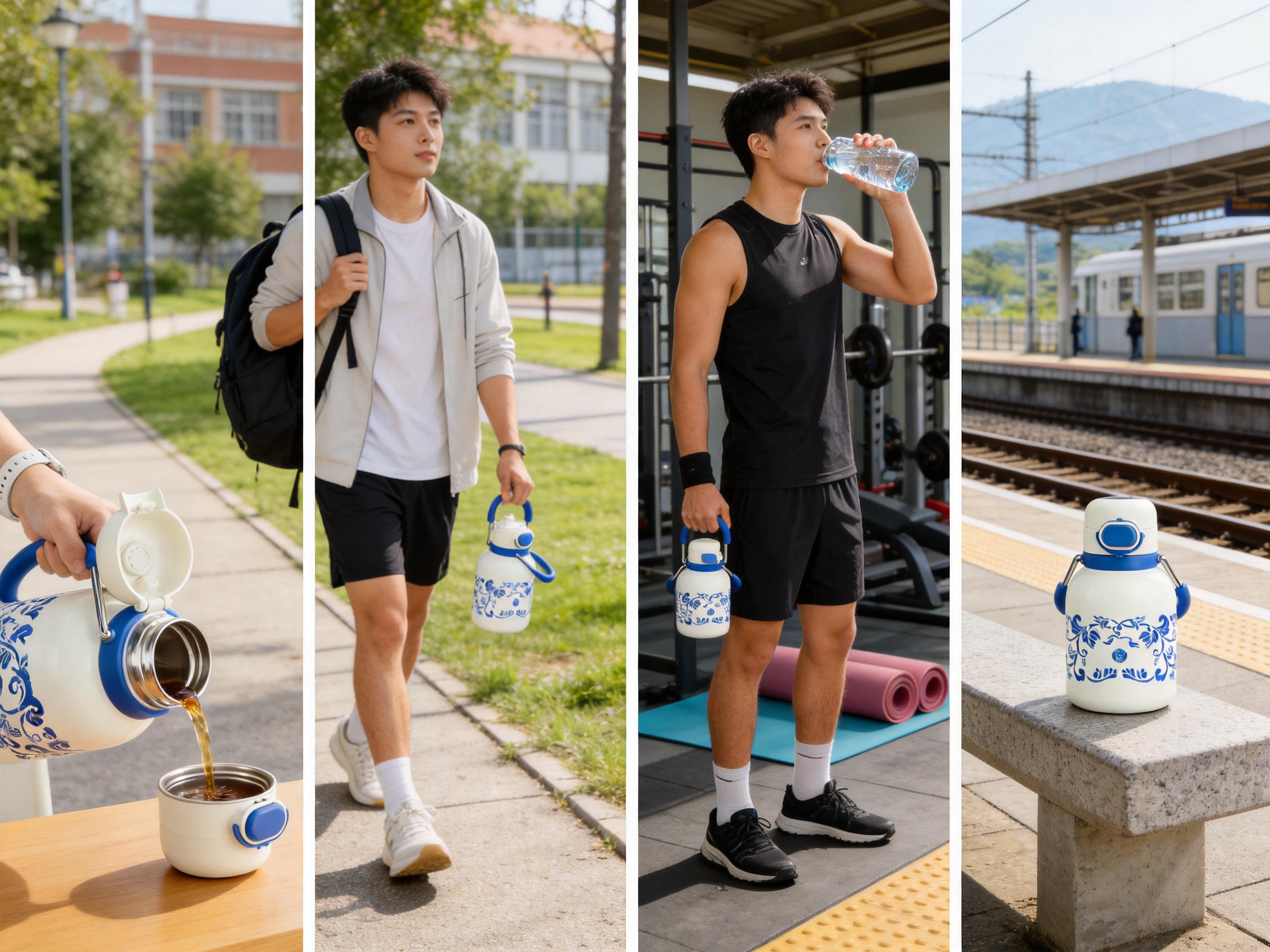
Applications in Work, School, Exercise, and Travel
Office and Workplace Use
In the workplace, the kettle can hold enough beverage for several hours and reduce repeated trips to a water dispenser. The outer lid can serve as a cup during meetings or desk use, while the one-press inner lid supports controlled pouring. The soft-touch finish and blue decorative pattern also make the product suitable for professional environments where appearance matters.
School and Campus Use
Students often spend extended periods in classrooms, libraries, laboratories, or campus facilities. A 1350 ml capacity can help maintain access to water or another beverage throughout the day. The stainless steel construction is suitable for repeated use, while the removable cup lid offers an alternative to drinking directly from a large vessel.
Fitness and Outdoor Activity
During exercise, users may need a larger volume of cold water and prefer not to refill frequently. The vacuum structure is designed to support cold retention, and the one-press feature can make pouring easier between activities. For outdoor use, the stainless steel body provides a more robust alternative to fragile glass, although users should always handle the product according to its intended operating conditions.
Commuting and Travel
Commuters and travelers benefit from a container that can preserve temperature and provide a practical serving method. Hot coffee or tea can be prepared before departure, while cold beverages can remain available during journeys. The built-in cup helps reduce dependence on disposable drinking vessels, supporting a more reusable daily routine.
Responsible Use and Care Considerations
To obtain the best performance, the kettle should be used and maintained appropriately. Before first use, the interior and lid components should be washed according to the care instructions. Hot liquids should be handled carefully, and the user should avoid overfilling the container because thermal expansion and pressure may affect safe operation.
The lid should be closed securely before transport. The one-press release mechanism should not be forced, and the sealing components should be checked periodically for residue or damage. After using coffee, tea, milk-based beverages, or sweetened drinks, prompt cleaning is especially important.
The exterior coating should be protected from sharp objects and unsuitable cleaning tools. Although the stainless steel shell is durable, no drinkware product is immune to dents, impact, or misuse. Proper handling helps preserve the vacuum structure, surface finish, and lid alignment.
Users should also follow any restrictions concerning dishwasher use, microwave use, freezer use, and beverage storage duration. The kettle is a reusable thermal vessel, not a cooking container. Clear care instructions are an important part of responsible product communication and should be supplied with commercial orders.
Why Integrated Manufacturing Matters
A product combining several materials and functions can be difficult to source through disconnected suppliers. If one supplier produces the metal body, another manages the coating, a third handles the decorative treatment, and a fourth assembles the lid, communication gaps may increase the risk of inconsistency. An integrated manufacturing partner can coordinate these operations more efficiently.
Heenoor’s stated integration of design, engineering validation, tooling development, standardized production, and quality management gives customers a single development and manufacturing framework. This can simplify technical communication, shorten feedback cycles, and improve accountability. It may also support more reliable planning for repeat orders and product extensions.
Manufacturing discipline is particularly important for export-oriented drinkware. International customers may require precise documentation, approved samples, packaging specifications, inspection procedures, and consistent delivery. A supplier accustomed to large-volume programs can build these requirements into the production process rather than treating them as afterthoughts.
Long-term supply stability also matters. A brand investing in packaging, marketing, retail placement, or institutional distribution needs confidence that the product can be supplied consistently. A company with an established history in drinkware manufacturing and a broad material base may be better positioned to support ongoing programs than a supplier focused only on short-term trading.
Evaluation Points for Buyers
Before placing an order, buyers should confirm the exact material specification for the inner liner and outer shell, the testing basis for antibacterial performance, the expected thermal retention standard, the coating requirements, the decoration approval process, and the packaging configuration. They should also request information about minimum order quantities, sampling, lead times, inspection, and available customization.
It is useful to evaluate a complete sample rather than only a product photograph. The buyer should examine the hand feel, lid operation, cup fit, pattern quality, stability, interior finish, cleaning access, and overall balance. If the product will be used with hot beverages, the serving method and exterior temperature should be evaluated according to the intended safety standard.
For larger projects, buyers may establish a quality agreement covering critical dimensions, acceptable cosmetic limits, color tolerance, functional testing, packing requirements, and shipment inspection. These controls help ensure that the delivered goods match the approved reference sample.
Buyers should also distinguish between verified performance claims and general marketing language. The 99.9 percent antibacterial rate, for example, should be associated with the relevant test method, organism, contact time, and sample condition. Clear technical communication protects the credibility of both the manufacturer and the customer.
Q&A
What type of product is this kettle?
It is a 1350 ml stainless steel vacuum kettle designed for hot and cold beverage storage. It combines a 316L stainless steel inner liner, 304 stainless steel outer shell, copper-plated isolation layer, high-vacuum insulation, a one-press inner lid, and a removable outer lid that can be used as a cup.
Why is 316L stainless steel used for the inner liner?
316L stainless steel is selected for its strong corrosion resistance and suitability for beverage-contact applications. It is intended to support the storage of varied drinks, including coffee, floral tea, lemonade, and water, when the product is used and cleaned appropriately.
Does the product have an antibacterial feature?
Yes. The inner liner is described as receiving antibacterial treatment, with supplied testing information indicating an antibacterial rate of 99.9 percent. Buyers should request the applicable test documentation and conditions when making formal product claims.
How does the kettle retain temperature?
The body uses a high-vacuum insulation layer to reduce heat transfer by conduction and convection. A 12-micron copper-plated isolation layer helps reflect radiant heat. The 304 stainless steel outer shell protects the structure, while the inner and outer walls work together as a thermal barrier.
Can the outer lid be used for drinking?
Yes. The removable outer lid is designed to double as a small drinking cup. This allows the user to pour a beverage rather than drink directly from the large 1350 ml body.
What is the purpose of the one-press inner lid?
The one-press inner lid releases the beverage with a single press and supports one-handed operation. It is intended to make pouring more convenient during work, commuting, exercise, school, and travel.
Is the kettle suitable only for water?
No. The corrosion-resistant 316L interior is intended for a broader range of drinks. The supplied product information specifically mentions coffee, floral tea, and lemonade, in addition to water. Users should follow the care instructions for any beverage that contains milk, sugar, pulp, or other residues.
What does the Floral Shadow Blue design represent?
The pattern is inspired by traditional Jiangnan blue calico. It combines a modern drinkware form with a blue-and-white decorative language associated with longstanding Eastern textile craftsmanship.
Who can benefit from this product?
The kettle is suitable for office workers, students, commuters, athletes, travelers, outdoor users, and households that want a larger reusable beverage container. It may also suit corporate gifting, hospitality programs, fitness campaigns, and retail drinkware collections.
What makes the product different from a basic vacuum bottle?
Its differentiation comes from the combined feature set: a 316L stainless steel inner liner, antibacterial treatment, copper-plated reflective layer, high-vacuum insulation, soft-touch exterior, large 1350 ml capacity, one-press inner lid, cup lid, and Jiangnan-inspired decorative design.
What manufacturing capabilities support the product?
The manufacturer integrates product design, engineering validation, tooling development, standardized production, and quality management. It has experience with stainless steel, titanium, plastic, and glass drinkware and supports large-volume product programs.
Can the product be customized for brands or organizations?
Potential customization areas may include color, decoration, branding, packaging, capacity, and selected functional details. Each change should be reviewed by engineering and confirmed through samples and validation before mass production.
What should buyers verify before ordering?
Buyers should verify material grades, antibacterial test documentation, thermal performance requirements, coating and color standards, decoration quality, lid function, packaging, inspection procedures, order quantities, lead times, and after-sales or repeat-order support.
Conclusion
The Xinyao Handheld Kettle presents a balanced combination of material engineering, thermal insulation, convenient operation, and cultural design. Its 316L stainless steel inner liner provides a strong foundation for beverage-contact use, while antibacterial treatment adds a hygiene-oriented feature. The 12-micron copper-plated layer and high-vacuum insulation structure are designed to reduce heat transfer and support long-lasting hot and cold retention.
The product’s practical advantages extend beyond its body construction. A 1350 ml capacity reduces refill frequency, the one-press inner lid supports one-handed pouring, and the outer lid doubles as a cup. The soft-touch finish offers a comfortable tactile experience, while the Floral Shadow Blue pattern gives the kettle a distinctive identity inspired by Jiangnan blue calico.
For B2B customers, the manufacturing foundation is equally important. Since 1999, Heenoor Co., Ltd. has developed capabilities across product design, engineering validation, tooling, standardized manufacturing, and quality management. Its experience with stainless steel, titanium, plastic, and glass drinkware supports product development for everyday, professional, premium, and customized markets.
Compared with simpler bottles and vacuum flasks, this kettle offers a broader set of benefits in one product: corrosion resistance, antibacterial treatment, thermal insulation, serving convenience, large capacity, comfortable handling, and visual differentiation. These characteristics make it a suitable option for brands, procurement teams, distributors, and organizations seeking dependable drinkware with a clear technical and design story.
References
1. Product specification and technical description for the Xinyao Handheld Kettle, model XN-861Y-1.
2. Stainless steel material information concerning 316L corrosion resistance and beverage-contact applications.
3. General engineering principles of vacuum insulation, conductive heat transfer, convective heat transfer, and radiant heat reflection.
4. Product information concerning antibacterial treatment and reported antibacterial testing performance.
5. Manufacturing capability profile of Heenoor Co., Ltd., including product design, engineering validation, tooling development, standardized production, and quality management.
6. General guidance for the care, cleaning, and responsible use of reusable stainless steel drinkware.
Product: Xinyao Handheld Kettle

You may also like…

Copyright © 2025 Heenoor Co., Ltd. All Rights Reserved.
 Custom Stainless Steel Drinkware Manufacturers
BACK TOP