 English
 中文简体
中文简体 日本語
日本語 Español
 عربى
عربى
Search
Categories
Recommend
Categories
 Lin Yuxi — International Product Sales Manager
Recommend
-
 Industry news
 -
 Industry news
 -
 Industry news
 -
 Industry news
Oct 06, 2026 - By admin
Engineering a Better Everyday Vacuum Flask for Tea, Coffee, and Cold Drinks
Content
- 1 1. A Vacuum Flask Designed Around Daily Use
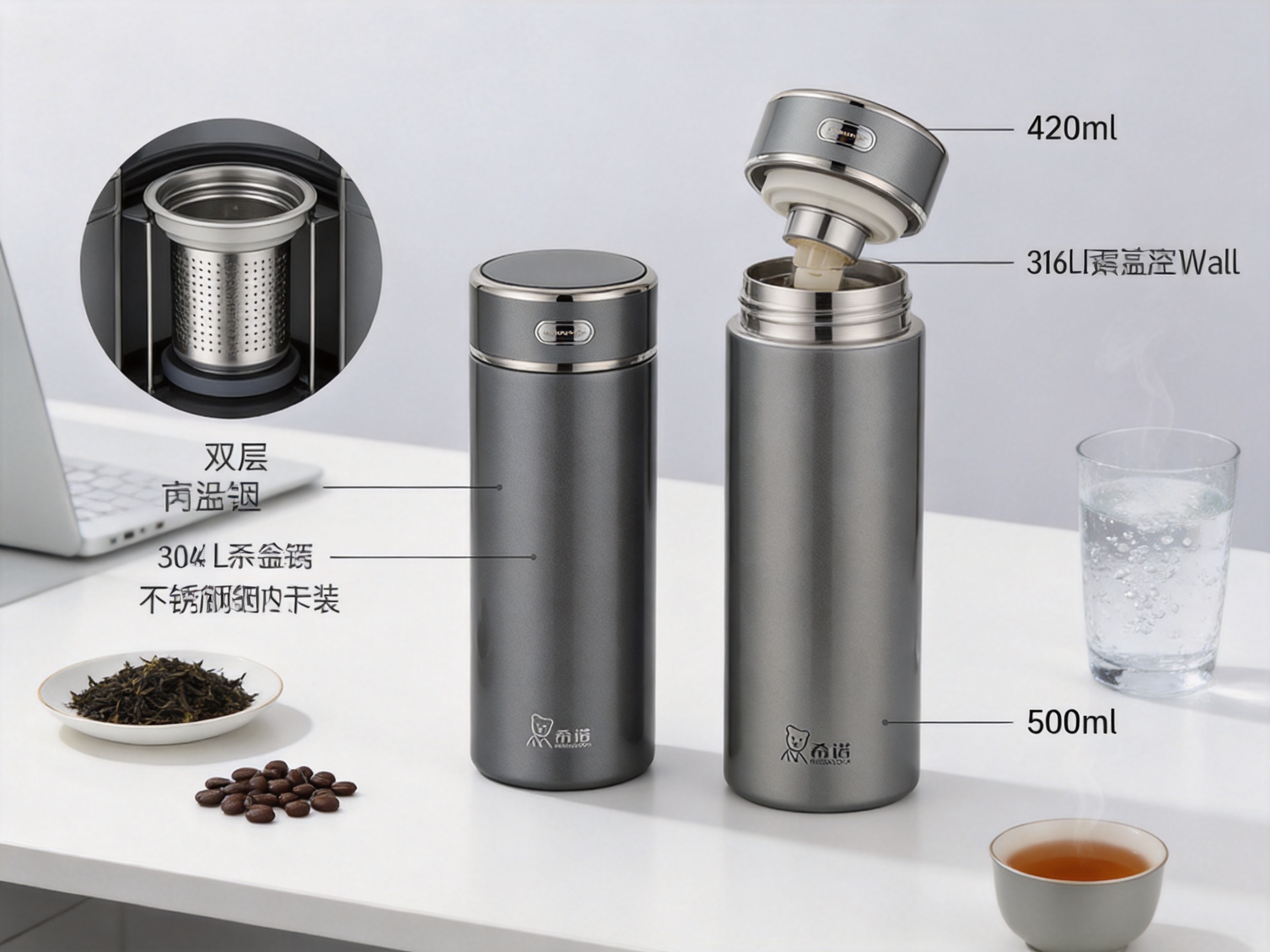
- 2 2. Material Engineering: 316L Interior and 304 Exterior
- 3 3. Double-Layer Vacuum Insulation
- 4 4. Integrated Tea Filtration
- 5 5. Surface Design and Long-Term Presentation
- 6 6. Product Specifications at a Glance
- 7 7. Advantages Compared with Basic Vacuum Flasks
- 8 8. Manufacturing Capabilities Behind the Product
- 9 9. Why Integrated Manufacturing Matters to Buyers
- 10 10. Applications Across Multiple Markets
- 11 11. Packaging and Presentation
- 12 12. Responsible Use and Maintenance
- 13 13. Sustainability Through Reuse and Durability
- 14 14. Procurement Considerations for Brands and Organizations
- 15 15. Frequently Asked Questions
- 15.1 Q1: What beverages can be used in this vacuum flask?
- 15.2 Q2: What is the difference between the 420 ml and 500 ml versions?
- 15.3 Q3: What material is used inside the flask?
- 15.4 Q4: What material is used for the external body?
- 15.5 Q5: Does the flask include a tea filter?
- 15.6 Q6: How does the vacuum structure help preserve temperature?
- 15.7 Q7: Is the product suitable for office use?
- 15.8 Q8: Is it suitable as a corporate or premium gift?
- 15.9 Q9: What makes the product different from a basic stainless steel bottle?
- 15.10 Q10: What manufacturing capabilities support the product?
- 15.11 Q11: How should the flask be maintained?
- 15.12 Q12: Can organizations request customized programs?
- 16 16. Overall Assessment
- 17 References
- 18 Product: Master Series Office Stainless Steel Vacuum Flask
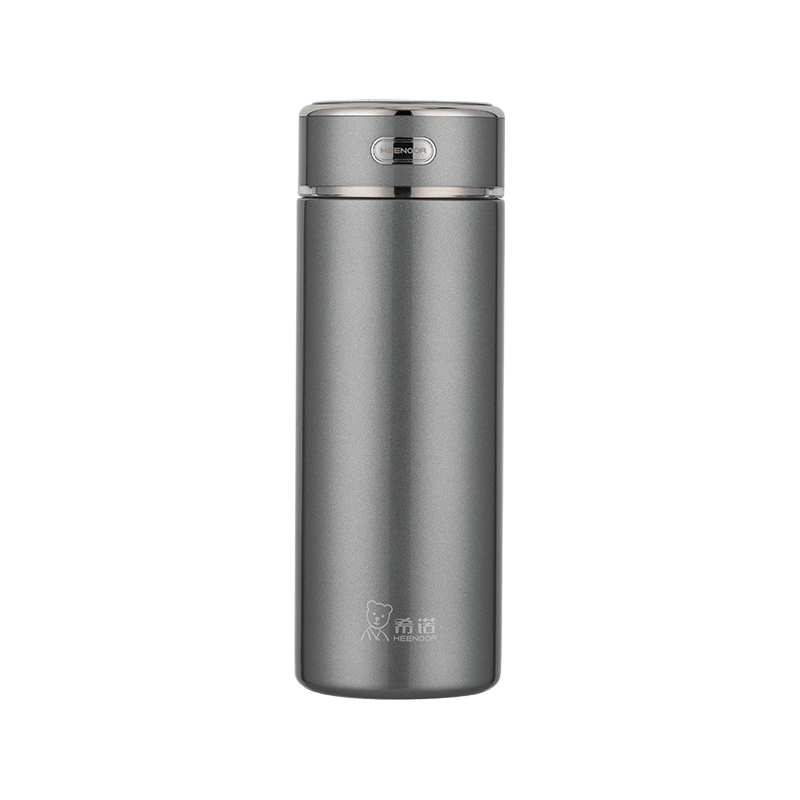
A dependable vacuum flask is more than a container with a decorative exterior. It is a carefully engineered drinking product that must balance thermal performance, material safety, comfort, durability, filtration, portability, and manufacturing consistency. The Master Series Office Stainless Steel Vacuum Flask is designed around these requirements, combining a 316L stainless steel interior, a 304 stainless steel body, a double-layer vacuum structure, a tea filtration system, and a refined multi-material lid.
Available in 420 ml and 500 ml capacities, the flask is intended for office use, business environments, home tea preparation, daily commuting, and premium gifting. Its compact proportions and moderate weight make it easier to carry than many larger vacuum bottles, while its internal construction is designed to support long-lasting insulation for both hot and cold beverages.
The product is manufactured by Heenoor Co., Ltd., a drinkware manufacturer with experience in stainless steel, titanium, plastic, and glass products. Since its establishment in 1999, the company has developed an integrated manufacturing model covering product design, engineering validation, tooling development, standardized production, and quality management. This integrated approach is important because the performance of a vacuum flask depends not only on the choice of steel, but also on forming accuracy, welding quality, vacuum processing, assembly control, and inspection discipline.
This article examines the product’s construction, functional advantages, material selection, manufacturing strengths, user applications, and suitability for organizations seeking a stable drinkware supply partner.
Master Series Office Stainless Steel Vacuum Flask
1. A Vacuum Flask Designed Around Daily Use
Many vacuum flasks are designed with a single use case in mind. Some prioritize maximum capacity, others focus on sports portability, and some are primarily decorative gift items. The Master Series Office Stainless Steel Vacuum Flask occupies a more versatile position. It is sized for practical daily hydration while retaining features that support tea brewing, coffee drinking, and formal presentation.
The 420 ml model is suitable for users who prefer a lighter and more compact flask. It can fit naturally into an office bag, work tote, briefcase, or smaller backpack. The 500 ml model provides additional volume for longer meetings, commuting, travel, or extended periods away from a kitchen or water dispenser. The difference between the two capacities allows brands and purchasing teams to select a size according to their target market rather than adopting a one-size-fits-all approach.
The product’s relatively low listed weight also contributes to portability. The 420 ml version weighs approximately 0.28 kg, while the 500 ml version weighs approximately 0.36 kg. These weights are practical for a product intended to be carried throughout the day. A flask that is technically strong but unnecessarily heavy can become inconvenient, particularly when combined with a laptop, documents, or other personal items.
The design also reflects the needs of office and professional users. Its simple solid-color body offers a restrained appearance that can be used in business settings without appearing overly sporty or casual. The smooth visual language makes it appropriate for personal use, corporate gifting, conference programs, hospitality applications, and premium promotional campaigns.
Balanced Capacity for Different Users
Capacity selection affects the entire user experience. A smaller flask heats and cools more quickly during filling, is easier to carry, and may be preferred by users who drink smaller servings. A larger flask reduces the need for refilling and is more suitable for long working sessions or travel. By offering both 420 ml and 500 ml versions, the product supports different consumption habits while preserving the same overall design concept.
For procurement teams, multiple capacity options can also simplify product range planning. A single design family may be presented in different sizes for different sales channels, gift packages, employee programs, or regional preferences. This can reduce the need to manage unrelated products while still giving buyers meaningful choice.
Comfort-Oriented Drinking Experience
The cup mouth is described as thickened and rounded. This detail has practical value. The mouth is one of the most frequently touched areas of a drinking vessel, and an abrupt or poorly finished rim can make drinking uncomfortable. A rounded edge creates a smoother contact point and supports a more refined perception of quality.
A well-finished mouth also contributes to cleaning convenience. Smooth, rounded surfaces are generally easier to wipe and less likely to retain residue than sharp transitions or rough finishing areas. This is particularly relevant for tea, coffee, juice, and other beverages that may leave flavor or color residues if the container is not cleaned promptly.
2. Material Engineering: 316L Interior and 304 Exterior
One of the product’s principal advantages is its use of different stainless steel grades for different structural functions. The inner pot is made from 316L stainless steel, while the cup body uses 304 stainless steel. This configuration places the more corrosion-resistant material in direct contact with beverages and uses a widely applied structural stainless steel for the external body.
Material selection is an important differentiator in drinkware. Stainless steel is not a single uniform material category. Different grades have different compositions, corrosion resistance characteristics, forming behavior, welding considerations, surface performance, and cost profiles. Selecting the appropriate grade for each part can improve functionality without unnecessarily increasing the material burden of the entire product.
Why 316L Is Valuable for the Inner Pot
The 316L stainless steel interior is designed for direct contact with beverages. Compared with regular stainless steel, 316L is recognized for stronger corrosion resistance and better resistance in challenging chemical environments. The product description specifically emphasizes its improved resistance to acids and alkalis, making it suitable for beverages such as tea, coffee, and juice.
Tea and coffee contain compounds that can affect the interior surface over repeated use, especially when residues remain in the flask for long periods. Juice can also be more chemically active than plain water. A corrosion-resistant inner material gives the product a stronger foundation for repeated beverage use and helps maintain the integrity of the liquid-contact surface over time.
The “L” designation is commonly associated with lower carbon content in austenitic stainless steel grades. In manufacturing contexts, lower carbon content can be beneficial for weldability and for reducing the risk of certain forms of corrosion associated with heat-affected areas when proper processing is followed. The actual performance of a finished flask still depends on material quality, welding parameters, cleaning, passivation practices where applicable, and inspection standards, but the selection of 316L is a technically meaningful choice for the inner pot.
For users, the practical benefit is confidence in a robust beverage-contact surface. For brands, it provides a stronger technical story than a product that simply states “stainless steel” without identifying the grade used in the interior.
The Role of 304 Stainless Steel in the Body
The outer cup body is made from 304 stainless steel, a widely used material for durable household and food-related products. It offers a useful balance of strength, formability, appearance, corrosion resistance, and manufacturing practicality. These characteristics make it suitable for shaping the external shell of a vacuum flask.
Using 304 stainless steel for the body can help maintain a reasonable product weight and manufacturing cost while preserving the structural qualities expected from a premium metal flask. It also provides a stable surface for the product’s solid-color exterior finish. The result is a material architecture in which the interior is optimized for beverage contact and corrosion resistance, while the outer body is optimized for structural support and visual presentation.
Multi-Material Lid Construction
The lid combines 316L or 304 stainless steel with zinc alloy, aluminum alloy, and PP. Each material can contribute different functional characteristics. Stainless steel offers durability and a premium tactile impression. Zinc alloy can support detailed, substantial components and decorative forms. Aluminum alloy is known for its low density and can help manage weight in selected structural or decorative parts. PP, or polypropylene, is commonly used in drinkware components where a lightweight, moldable polymer is needed.
A multi-material lid requires careful engineering because different materials expand, contract, flex, and respond to assembly forces differently. The quality of the final result depends on dimensional control, interface design, part compatibility, sealing performance, and assembly consistency. When these factors are controlled effectively, a multi-material lid can provide a combination of visual refinement, durability, manageable weight, and practical usability.
3. Double-Layer Vacuum Insulation
The flask uses a double-layer vacuum structure. This construction places an inner vessel inside an outer body and removes much of the air from the space between them. The resulting vacuum layer helps reduce heat transfer through conduction and convection, allowing the flask to slow down temperature change in the beverage.
Heat moves through several mechanisms. Conduction transfers energy through solid materials. Convection moves heat through fluid or air circulation. Radiation can also transfer thermal energy across a gap. A vacuum structure is particularly effective at reducing conduction through air and preventing convection in the inter-wall space. The remaining thermal behavior depends on the metal walls, the neck area, the lid, the sealing interfaces, the vacuum level, and the overall geometry.
For hot beverages, the vacuum structure helps reduce the rate at which heat leaves the flask. For cold beverages, it helps slow the rate at which external heat enters. This makes the same product suitable for tea, coffee, juice, water, and other everyday drinks.
Insulation as a Complete System
It is important to understand that vacuum insulation is not created by the cavity alone. A flask’s thermal performance is a system-level result. The body must be formed accurately, the inner and outer shells must be joined securely, and the vacuum process must be completed under controlled conditions. The lid and mouth area must also be designed to limit thermal leakage and support dependable closure.
Manufacturing precision is therefore central to product performance. A small defect in a weld, an incorrectly formed connection, or an insufficiently maintained vacuum can reduce insulation effectiveness. This is one reason an experienced manufacturer with integrated engineering and production capabilities can provide advantages over suppliers that rely primarily on fragmented outsourcing.
Benefits for Hot and Cold Beverages
The product is suitable for hot tea, coffee, and cold drinks. For office workers, this means a morning coffee can remain enjoyable during a working session without requiring repeated trips to a coffee machine. Tea drinkers can prepare a beverage in advance and carry it into meetings or work areas. Users who prefer cold water or juice can also benefit from reduced temperature change during commutes and daily activities.
The product should still be used according to safe beverage-handling practices. Very hot liquids require care when opening, pouring, or drinking. The flask should not be overfilled, and the lid should be secured correctly. Users should also follow appropriate cleaning procedures to prevent residue buildup and preserve the taste of future beverages.
4. Integrated Tea Filtration
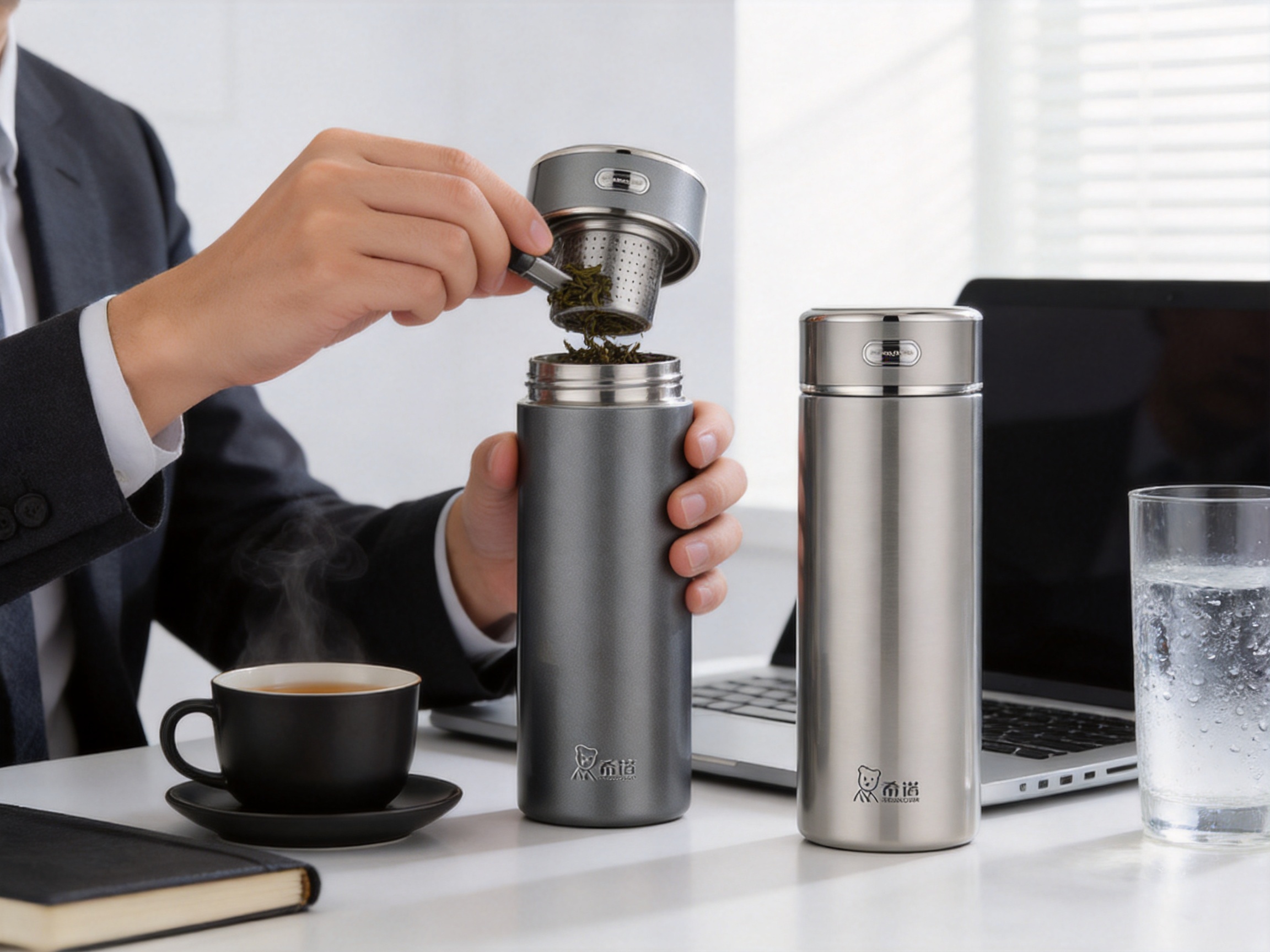
A major functional distinction is the inclusion of a filter made from 316L stainless steel and silicone rubber. This component allows users to switch between different tea brewing methods and helps separate tea leaves from the liquid.
Tea preparation can be inconvenient when leaves remain in the drinking area or continue steeping after the desired strength has been reached. A filter offers a more controlled experience. Users can place loose tea into the designated filtration area, add water, and separate the leaves from the liquid when appropriate. This is particularly valuable for people who prefer loose-leaf tea but do not want to carry a separate teapot or infuser.
Material Suitability of the Filter
Using 316L stainless steel in the filter gives the liquid-contact component a corrosion-resistant metal surface. Tea contains naturally occurring compounds that can leave deposits, and the filter may be exposed to hot liquid for extended periods. A robust stainless steel mesh or screen supports repeated use when properly cleaned.
The silicone rubber elements can provide flexibility and help create controlled contact points between the filter and other components. Silicone is also commonly selected for drinkware seals and soft interfaces because it can offer resilience, flexibility, and a more comfortable fit than a rigid material alone. The final performance depends on the specific formulation, dimensional accuracy, and assembly design, but the combination of stainless steel and silicone is well suited to a removable or integrated tea filtration system.
Flexible Brewing Options
The filter system is intended to support different tea brewing methods. Users may prefer a stronger or lighter infusion, larger or smaller leaves, shorter or longer steeping times, or different serving habits. The ability to separate leaves from the beverage can make the flask more adaptable than a basic bottle with no infusion feature.
This versatility helps broaden the product’s appeal. It is not limited to users who simply need to transport water. It can serve tea enthusiasts, office professionals, business travelers, hospitality staff, and gift recipients who appreciate a more deliberate beverage experience.
The filter should be cleaned after use, particularly when fine tea particles or flavored beverages are involved. A removable or accessible filter structure is generally easier to maintain than a narrow internal passage that cannot be reached. The thickened, rounded mouth also supports easier access during cleaning.
5. Surface Design and Long-Term Presentation
The product uses a simple solid-color exterior. Minimalist color treatment can be an important advantage in professional drinkware because it creates broad compatibility with office environments, uniforms, business gifts, and corporate visual systems. A restrained exterior is less likely to become visually outdated than highly decorative graphics or short-lived novelty patterns.
The product description also emphasizes resistance to paint chipping with extended use. Exterior durability is important because flasks are frequently placed on desks, carried in bags, set in vehicle holders, and exposed to contact with other objects. A coating that quickly chips or peels can make an otherwise functional flask appear worn and reduce perceived value.
Finish quality is influenced by numerous manufacturing factors, including surface preparation, cleaning, coating application, curing conditions, handling procedures, and packaging protection. Consistent appearance requires more than simply selecting a color. Production controls must ensure that the coating adheres properly and that finished products are protected from damage before they reach the customer.
Premium Appearance Without Excessive Ornament
The product’s design language is solid, clean, and practical. This helps it occupy a premium position without relying on excessive decoration. The combination of a refined lid, rounded mouth, carefully finished body, and custom Master Series packaging supports a gift-ready presentation.
Premium presentation is especially important in business procurement. A company may purchase drinkware for employees, clients, conferences, sales programs, or holiday gifts. In these settings, the product must communicate quality while remaining useful after the event. A reusable vacuum flask can continue to provide value long after a promotional occasion, increasing the likelihood that it will remain in regular use.
6. Product Specifications at a Glance
The following table summarizes the principal specifications provided for the product family.
| Specification | 420 ml Version | 500 ml Version |
|---|---|---|
| Model | XN-300m | XN-301m |
| Capacity | 420 ml | 500 ml |
| Approximate Weight | 0.28 kg | 0.36 kg |
| Filter Screen | 316L stainless steel and silicone rubber | |
| Lid | 316L or 304 stainless steel, zinc alloy, aluminum alloy, and PP | |
| Inner Pot | 316L stainless steel | |
| Cup Body | 304 stainless steel | |
| Thermal Structure | Double-layer vacuum construction | |
| Primary Applications | Tea, coffee, juice, water, office use, home use, business gifting | |
The two models share the same core material strategy and functional concept. The main selection factor is capacity and the resulting balance between portability and beverage volume.
7. Advantages Compared with Basic Vacuum Flasks
The product’s competitive value comes from the combination of several features rather than from one isolated specification. A basic vacuum flask may provide a metal body and a closure, but this model adds differentiated material selection, integrated filtration, a refined lid system, multiple sizes, and a premium presentation format.
Higher-Specification Beverage Contact Surface
Many products are promoted simply as stainless steel drinkware without identifying the grade of the inner vessel. The use of 316L stainless steel in the inner pot gives this flask a clearer technical position. It is designed for stronger corrosion resistance and improved resistance to acidic and alkaline conditions compared with regular stainless steel, which is relevant for tea, coffee, and juice applications.
More Versatile Than a Standard Bottle
A standard bottle primarily transports a beverage that has already been prepared. The integrated filter gives this flask an additional role as a tea-brewing vessel. This makes it more versatile for users who alternate between water, tea, coffee, and other drinks.
Professional and Giftable Design
Some high-performance bottles have a strongly athletic appearance, while some gift products sacrifice daily practicality for decoration. The solid-color body and refined component design provide a middle ground. The flask is useful enough for everyday office use but polished enough for business presentation and premium gifting.
Two Practical Capacities
Offering 420 ml and 500 ml versions allows the product line to address different preferences without introducing a completely different structure. Buyers can select the smaller version for compact portability or the larger version for extended use. This flexibility is useful in retail, corporate purchasing, hospitality, and promotional programs.
Manufacturing Support for Scalable Programs
The manufacturer’s integrated capabilities are another competitive advantage. Product development, engineering validation, tooling development, standardized production, and quality management are coordinated within a broader manufacturing system. This can make it easier for customers to move from an approved design to repeat production while maintaining consistent specifications.
8. Manufacturing Capabilities Behind the Product
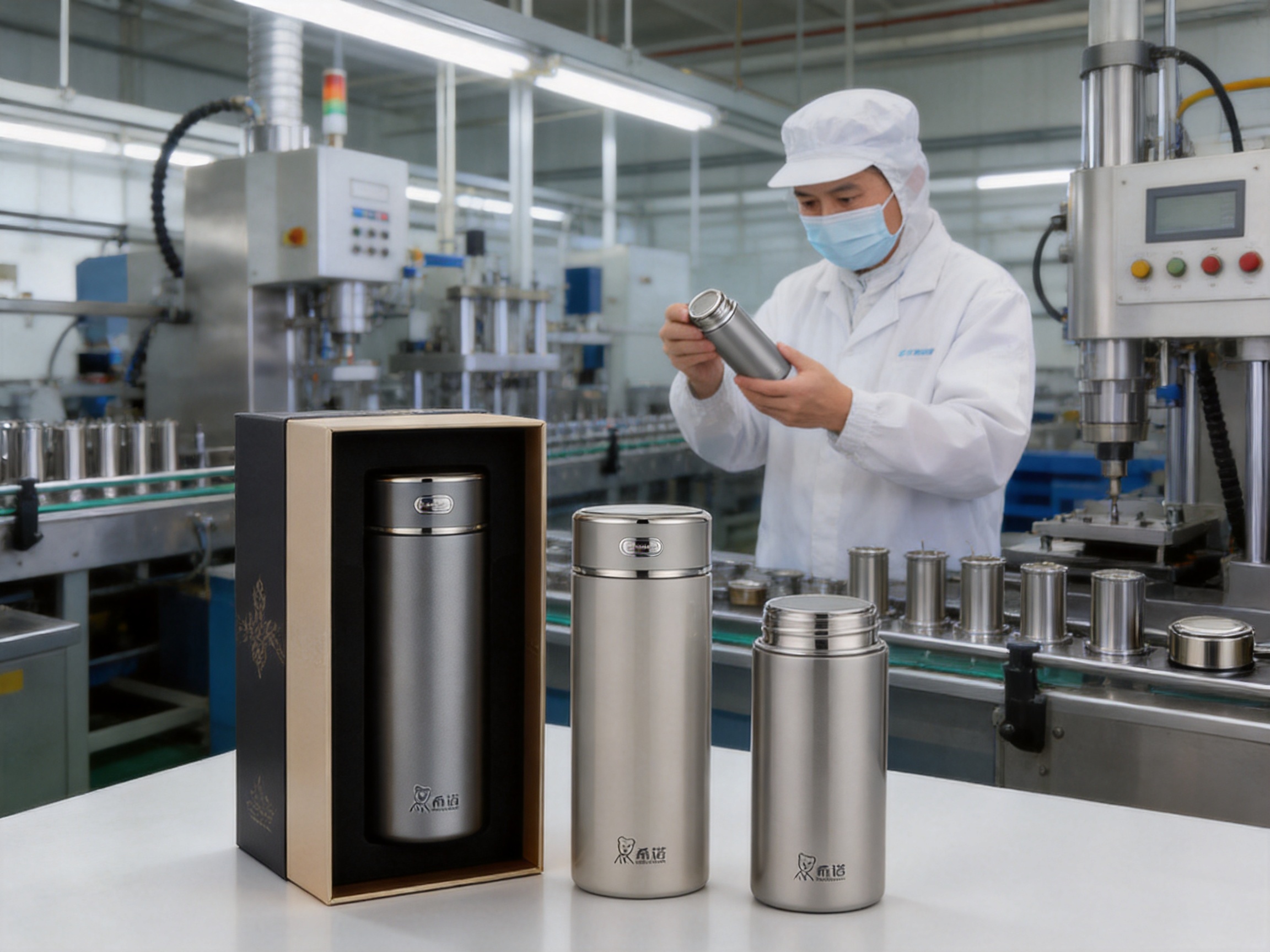
The performance of a vacuum flask is closely connected to manufacturing execution. Even excellent design concepts can fail if production processes are not stable. Heenoor’s stated manufacturing model integrates multiple stages of product realization, allowing the company to support projects from initial development through industrial production.
Product Design and Development
Product design is the starting point for determining the flask’s shape, proportions, capacity, lid architecture, filter structure, user interface, and exterior appearance. Design decisions must account for how the product will be formed, welded, polished, coated, assembled, cleaned, packaged, and transported.
For a product with multiple materials, design coordination becomes even more important. The stainless steel body, filter, silicone components, zinc alloy elements, aluminum alloy parts, and PP components must work together as a complete system. Tolerances, connection methods, sealing interfaces, and assembly sequences should be considered before mass production begins.
Engineering Validation
Engineering validation helps confirm whether the design performs as intended. For a vacuum flask, relevant validation areas can include dimensional accuracy, lid fit, filter integration, vacuum performance, leak resistance, surface appearance, thermal behavior, and user handling.
Validation is also valuable for identifying potential production risks. A component may perform well in a prototype but become difficult to assemble consistently at scale. A coating may look attractive on a sample but require improved process control for larger production volumes. An integrated engineering team can identify such issues earlier and refine the product before full-scale manufacturing.
Tooling Development
Tooling affects the repeatability of formed metal parts and molded components. The outer body and inner pot require tooling that supports accurate shaping and consistent dimensions. The lid and filter components may also require dedicated tools for metal forming, plastic molding, or related production steps.
Well-developed tooling can reduce variation between batches and help maintain alignment between components. It also supports efficient production by making forming and assembly more predictable. For buyers managing large programs, tooling capability is important because it directly influences capacity, consistency, and the ability to implement controlled design revisions.
Standardized Production
Standardized production provides a framework for repeating approved processes across different production runs. Standardization may cover material specifications, forming parameters, welding procedures, vacuum processing, surface treatment, component inspection, assembly operations, and packaging.
Consistency is especially important in drinkware because users interact with the product every day. A lid that fits well on one unit but feels loose on another can damage customer confidence. Similarly, differences in coating shade, mouth finishing, filter fit, or body alignment can affect perceived quality. Standardized production helps reduce these variations.
Quality Management
Quality management connects design requirements with actual manufacturing results. It can include incoming material checks, process inspections, dimensional verification, appearance evaluation, functional testing, and finished-product review. The exact inspection plan depends on the customer’s requirements and the product configuration.
For this flask, quality attention is particularly relevant to the 316L inner pot, 304 body, vacuum structure, filter screen, silicone interfaces, lid assembly, surface finish, and packaging. A complete quality approach considers both visible appearance and hidden functional performance.
9. Why Integrated Manufacturing Matters to Buyers
Organizations purchasing drinkware often need more than a product sample. They need confidence that the approved design can be reproduced, delivered, and supported over time. An integrated manufacturer can offer advantages throughout this process.
Clearer Technical Communication
When design, engineering, tooling, production, and quality functions are connected, technical questions can be directed to teams familiar with the complete product. This can reduce misunderstandings regarding material grades, dimensions, surface treatment, filter details, or packaging requirements.
Better Control of Design Changes
Products may require changes after sampling. A customer may request a different color, logo treatment, packaging format, capacity, lid detail, or filter configuration. Controlled engineering and tooling processes help assess the effect of these changes before they are introduced into production.
More Reliable Scale-Up
A prototype is not the same as a mass-produced item. Scaling up requires attention to cycle time, tooling wear, assembly sequence, worker training, inspection capacity, and material supply. A manufacturer experienced in industrial production is better positioned to identify the differences between sample development and stable volume manufacturing.
Long-Term Supply Stability
Heenoor positions itself as a manufacturing partner for brands, organizations, and procurement teams that value technical clarity, manufacturing discipline, and long-term supply stability. This approach is relevant to customers who need repeat orders rather than a one-time purchase.
Long-term stability includes more than production capacity. It also involves the ability to maintain agreed specifications, communicate clearly, support packaging requirements, manage quality expectations, and respond to product development needs as a customer’s program evolves.
10. Applications Across Multiple Markets
Office and Workplace Use
The product is especially suitable for office environments. Its moderate capacity is appropriate for desk use, meetings, work sessions, and daily commuting. The professional solid-color design can blend into a corporate setting, while the tea filter supports users who prefer preparing loose-leaf tea at work.
Organizations may use the flask as an employee benefit, onboarding item, workplace wellness product, or internal recognition gift. The practical nature of the product increases the likelihood of continued use, especially when compared with decorative items that have limited daily function.
Business and Corporate Gifting
The combination of stainless steel construction, custom Master Series packaging, and a polished appearance supports premium gifting programs. The product can be presented to clients, partners, employees, or event participants. Its useful function gives the gift a longer service life and allows the recipient to associate the product with the organization that provided it.
Tea Retail and Specialty Beverage Programs
The integrated filter makes the flask relevant to tea retailers and specialty beverage brands. It may be offered as an accessory alongside loose-leaf tea, seasonal collections, corporate tea programs, or membership packages. The 316L interior and filter provide a stronger material story for customers who care about beverage contact surfaces.
Hospitality and Professional Services
Hotels, executive offices, travel services, and professional firms may use the product as part of guest amenities or client gifts. The two capacity options provide flexibility for different settings. A smaller size may suit meeting rooms or welcome packages, while the larger version may be more appropriate for travel or extended use.
Retail and E-Commerce
For retail and e-commerce, the product offers several communication points: 316L stainless steel interior, 304 stainless steel body, double-layer vacuum insulation, tea filtration, two capacities, and premium packaging. These features can be explained clearly in product listings and sales materials without relying entirely on appearance-based marketing.
11. Packaging and Presentation
The flask comes with custom packaging from the Master Series. Packaging plays several roles in a drinkware program. It protects the product during storage and transportation, organizes the presentation of the flask and accessories, and communicates the intended market position.
For gifting, packaging can be as important as the item itself. A well-considered package creates a stronger opening experience and reduces the need for additional wrapping. For e-commerce, packaging must also help protect the finish and lid during shipment. For corporate programs, custom packaging can support coordinated branding and make distribution more efficient.
Packaging development should be coordinated with the product design. The dimensions of the flask, filter, lid, and accessories must be accommodated securely. Protective materials should minimize movement and surface contact that could lead to scratches or coating damage. Clear identification of the model and capacity can also help reduce distribution errors when both the 420 ml and 500 ml versions are ordered together.
12. Responsible Use and Maintenance
Proper care helps preserve the performance and appearance of any reusable vacuum flask. Users should rinse the flask after each use and wash it with suitable dishwashing tools. Tea, coffee, juice, and flavored beverages should not be allowed to remain inside for unnecessarily long periods. Regular cleaning is particularly important for the filter and lid, where residue may collect.
A soft brush can help clean the inner pot and filter screen without unnecessarily scratching surfaces. The lid should be separated or opened according to its design so that hidden areas can dry completely. After washing, allowing the components to air-dry can help reduce retained moisture and odor.
Users should avoid placing liquids in the flask that are incompatible with the product or its seals. Carbonated beverages may create pressure and are generally not appropriate for many vacuum flask designs unless specifically approved. Extremely hot liquids should be handled carefully, and users should ensure the lid is not over-tightened or opened abruptly after filling.
These care practices do not replace manufacturing quality, but they help maintain the product’s appearance, taste neutrality, filtration function, and sealing performance throughout its service life.
13. Sustainability Through Reuse and Durability
A reusable stainless steel flask can support reduced reliance on disposable beverage containers. The environmental value of reuse depends on actual service life, user behavior, material sourcing, manufacturing efficiency, transportation, and end-of-life handling. A product that is used frequently for a long period generally offers greater practical benefit than a low-quality item that must be replaced quickly.
The use of durable stainless steel in the body and inner pot supports repeated use. The product’s solid-color exterior and resistance to paint chipping are also relevant because a better-preserved appearance can extend the period during which users are willing to keep the flask.
For organizations, selecting a reusable product with clear material specifications and stable manufacturing support can contribute to more responsible procurement decisions. Buyers may also request additional information about packaging materials, production controls, shipment planning, and recycling considerations according to their own sustainability requirements.
14. Procurement Considerations for Brands and Organizations
When evaluating a vacuum flask supplier, buyers should review the complete program rather than considering only unit price. Important factors include material grades, available capacities, prototype support, tooling capability, surface treatment, filtration design, packaging, quality controls, communication, and repeat-order stability.
Confirming the Product Configuration
Buyers should confirm whether the required model is XN-300m at 420 ml or XN-301m at 500 ml. They should also verify the exact lid configuration, filter structure, color, coating, packaging format, and any requested branding treatment before approval.
Reviewing Material Requirements
Material declarations should clearly distinguish the 316L inner pot, 304 cup body, filter materials, lid materials, and polymer components. This clarity helps buyers prepare accurate product documentation and communicate meaningful information to end users.
Evaluating Samples and Production Standards
Samples should be assessed for appearance, lid fit, mouth comfort, filter operation, weight, dimensions, and general handling. For larger programs, the approved sample should be documented as a reference for production. Buyers may also establish inspection criteria for color, surface defects, component alignment, packaging, and functional performance.
Planning for Reorders
Long-term programs benefit from a clear reorder process. The manufacturer and buyer should maintain records of approved materials, tooling, packaging, colors, labels, and inspection requirements. This reduces ambiguity when a product is reordered months or years after the initial production run.
15. Frequently Asked Questions
Q1: What beverages can be used in this vacuum flask?
The flask is designed for beverages such as tea, coffee, juice, water, and other everyday hot or cold drinks. Because the inner pot is made from 316L stainless steel, it is intended to provide a corrosion-resistant beverage-contact surface suitable for a range of common beverages.
Q2: What is the difference between the 420 ml and 500 ml versions?
The primary difference is capacity. The 420 ml model weighs approximately 0.28 kg, while the 500 ml model weighs approximately 0.36 kg. The smaller version emphasizes compact portability, and the larger version provides additional beverage volume for longer use between refills.
Q3: What material is used inside the flask?
The inner pot is made from 316L stainless steel. This material is selected for its enhanced corrosion resistance and suitability for beverage-contact applications.
Q4: What material is used for the external body?
The cup body is made from 304 stainless steel. It provides structural support, durability, formability, and a suitable base for the exterior finish.
Q5: Does the flask include a tea filter?
Yes. The filter screen uses 316L stainless steel and silicone rubber. It allows users to prepare tea and separate tea leaves from the liquid according to their preferred brewing method.
Q6: How does the vacuum structure help preserve temperature?
The flask uses a double-layer vacuum structure that reduces heat transfer through conduction and convection. This helps slow temperature change, keeping hot beverages warm and cold beverages cool for longer than a conventional non-insulated container.
Q7: Is the product suitable for office use?
Yes. Its moderate capacities, lightweight construction, professional solid-color appearance, tea filter, and insulated design make it suitable for desks, meetings, commuting, and general workplace use.
Yes. The product combines a refined appearance, stainless steel construction, practical daily function, and custom Master Series packaging. These characteristics make it suitable for employee gifts, client gifts, event programs, and premium promotional applications.
Q9: What makes the product different from a basic stainless steel bottle?
The main differentiators are the 316L stainless steel interior, 304 stainless steel body, double-layer vacuum construction, integrated tea filter, multi-material lid, two capacity choices, rounded mouth, solid-color finish, and custom packaging.
Q10: What manufacturing capabilities support the product?
The manufacturer integrates product design, engineering validation, tooling development, standardized production, and quality management. This supports the transition from product concept and sampling to repeatable industrial production.
Q11: How should the flask be maintained?
Rinse and clean the inner pot, filter, lid, and mouth after use. Tea, coffee, and juice residues should not be left inside for long periods. A soft brush and suitable cleaning solution can help preserve the surfaces. Components should be allowed to dry thoroughly after washing.
Q12: Can organizations request customized programs?
The manufacturer serves brands, organizations, and procurement teams requiring product development and industrial manufacturing support. Custom requirements should be discussed in relation to color, packaging, branding, capacity, tooling, quantities, and quality standards.
16. Overall Assessment
The Master Series Office Stainless Steel Vacuum Flask is a balanced drinkware product built around practical daily use and differentiated material engineering. Its 316L stainless steel inner pot provides a strong beverage-contact foundation, while the 304 stainless steel body supports a durable and manageable external structure. The double-layer vacuum design helps reduce heat transfer, making the flask appropriate for both hot and cold drinks.
The integrated 316L stainless steel and silicone rubber filter expands the product beyond ordinary beverage storage. Users can prepare tea, separate leaves, and enjoy a more flexible brewing experience without carrying a separate infuser. The rounded mouth, solid-color body, multi-material lid, and custom packaging further support comfort, presentation, and premium positioning.
From a procurement perspective, the product benefits from the manufacturer’s integrated capabilities in design, engineering validation, tooling development, standardized production, and quality management. These strengths are valuable for brands and organizations that require more than a sample: they require a repeatable, scalable, and clearly managed supply program.
With 420 ml and 500 ml options, the flask can serve office users, tea drinkers, business professionals, retail customers, hospitality programs, corporate gifting campaigns, and other markets seeking a reusable, presentable, and technically differentiated drinkware solution.
References
1. Product specification materials for the Master Series Office Stainless Steel Vacuum Flask, including model, capacity, weight, material, filter, lid, and packaging information.
2. Heenoor Co., Ltd. company information concerning product development, engineering validation, tooling development, standardized production, and quality management.
3. General stainless steel engineering references concerning the properties and common applications of 304 stainless steel and 316L stainless steel.
4. General thermal engineering references concerning conduction, convection, radiation, and vacuum insulation principles.
5. General drinkware design references concerning reusable beverage containers, tea filtration systems, material selection, cleaning, and user safety.
Product: Master Series Office Stainless Steel Vacuum Flask

You may also like…
Copyright © 2025 Heenoor Co., Ltd. All Rights Reserved.
 Custom Stainless Steel Drinkware Manufacturers
BACK TOP