 English
 中文简体
中文简体 日本語
日本語 Español
 عربى
عربى
Search
Categories
Recommend
Categories
 Lin Yuxi — International Product Sales Manager
Recommend
-
 Industry news
 -
 Industry news
 -
 Industry news
 -
 Industry news
Aug 25, 2026 - By admin
Double-Layer Antibacterial Goose Egg Glass: A Technical Guide to Safer, Smarter, Car-Friendly Drinkware
Content
- 1 1. Product Overview and Design Philosophy
- 2 2. High-Borosilicate Glass Body
- 3 3. Titanium Components and Material Stability
- 4 4. Silver Ion Mist Coating and Antibacterial Positioning
- 5 5. Leak-Resistant Lid Construction
- 6 6. Car-Friendly Dimensions and Mobility
- 7 7. Comparison with Conventional Drinkware
- 8 8. Manufacturing Integration and Product Development Strength
- 9 9. Material Coordination in the Production Process
- 10 10. Quality Considerations for Commercial Buyers
- 11 11. Product Applications
- 12 12. Care and Use Recommendations
- 13 13. Sustainability and Long-Term Value
- 14 14. Why Manufacturing Capability Matters to Product Performance
- 15 15. Customization and Procurement Potential
- 16 16. Technical Summary
- 17 17. Frequently Asked Questions
- 17.1 Q1: What is the main purpose of the Double-Layer Antibacterial Goose Egg Glass?
- 17.2 Q2: Why is high-borosilicate glass used for the cup body?
- 17.3 Q3: What components are made of pure titanium?
- 17.4 Q4: Is the product suitable for tea?
- 17.5 Q5: Does the silver ion mist coating eliminate the need for cleaning?
- 17.6 Q6: Is the cup leakproof?
- 17.7 Q7: Can the cup be used in a car?
- 17.8 Q8: What capacities are available?
- 17.9 Q9: How much does each version weigh?
- 17.10 Q10: Is the product insulated like a vacuum flask?
- 17.11 Q11: Is the product suitable for outdoor activities?
- 17.12 Q12: What makes the product different from a normal glass cup?
- 17.13 Q13: What manufacturing capabilities support this product?
- 17.14 Q14: Can commercial buyers request customized programs?
- 17.15 Q15: What should buyers verify before placing a large order?
- 18 18. Conclusion
- 19 References
- 20 Product: Double-Layer Antibacterial Goose Egg Glass
Modern drinkware must do more than hold water. Consumers increasingly expect a drinking vessel to combine material safety, durability, portability, easy cleaning, thermal adaptability, and a refined appearance. Commercial buyers, meanwhile, look for products that are consistent in quality, scalable in production, suitable for branding, and reliable across daily-use environments. The Double-Layer Antibacterial Goose Egg Glass addresses these requirements through a carefully coordinated material system built around high-borosilicate glass, pure titanium components, heat-resistant silicone, and a silver ion mist coating.
Designed as a compact glass water bottle for cars, offices, commuting, travel, and outdoor use, this product combines the visual clarity of glass with the material stability of titanium. Its compact capacities of 210 milliliters, 250 milliliters, and 280 milliliters allow the bottle to fit most vehicle cup holders while remaining convenient to carry. The curved “goose egg” body is shaped to feel secure in the hand and stable on a tabletop, and the lid and filter system are designed to support both direct drinking and tea preparation.
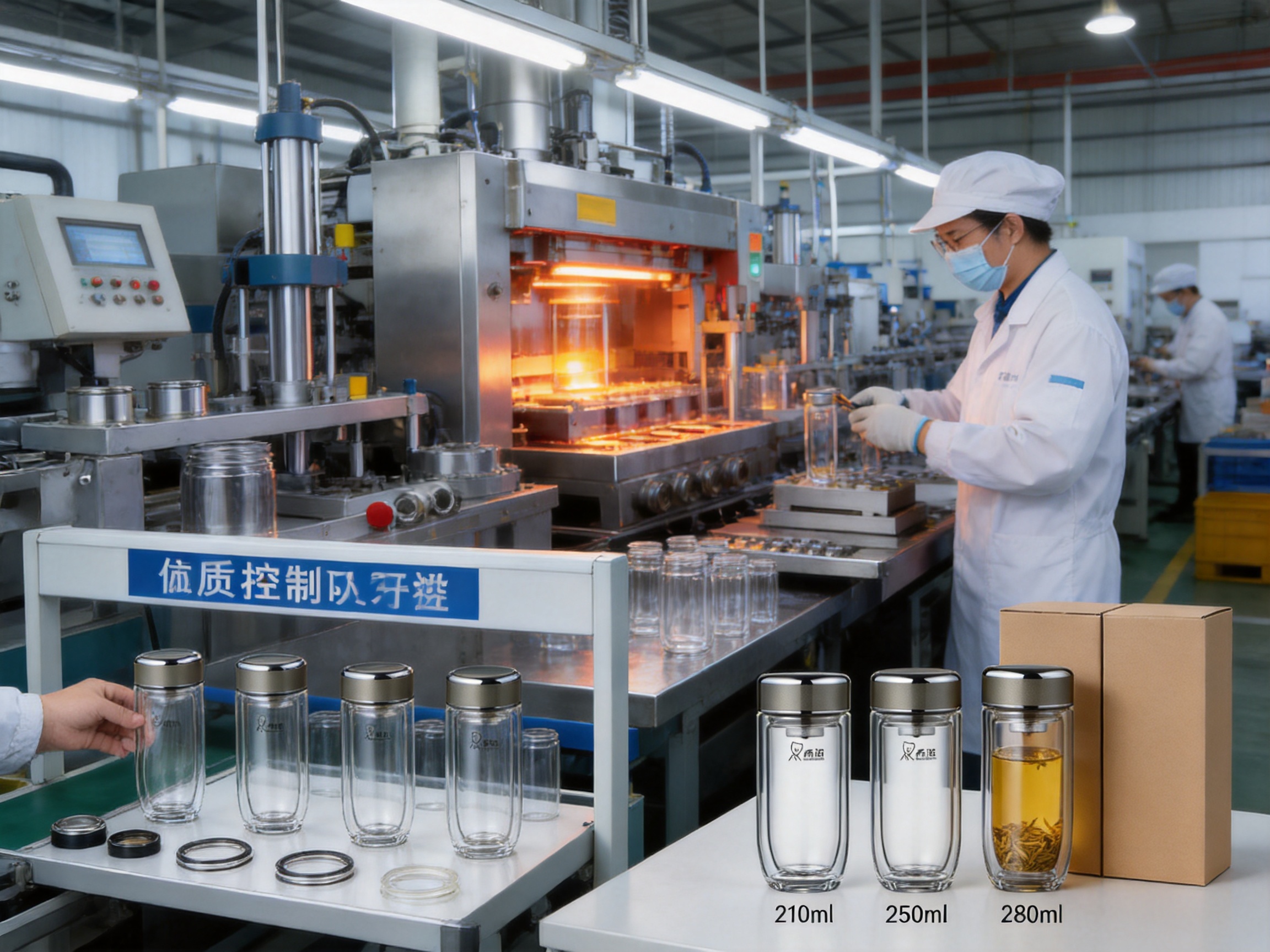
The product is also supported by the manufacturing capabilities of Heenoor Co., Ltd., a drinkware manufacturer established in 1999. The company integrates product design, engineering validation, tooling development, standardized production, and quality management. This integrated approach is important because a premium drinkware product is not defined by material selection alone. The final result depends on how accurately the materials, dimensions, sealing parts, surface treatments, assembly methods, and inspection procedures work together.
This article examines the product’s structure, material advantages, functional performance, application value, and manufacturing strengths. It also explains how this glass compares with conventional stainless steel, ordinary glass bottles, plastic drinkware, and less specialized travel cups.
1. Product Overview and Design Philosophy
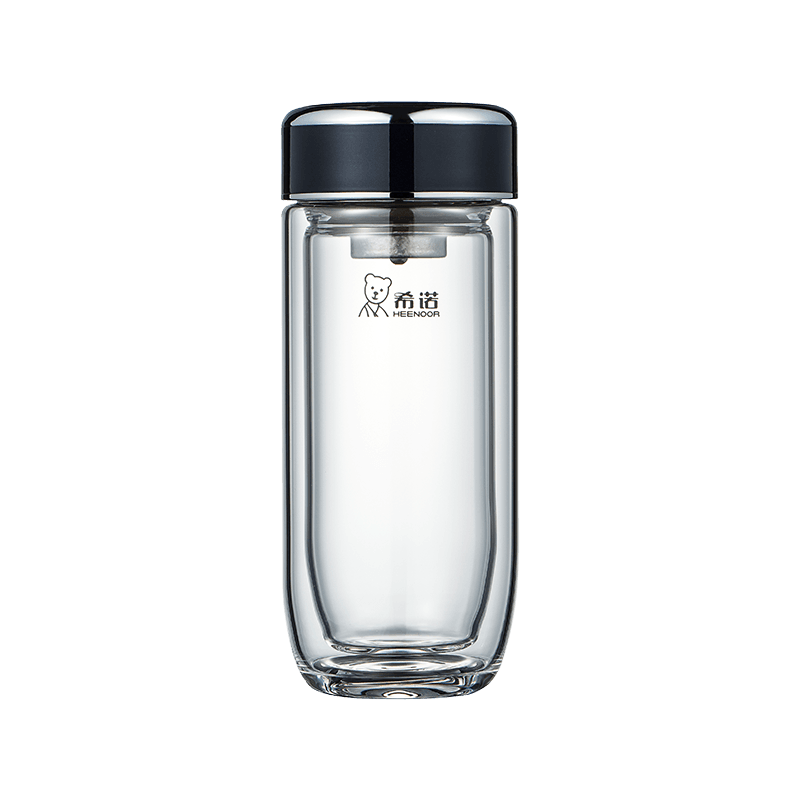
The Double-Layer Antibacterial Goose Egg Glass is a compact glass water bottle with a high-borosilicate glass body, a pure titanium lid water-contact surface, a pure titanium filter screen, silicone sealing elements, and a silver ion mist coating on the inner glass wall. The design is intended to provide a cleaner drinking experience while retaining the transparency and visual appeal associated with glass drinkware.
The product’s name reflects its rounded, curved body. Instead of using a straight cylindrical profile, the cup adopts a soft, ergonomic form that resembles an egg. This shape supports three practical objectives: comfortable hand placement, stable positioning, and a distinctive appearance for retail or corporate gifting. The design also helps differentiate the bottle from standardized cylindrical travel cups that often look similar across competing product lines.
Although compact, the product is designed for several consumption patterns. It can be used for water, tea, infused beverages, and other suitable non-carbonated drinks. The filter screen makes it possible to retain tea leaves or other larger ingredients while drinking. Because the body is transparent, users can observe the color and concentration of tea without removing the lid.
The product is available in three capacities:
Model |
Capacity |
Approximate Weight |
Primary Positioning |
XN-1915 |
210 ml |
0.38 kg |
Compact personal use and vehicle travel |
XN-1916 |
250 ml |
0.41 kg |
Balanced daily-use capacity |
XN-1917 |
280 ml |
0.42 kg |
Extended use while remaining car-friendly |
The three sizes allow buyers to select a version according to the intended sales channel or end-user preference. The smallest version may be attractive for compact vehicles, short commutes, and gift sets. The middle size provides a practical balance between portability and capacity. The largest option offers a little more beverage volume without moving into the oversized dimensions common to many sports bottles or insulated tumblers.
The product is supplied in an elegant gift box, which expands its suitability beyond ordinary personal drinkware. It can be positioned for business travel, employee recognition, premium promotional programs, executive gifts, seasonal gift collections, and daily-use retail products.
2. High-Borosilicate Glass Body
The cup body is manufactured from high-borosilicate glass. This material is widely valued in drinkware, laboratory equipment, cookware, and other applications where clarity and resistance to temperature changes are important. Compared with ordinary glass, high-borosilicate glass is formulated to provide improved resistance to thermal shock and a lower coefficient of thermal expansion.
For a drinking vessel, this characteristic is particularly useful because beverages may be served at different temperatures. Users may pour warm tea into the cup, refill it with room-temperature water, or move between indoor and outdoor environments. No glass product should be exposed carelessly to extreme thermal shock, but high-borosilicate glass provides a more suitable material base for changing beverage temperatures than many conventional glass formulations.
Transparency is another major advantage. The clear body allows users to observe the color, clarity, and approximate remaining volume of the beverage. This is especially valuable for tea drinkers, who often evaluate a drink by its color and infusion strength. Opaque stainless steel or colored plastic can conceal the beverage, whereas glass provides immediate visual feedback.
Glass also has a relatively neutral sensory profile. When properly manufactured and cleaned, it does not normally contribute a metallic taste or retain flavors as readily as some plastic products. This makes it suitable for users who alternate between water, tea, herbal drinks, and other beverages.
The body is not simply a transparent container. Its curved profile provides an ergonomic interface between the user and the material. The rounded sides are easier to hold than a flat-sided vessel, while the stable base helps reduce movement on desks, counters, and other level surfaces. The shape also gives the product a more premium visual identity than a basic straight-wall bottle.
The rounded drinking mouth contributes to comfort. A well-finished rim is important because it is the part of the cup that directly contacts the lips. The rounded edge is intended to provide a smoother drinking experience while reducing the sharp or unfinished sensation that can occur with poorly processed glass components.
3. Titanium Components and Material Stability
The lid’s water-contact surface and the filter screen are made of pure titanium. Titanium is known for its high corrosion resistance, biocompatibility, and chemical stability. These properties make it an attractive material for drinkware components that come into contact with beverages.
Compared with conventional stainless steel, titanium offers a different performance profile. Stainless steel is widely used and remains a practical material for many drinkware applications. However, users who specifically want a lightweight, highly corrosion-resistant, and chemically stable metal may prefer titanium. Titanium is also valued in medical, food-contact, outdoor, and high-performance applications because it can maintain its properties in demanding environments.
The use of pure titanium in the water-contact area of the lid is a meaningful design choice. The lid is exposed to moisture, steam, beverage residue, and repeated washing. A chemically stable metal surface can help support long-term use without easily reacting with ordinary beverages. This is particularly relevant for users who drink tea or other liquids with mild acidity and who expect their drinkware to remain neutral in taste and appearance.
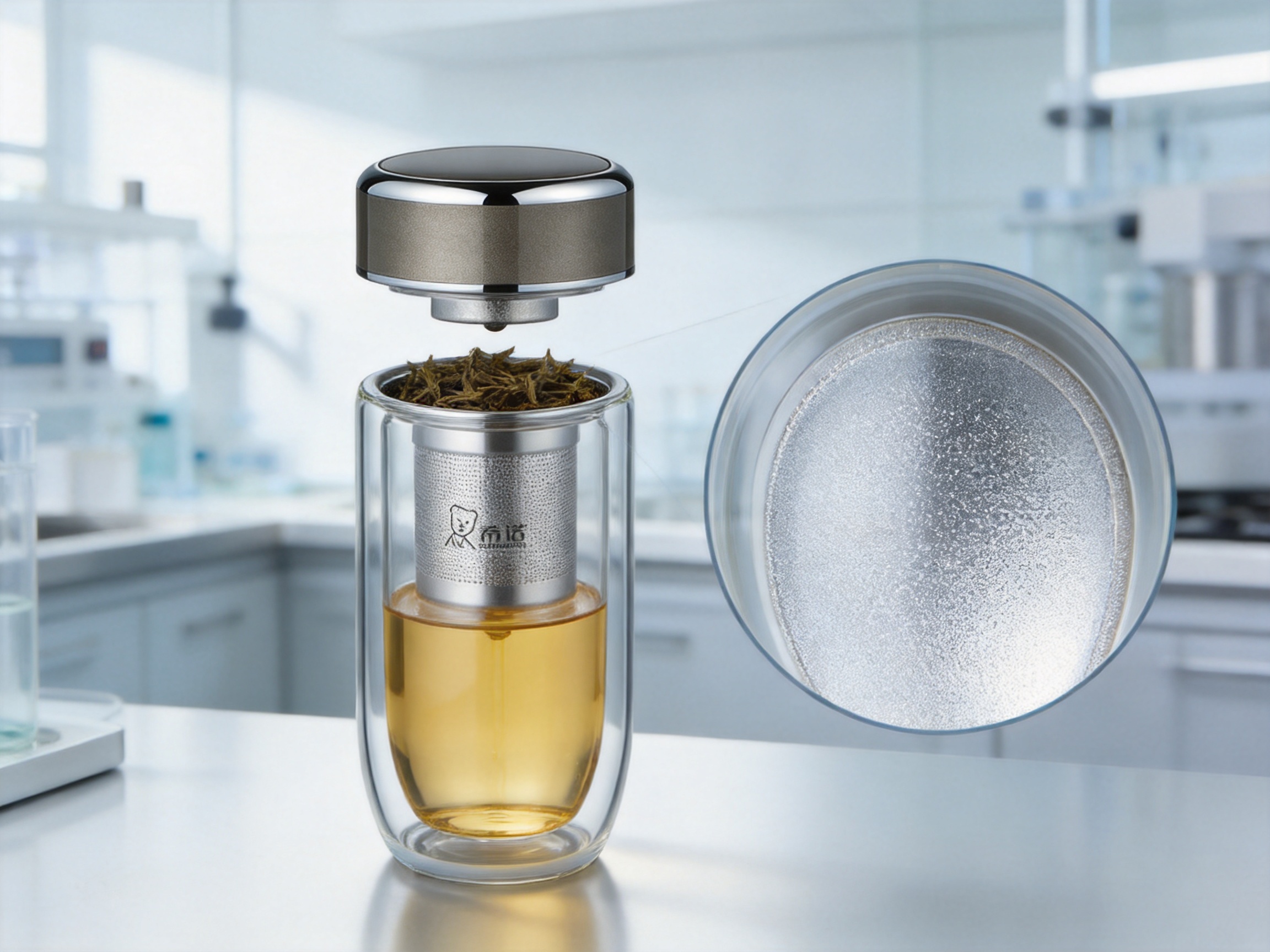
The filter screen is also made from pure titanium and is combined with heat-resistant silicone rubber. This construction provides a durable filter assembly designed to maintain its form when exposed to hot beverages. The filter can help retain tea leaves or larger particles while allowing liquid to pass through.
A protective ring is positioned around the filter edge. Its purpose is to help prevent the metal filter from directly scratching the glass wall during use or assembly. This is an important detail because the interaction between two rigid materials can create wear points if the design does not include an appropriate buffer. The heat-resistant silicone element provides that protective interface while also supporting a more controlled fit.
The lid specification is listed as pure titanium plus PP. The water-contact surface emphasizes the titanium material, while polypropylene may be used as part of the lid structure. This combination allows the product to balance the premium properties of titanium with the dimensional flexibility and practical forming characteristics of an engineered polymer.
4. Silver Ion Mist Coating and Antibacterial Positioning
The inner wall of the glass body is treated with a silver ion mist coating. According to the product information, silver ions are fixed onto the glass surface at high temperature. The treatment is designed to provide ongoing antibacterial protection on the inner surface.
Silver has long been studied for its ability to inhibit the growth of certain microorganisms. In a drinkware context, a silver ion treatment is intended to add an additional hygiene-oriented feature beyond ordinary washing. It is not a replacement for cleaning, rinsing, or safe beverage handling. Instead, it is a supplementary surface treatment designed to help reduce the risk of bacterial persistence on the treated area.
The placement of the coating on the inner glass wall is significant because this is the surface that comes into contact with the beverage and is most likely to retain moisture after use. Fixing the silver ions at high temperature is intended to create a more durable surface treatment than a removable liquid coating. The coating is integrated into the product’s internal surface rather than being presented as a temporary fragrance, film, or disposable insert.
For commercial buyers, the antibacterial positioning can provide a clear point of differentiation. Many ordinary glass bottles offer transparency but do not include a specialized antibacterial surface treatment. Many stainless steel bottles offer durability but do not provide a visible glass interior. The combination of glass transparency and an antibacterial-oriented surface treatment gives this product a distinct market story.
Marketing communication should still be precise. Antibacterial performance depends on the specific test method, microorganism, contact time, surface condition, and maintenance practices. Product claims should therefore be supported by appropriate technical documentation when the bottle is promoted in regulated markets. The practical message is that the treated glass surface adds a hygiene-focused design feature while normal cleaning remains essential.
Double-Layer Antibacterial Goose Egg Glass
5. Leak-Resistant Lid Construction
A travel-oriented drinking vessel must control leakage. A product that performs well on a desk but leaks inside a vehicle, bag, or briefcase will not satisfy its intended use. The Double-Layer Antibacterial Goose Egg Glass uses a pure titanium and PP lid with a silicone sealing ring. The sealing ring is designed to help prevent liquid from escaping when the cup is inverted.
The silicone ring plays several roles. It creates a compressible interface between the lid and the glass mouth, accommodates small dimensional variations, and helps form a continuous seal when the lid is correctly installed. Silicone is also commonly selected for drinkware sealing because it remains flexible across a broad range of ordinary service temperatures and can be cleaned when properly designed.
Leak resistance depends on the complete system rather than one component. The glass mouth must be formed consistently, the lid must fit correctly, the sealing ring must be positioned accurately, and the user must close the lid fully. Manufacturing controls are therefore critical. A sealing ring that is made to the correct material specification but assembled unevenly may not produce consistent performance.
The product’s design also recognizes that the filter assembly can influence the lid’s sealing behavior. If the filter is misaligned or if a rigid component interferes with the sealing ring, the closure may not seat uniformly. The use of heat-resistant silicone around the filter helps create a controlled relationship between the filter and the glass body.
For daily use, the lid should be closed firmly but without excessive force. Users should inspect the sealing ring regularly for residue, deformation, or damage. Cleaning the ring and the contact surfaces helps preserve the intended seal. These care practices are relevant to all reusable drinkware, especially products that are frequently transported in a horizontal or inverted position.
6. Car-Friendly Dimensions and Mobility
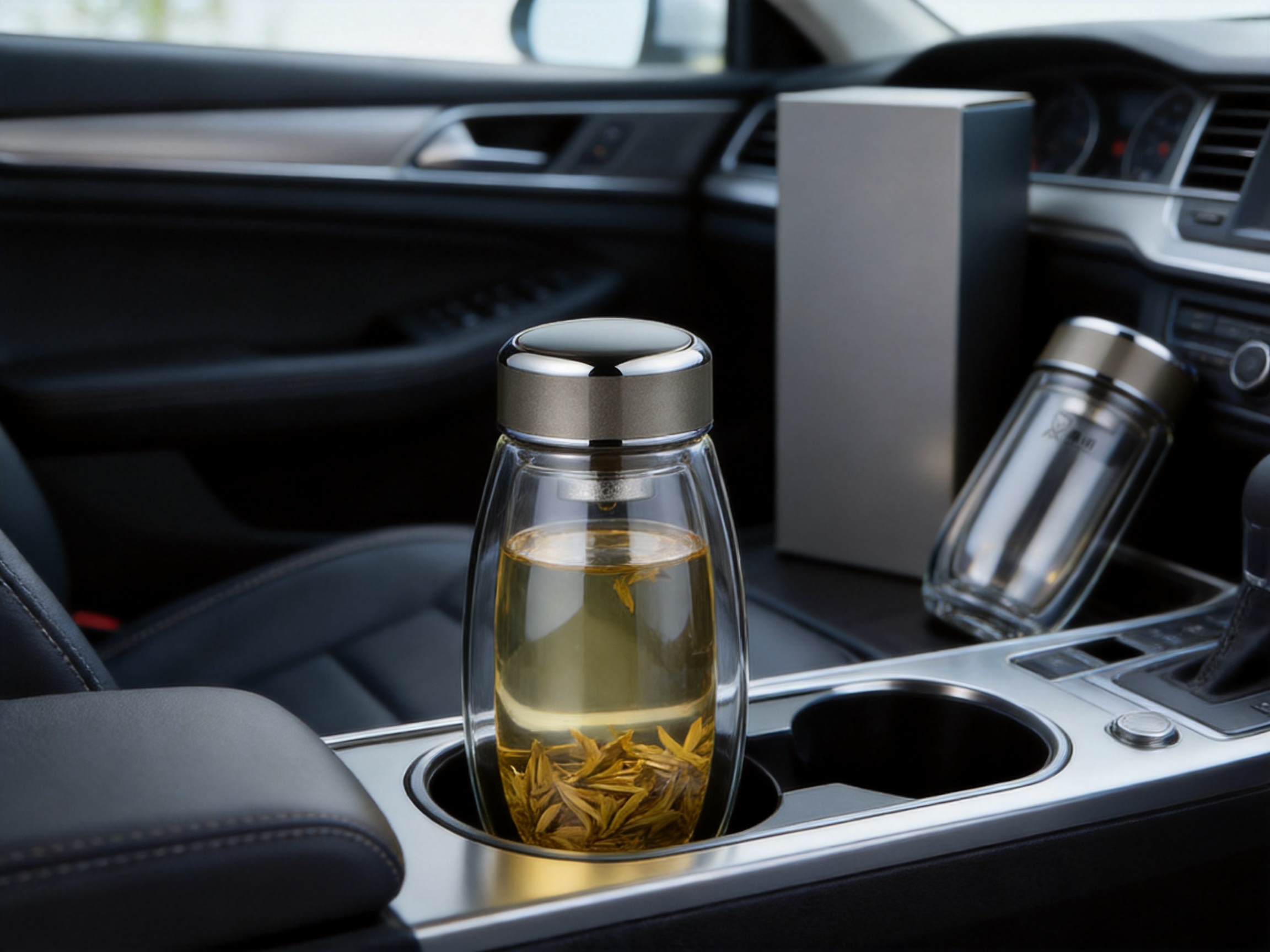
The product is specifically designed for in-car use. Its diameter is suitable for most car cup holders, making it more convenient than many large-format glass bottles. This is a practical advantage because vehicle interiors often have limited storage space and cup holders with standardized but varying dimensions.
A car-friendly bottle must satisfy several requirements at once. It should be narrow enough to enter a cup holder, stable enough to resist tipping during normal driving, short enough to remain accessible, and easy to open without creating an awkward reach. The compact capacities of 210 ml, 250 ml, and 280 ml allow the product to remain portable while offering meaningful beverage volume.
The compact format also supports commuting. It can be carried from a vehicle to an office, placed beside a computer, or stored in a work bag when appropriate protection is used. Unlike a large sports bottle, it does not dominate a desk or occupy excessive space in a vehicle console.
The curved exterior contributes to handling during movement. A comfortable grip reduces the likelihood that the bottle will slip during entry or removal from a cup holder. The stable base helps maintain balance when the bottle is placed on a flat surface after use.
Because the cup is made of glass, users should still handle it with reasonable care. A car-friendly design does not mean the product is impact-proof. Buyers seeking a glass drinking experience should understand that glass requires more careful handling than flexible plastic or certain metal constructions. The product’s value lies in its balance of transparency, material quality, compact dimensions, and refined design rather than in impact resistance alone.
7. Comparison with Conventional Drinkware
7.1 Comparison with Ordinary Glass Bottles
Ordinary glass bottles provide visual clarity and a neutral drinking surface, but they may not include specialized features such as a titanium filter, a high-temperature silver ion mist coating, or a car-oriented compact form. Many standard glass bottles also use basic plastic lids that are functional but do not offer the same premium material positioning.
The Double-Layer Antibacterial Goose Egg Glass adds a more deliberate material hierarchy. High-borosilicate glass forms the body, pure titanium is used in key water-contact components, and silicone is applied where flexibility and sealing are needed. This coordinated construction gives the product a stronger technical story than a simple glass container.
7.2 Comparison with Stainless Steel Drinkware
Stainless steel is popular because it is strong, reusable, and suitable for insulated products. However, stainless steel drinkware is opaque, which prevents users from observing the beverage. It can also create a different sensory experience for people who prefer drinking from glass.
The glass body of this product allows full visibility of the beverage, while titanium components provide a premium metal alternative for the lid and filter. The product is not intended to replace every stainless steel bottle. Instead, it serves customers who prioritize transparency, tea visibility, compact mobility, and a refined glass-and-titanium material combination.
Another difference is thermal function. The product description emphasizes high-borosilicate glass and resistance to sudden temperature changes, not vacuum insulation. Buyers who need long-duration hot or cold retention should select a purpose-built insulated vessel. Buyers who value visibility and a direct connection with the beverage may find this product more suitable.
7.3 Comparison with Plastic Bottles
Plastic bottles are often lightweight, flexible, and inexpensive. They are convenient for sports and high-impact environments, but some users are concerned about odor retention, flavor carryover, surface wear, or the long-term appearance of plastic. The glass body of this product offers a clear, premium alternative with a more neutral sensory profile.
The trade-off is that glass is heavier and more fragile than many plastic materials. The listed product weights range from approximately 0.38 kg to 0.42 kg, reflecting the use of a substantial glass body and metal components. This weight can communicate quality, but it should be considered when selecting the product for children, high-impact outdoor activities, or situations where weight reduction is the primary goal.
7.4 Comparison with Basic Travel Cups
Basic travel cups often focus on volume and simple portability. They may be designed for coffee, water, or general beverage use, but they do not necessarily include a filter screen or transparent body. The Double-Layer Antibacterial Goose Egg Glass is particularly relevant to tea drinkers and users who want to monitor the drink visually.
The combination of a filter, rounded drinking mouth, titanium water-contact parts, and silver ion mist coating provides multiple product features that can be communicated together. Rather than competing solely on capacity, the product competes through material differentiation, usability, and specialized design details.
8. Manufacturing Integration and Product Development Strength
The product’s performance depends on coordinated manufacturing. Glass forming, titanium component production, silicone molding, surface treatment, lid assembly, and packaging must be managed as one product system. Heenoor Co., Ltd. describes its manufacturing operation as integrating product design, engineering validation, tooling development, standardized production, and quality management.
Product design is the first stage of this process. Designers must translate user requirements into measurable features. For this cup, those requirements include car-compatible dimensions, a comfortable curved profile, a rounded mouth, a stable base, a suitable filter opening, and a lid that can support a reliable seal. The design must also account for the different behavior of glass, titanium, PP, and silicone.
Engineering validation follows design development. Validation helps determine whether the proposed structure can be manufactured consistently and whether it can meet intended functional requirements. Areas for evaluation may include dimensional fit, lid engagement, sealing performance, filter alignment, resistance to temperature changes, surface appearance, and compatibility between components.
Tooling development is particularly important when a product has a curved body and multiple fitted parts. Tooling influences repeatability, surface quality, dimensional accuracy, and production efficiency. Properly developed tooling supports standardized results across production runs and helps reduce variation between individual units.
Standardized production converts an approved design into a repeatable manufacturing program. Standardization can include documented material specifications, controlled processing conditions, defined assembly sequences, inspection points, and packaging requirements. These controls are essential for buyers who need predictable quality across large-volume orders.
Quality management connects each stage. It is more effective to identify potential problems during design and engineering than to rely only on final inspection. For a multi-material product, quality management should address the glass body, coating condition, titanium parts, silicone rings, PP components, assembly fit, appearance, and packaging protection.
Heenoor’s experience across stainless steel, titanium, plastic, and glass drinkware provides a broad manufacturing base. This is valuable for customers developing product families rather than a single item. A buyer may require glass bottles for premium collections, stainless steel products for insulation, titanium products for lightweight performance, and plastic items for economical programs. A supplier familiar with several material systems can help coordinate development and production across these categories.
9. Material Coordination in the Production Process
One of the most important manufacturing strengths of this product is the coordination of dissimilar materials. Glass, titanium, PP, and silicone each respond differently to heat, pressure, moisture, and mechanical loading. The product must be designed so these materials complement one another rather than create stress points.
High-borosilicate glass offers clarity and thermal stability, but it remains a brittle material. The edges and contact points require careful finishing. The rounded mouth improves user comfort, while the protective filter ring helps limit direct metal-to-glass contact. These details reduce avoidable wear during normal assembly and use.
Titanium provides corrosion resistance and chemical stability, but it is a rigid material that must be dimensioned accurately when fitted to glass and silicone. The filter must sit securely without creating excessive pressure against the inner wall. The lid’s titanium water-contact surface must also align with the sealing structure so that the user receives both premium material contact and practical closure performance.
PP offers useful forming and structural characteristics in the lid assembly. It can support the overall closure architecture while allowing the titanium component to be applied where water contact and premium positioning matter most. Silicone supplies flexibility, sealing, cushioning, and heat resistance. The successful product is therefore not simply “made of titanium” or “made of glass”; it is the result of thoughtful material allocation.
Material coordination also affects cleaning. Surfaces that contact beverages should be accessible enough to rinse, and removable or exposed filter areas should not create unnecessary residue traps. The filter’s protective ring and heat-resistant silicone should remain properly seated during washing and reassembly.
10. Quality Considerations for Commercial Buyers
Commercial buyers evaluating this product should examine more than the appearance of a sample. A complete purchasing assessment may include material documentation, dimensional drawings, sealing tests, thermal shock evaluation, coating performance information, packaging specifications, and production consistency.
For the glass body, buyers may request confirmation of the high-borosilicate glass specification and review the acceptance criteria for clarity, bubbles, inclusions, scratches, edge finishing, and dimensional tolerances. The exact inspection requirements should be agreed during product development and documented before mass production.
For titanium parts, buyers may review the material grade or purity specification, surface finish, dimensional accuracy, and resistance to corrosion under intended use conditions. Because the filter is a functional component, its mesh or opening design should also be evaluated for the intended tea or beverage application.
For the silicone components, the focus may include elasticity, heat resistance, odor, color stability, fit, and long-term sealing behavior. The sealing ring should be inspected for flash, deformation, incomplete molding, and assembly displacement.
For the silver ion mist coating, commercial communication should be supported by appropriate test information. Buyers may need details regarding the coating process, surface adhesion, durability after cleaning, and the test standard used to evaluate antibacterial performance. This information allows retailers and distributors to communicate responsibly with end users.
Packaging deserves attention because glass products must be protected during storage and transportation. The supplied gift box should be evaluated for internal support, cushioning, closure security, labeling, and resistance to handling. A premium product can lose much of its perceived value if the packaging allows scratching, movement, or breakage during shipping.
11. Product Applications
11.1 Automotive and Commuting Use
The compact diameter and moderate capacities make the product suitable for vehicle cup holders and short-to-medium commutes. It can be used by drivers, passengers, sales representatives, consultants, and business travelers who want a refined drinking vessel that can move between the car and office.
The transparent body is convenient while traveling because users can quickly see whether the cup contains water, tea, or another beverage. The filter makes it possible to prepare tea without carrying a separate strainer. The leak-resistant lid is useful when the cup is moved between upright and horizontal positions, provided it is closed correctly.
11.2 Office and Desk Use
At the office, the product provides a compact alternative to large bottles and disposable cups. Its stable base and clear body make it suitable for desks, meeting rooms, reception areas, and executive offices. The gift box also supports corporate procurement programs, especially when a company wants to provide a practical item with a premium appearance.
11.3 Tea Drinking
The filter screen and visible glass body make this product especially relevant to tea drinkers. Users can observe the infusion process and remove or retain tea leaves according to preference. The rounded mouth supports direct drinking, while the titanium and heat-resistant silicone components are designed for contact with hot beverages under appropriate use conditions.
11.4 Outdoor and Travel Situations
The product can support light outdoor use, hotel stays, business travel, and short excursions. Its compact form is easier to pack than a large glass pitcher or oversized bottle. However, because it is glass, users should place it in a protected compartment and avoid situations involving high impact or uncontrolled drops.
11.5 Gifting and Promotional Programs
The combination of gift-box packaging, premium material selection, and distinctive body design creates opportunities for gifting. It may be suitable for business partners, hospitality programs, employee appreciation, conference gifts, premium retail sets, and seasonal promotions.
12. Care and Use Recommendations
Proper care helps preserve the appearance and function of the product. Before first use, the cup, lid, filter, and sealing ring should be washed according to the purchaser’s cleaning instructions. Residue from packaging or manufacturing should be removed before filling the cup with a beverage.
Users should inspect the glass body before each use. If a crack, chip, or significant scratch is found, the product should not be used for hot or cold beverages. Glass damage can become more serious when the cup is exposed to pressure or temperature changes.
The lid should be tightened evenly and checked for correct seating. The silicone sealing ring should remain in its intended groove and should not be twisted or folded. If the ring becomes permanently deformed, torn, or excessively worn, it should be replaced through an appropriate supply channel.
The filter should be rinsed after use, particularly when tea leaves or fine beverage particles have been retained. Residue should not be allowed to dry inside the filter openings. The protective silicone ring should also be checked to ensure that it remains attached and continues to protect the glass wall.
Although high-borosilicate glass offers improved resistance to sudden temperature changes, users should avoid extreme thermal shock. Do not pour boiling liquid into a very cold cup or expose a hot cup immediately to ice water. Gradual temperature transitions are safer for all glass drinkware.
Cleaning methods should follow the supplier’s instructions. Mild detergent and a soft cleaning tool are generally preferable to abrasive pads that can damage surfaces or create visible wear. The lid should be disassembled only as far as necessary for thorough cleaning, and all components should be dried before reassembly.
13. Sustainability and Long-Term Value
Reusable drinkware supports the reduction of dependence on single-use beverage containers. A durable product that remains attractive and functional over a long service life can provide greater value than disposable alternatives. The Double-Layer Antibacterial Goose Egg Glass is designed for repeated use in daily routines, commuting, office environments, and travel.
Material durability contributes to product longevity. High-borosilicate glass provides a stable body material, titanium components resist corrosion, and silicone sealing parts can be replaced or maintained when appropriate. Long-term value depends not only on initial purchase price but also on how consistently the product performs over time.
The transparent design may also encourage users to maintain the cup because residue and beverage color are visible. A bottle that can be inspected easily is often easier to clean properly than one with a completely hidden interior.
Responsible sustainability communication should remain factual. The environmental benefit of reusable drinkware depends on repeated use, proper care, transportation, packaging, and eventual disposal. Buyers should consider the full product life cycle and should avoid treating one material feature as a complete environmental solution.
14. Why Manufacturing Capability Matters to Product Performance
A product specification is only valuable when the manufacturing process can deliver it consistently. The stated combination of high-borosilicate glass, pure titanium, silicone, PP, and silver ion mist coating creates a higher level of production coordination than a simple single-material bottle.
Manufacturing experience helps reduce the gap between a design concept and a reliable finished product. A company with capabilities in product development, tooling, standardized production, and quality management can evaluate whether a feature is attractive not only in a drawing but also in repeated production. This perspective helps identify problems such as difficult assembly, unstable tolerances, poor sealing, coating inconsistency, or packaging damage before they affect large orders.
Heenoor’s long-term involvement in stainless steel, titanium, plastic, and glass drinkware allows it to approach the product from a cross-material perspective. This can be useful when a customer requests modifications to the body, lid, filter, color, packaging, or capacity. The supplier’s role is not limited to producing a finished sample; it can support the broader process of turning a drinkware concept into a manufacturable product program.
For international buyers, dependable communication and project support are also important. Technical clarity helps both parties align on dimensions, materials, tolerances, packaging, inspection criteria, and delivery expectations. Manufacturing discipline supports repeat orders, while continuous improvement can help refine product performance over time.
15. Customization and Procurement Potential
The product can serve as a foundation for customized drinkware programs. Depending on the project, buyers may discuss packaging design, gift-box presentation, labeling, color coordination, product inserts, capacity selection, and other commercial details. Any customization should be reviewed against the product’s material structure and production requirements.
Capacity selection is one of the simplest ways to tailor the product to a target market. The 210 ml version may suit compact luxury gift sets or vehicle-focused programs. The 250 ml version can serve as a general-purpose option. The 280 ml version provides a slightly larger serving while retaining a compact footprint.
Packaging customization may be important for corporate buyers. The gift box can support brand presentation, event themes, executive gifting, or retail positioning. Packaging development should include internal protection because the visual quality of the product and the safety of the glass body must be preserved throughout transportation.
For larger drinkware programs, buyers may also compare this glass product with other material categories supplied by the same manufacturer. Stainless steel may be selected for insulated products, titanium for lightweight premium applications, plastic for cost-sensitive programs, and glass for transparency-oriented collections. This multi-material capability can simplify supplier management for companies building a broader drinkware portfolio.
16. Technical Summary
Feature |
Product Specification or Design Intent |
Commercial Benefit |
Cup body |
High-borosilicate glass |
Clarity, visual beverage inspection, and improved resistance to sudden temperature changes |
Inner wall |
Silver ion mist coating fixed at high temperature |
Additional antibacterial-oriented surface feature |
Lid |
Pure titanium plus PP |
Premium material positioning and practical structural support |
Filter |
Pure titanium plus heat-resistant silicone rubber |
Tea filtration, corrosion resistance, and high-temperature form stability |
Sealing ring |
Silicone |
Supports leak resistance when correctly installed |
Body shape |
Curved goose-egg profile |
Comfortable grip, distinctive appearance, and stable placement |
Capacities |
210 ml, 250 ml, and 280 ml |
Choice of compact sizes for cars, offices, commuting, and gifting |
Packaging |
Gift box |
Suitable for retail presentation, business travel, and corporate gifts |
17. Frequently Asked Questions
Q1: What is the main purpose of the Double-Layer Antibacterial Goose Egg Glass?
The product is designed as a compact glass water bottle for water, tea, commuting, office use, car travel, outdoor use, and gifting. Its key features include high-borosilicate glass, titanium water-contact components, a filter, a silicone sealing ring, and a silver ion mist coating on the inner glass wall.
Q2: Why is high-borosilicate glass used for the cup body?
High-borosilicate glass is valued for its clarity and improved resistance to sudden temperature changes compared with many ordinary glass formulations. It also allows users to observe tea color, beverage clarity, and remaining volume.
Q3: What components are made of pure titanium?
The water-contact surface of the lid and the filter screen are made of pure titanium according to the product information. Titanium is selected for its biocompatibility, corrosion resistance, and chemical stability.
Q4: Is the product suitable for tea?
Yes. The product includes a titanium filter screen with heat-resistant silicone. The transparent glass body allows users to observe the tea color and infusion process. Users should follow appropriate temperature and cleaning practices.
Q5: Does the silver ion mist coating eliminate the need for cleaning?
No. The coating is an additional antibacterial-oriented feature and does not replace regular washing, rinsing, drying, or safe beverage handling. Cleaning remains necessary after each use.
Q6: Is the cup leakproof?
The lid uses a silicone sealing ring intended to prevent leakage when the cup is inverted, provided the lid is correctly installed and fully closed. Actual performance depends on correct assembly, clean sealing surfaces, and the condition of the sealing ring.
Q7: Can the cup be used in a car?
Yes. The product’s diameter is designed to suit most car cup holders. Its compact capacities and curved body support vehicle use, commuting, and movement between a car and an office.
Q8: What capacities are available?
The available capacities are 210 ml, 250 ml, and 280 ml. The corresponding models are XN-1915, XN-1916, and XN-1917.
Q9: How much does each version weigh?
The listed weights are approximately 0.38 kg for the 210 ml version, 0.41 kg for the 250 ml version, and 0.42 kg for the 280 ml version.
Q10: Is the product insulated like a vacuum flask?
The product information emphasizes high-borosilicate glass and resistance to sudden temperature changes. It is not described as a vacuum-insulated flask. Buyers requiring extended hot or cold retention should confirm the intended thermal performance before purchase.
Q11: Is the product suitable for outdoor activities?
It is suitable for light outdoor use, travel, and commuting, but it remains a glass product and should be protected from drops and strong impact. It is not intended to be treated as an impact-resistant sports bottle.
Q12: What makes the product different from a normal glass cup?
The product combines several specialized features: a compact car-friendly shape, high-borosilicate glass, a silver ion mist coating, pure titanium lid and filter components, a heat-resistant silicone filter ring, a leak-resistant silicone lid seal, and gift-box packaging.
Q13: What manufacturing capabilities support this product?
The manufacturer integrates product design, engineering validation, tooling development, standardized production, and quality management. It also has experience with stainless steel, titanium, plastic, and glass drinkware.
Q14: Can commercial buyers request customized programs?
Commercial buyers can discuss project requirements such as capacity selection, packaging, presentation, labeling, and other development details with the manufacturer. Customization should be evaluated against material compatibility, tooling, quality requirements, and order volume.
Q15: What should buyers verify before placing a large order?
Buyers should confirm material specifications, dimensions, coating documentation, sealing performance, filter design, thermal-use guidance, inspection standards, packaging protection, production capacity, and quality-control procedures. These details help ensure that the delivered product matches the intended market requirements.
18. Conclusion
The Double-Layer Antibacterial Goose Egg Glass occupies a distinctive position between ordinary glass bottles, stainless steel travel drinkware, plastic containers, and basic tea cups. Its design focuses on a coordinated set of benefits rather than a single feature. High-borosilicate glass provides transparency and a refined drinking experience. Pure titanium is used in important water-contact components. The silver ion mist coating adds a hygiene-oriented surface treatment. The filter supports tea preparation, while heat-resistant silicone protects the glass and supports reliable component fit.
The product’s compact capacities and car-friendly diameter make it relevant to commuting, vehicle use, office routines, travel, and light outdoor activities. Its curved body, rounded mouth, stable base, and gift-box packaging add practical and commercial value. At the same time, the product retains the handling requirements associated with glass and should be used, cleaned, and transported with care.
Its broader strength comes from the manufacturing system behind the design. Product development, engineering validation, tooling, standardized production, and quality management are essential to producing a multi-material drinkware item with consistent performance. Heenoor Co., Ltd.’s experience across glass, titanium, stainless steel, and plastic drinkware provides a foundation for customers seeking a dependable manufacturing partner for both individual products and wider drinkware programs.
For buyers seeking a premium, transparent, tea-friendly, car-compatible bottle with titanium contact components and an antibacterial-oriented inner surface, this product offers a well-defined combination of aesthetics, functionality, and material differentiation.
References
1. Product specification for the Double-Layer Antibacterial Goose Egg Glass, including models XN-1915, XN-1916, and XN-1917.
2. Technical information supplied for the high-borosilicate glass body, pure titanium lid contact surface, titanium filter screen, PP lid structure, and heat-resistant silicone components.
3. General technical literature concerning high-borosilicate glass and its resistance to thermal expansion and sudden temperature changes.
4. General materials references concerning titanium corrosion resistance, biocompatibility, and chemical stability in consumer applications.
5. General research references concerning silver ion surface treatments and antibacterial mechanisms.
6. Manufacturing capability information concerning product design, engineering validation, tooling development, standardized production, and quality management.
7. General drinkware design principles concerning sealing systems, silicone gasket performance, glass finishing, filter protection, and reusable product care.
Product: Double-Layer Antibacterial Goose Egg Glass

You may also like…

Copyright © 2025 Heenoor Co., Ltd. All Rights Reserved.
 Custom Stainless Steel Drinkware Manufacturers
BACK TOP