 English
 中文简体
中文简体 日本語
日本語 Español
 عربى
عربى
Search
Categories
Recommend
Categories
 Lin Yuxi — International Product Sales Manager
Recommend
-
 Industry news
 -
 Industry news
 -
 Industry news
 -
 Industry news
Aug 27, 2026 - By admin
Why Dual-Drink Vacuum Tumblers Are Shaping the Next Generation of Everyday Drinkware
Content
- 1 Product Overview and Core Specifications
- 2 Vacuum Insulation and Temperature Management
- 3 Stainless Steel Selection and Food-Contact Considerations
- 4 Dual-Drink Lid for Different Drinking Habits
- 5 Removable Tea Strainer and Beverage Flexibility
- 6 Ergonomic Design and Everyday Portability
- 7 Use Cases Across Different Environments
- 8 Advantages Over Conventional Competitor Designs
- 9 Manufacturing Integration as a Competitive Strength
- 10 Advanced Product Development Workflow
- 11 Metal Body Production and Vacuum Technology
- 12 Plastic Lid Molding and Component Assembly
- 13 Quality Control for Reliable Drinkware Programs
- 14 Customization and B2B Application Potential
- 15 Responsible Design and Product Lifecycle Value
- 16 Care and Maintenance Considerations
- 17 Why Supplier Capability Matters to Buyers
- 18 Frequently Asked Questions
- 18.1 What is the capacity of the dual-drink tumbler?
- 18.2 What material is used for the inner liner?
- 18.3 Can the tumbler hold both hot and cold drinks?
- 18.4 What makes the lid different from a standard tumbler lid?
- 18.5 Does the product include a tea strainer?
- 18.6 Is the tumbler designed to resist leakage?
- 18.7 Why is 316L stainless steel suitable for drinkware?
- 18.8 Can the tumbler be used for tea and acidic drinks?
- 18.9 Is the product suitable for office and meeting environments?
- 18.10 Is the product suitable for long-distance hiking?
- 18.11 What color is available?
- 18.12 Is the tumbler available for customization?
- 18.13 What manufacturing capabilities support this product?
- 18.14 Why should buyers evaluate manufacturing processes when selecting a tumbler?
- 19 Conclusion
- 20 References
- 21 Product: HEENOOR Xinyao Series Dual-drink Coffee Tumbler
Modern drinkware has moved well beyond the simple task of holding water, tea, or coffee. Consumers now expect a bottle or tumbler to preserve temperature, prevent leaks, support different drinking habits, remain comfortable in the hand, and fit naturally into commuting, office, travel, study, and outdoor routines. At the same time, buyers increasingly pay attention to material safety, cleanability, durability, appearance, and the environmental value of using a reusable product.
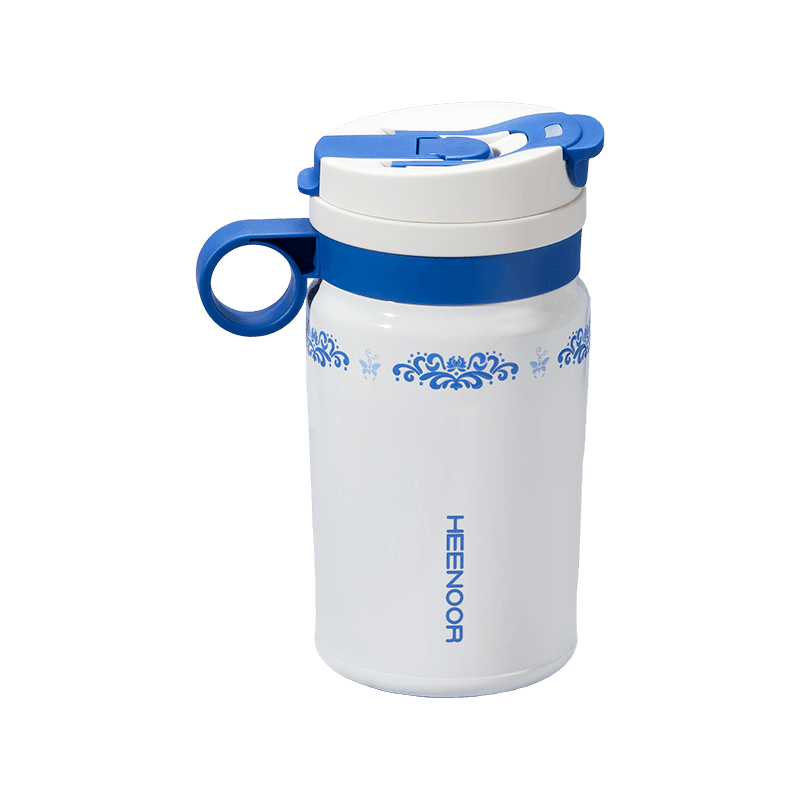
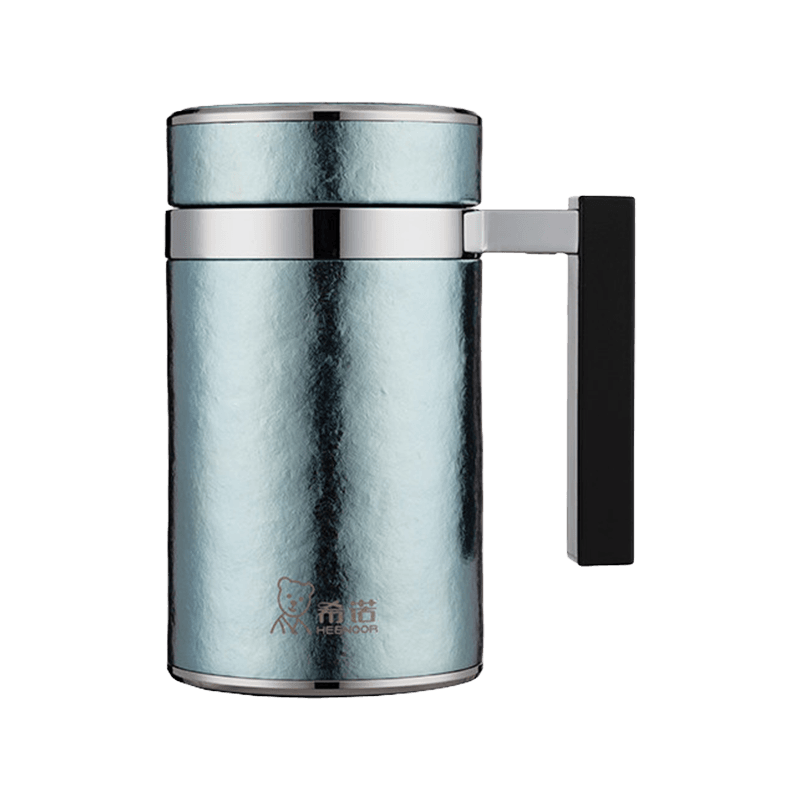
The HEENOOR Xinyao Series Dual-drink Coffee Tumbler responds to these expectations through a compact design that combines vacuum insulation, a dual-drink lid, a removable tea strainer, a non-slip handle, and a food-contact stainless steel inner liner. With a 380-milliliter capacity and an Ivy Green, also described as Vine Green, finish, the tumbler is designed for users who want a practical drinkware product with a refined appearance.
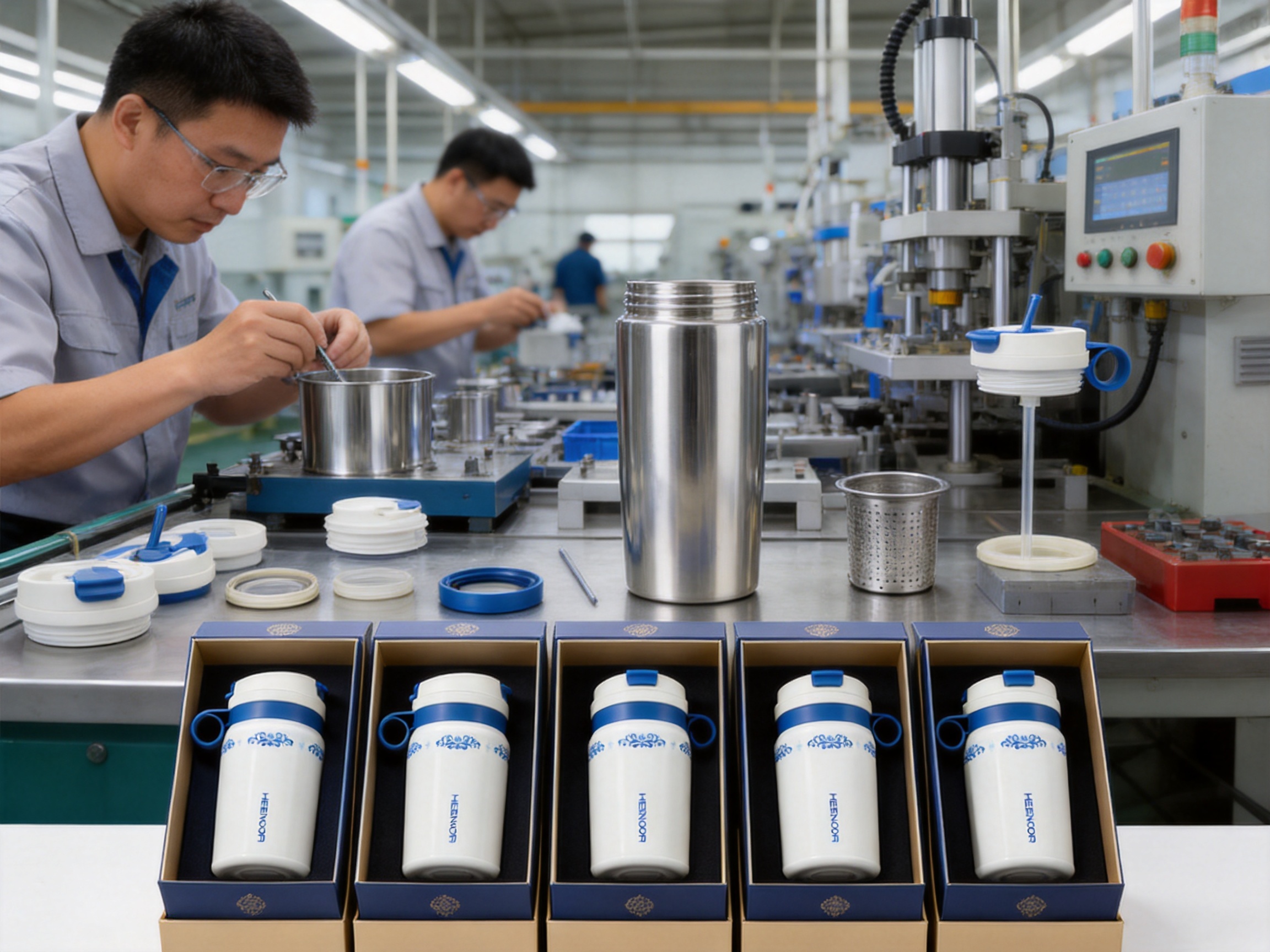
More importantly, the product reflects the capabilities of its manufacturer, Heenoor Co., Ltd., a drinkware company established in 1999. The company combines design development, engineering validation, tooling development, standardized production, and quality management. These capabilities are important because the performance of a vacuum tumbler depends not only on its appearance but also on the accuracy of forming, welding, assembly, sealing, inspection, and process control.
This article examines the product’s construction, user benefits, competitive advantages, manufacturing considerations, customization potential, and suitability for professional procurement. It also explains why integrated manufacturing experience can make a meaningful difference when brands and organizations are selecting a stainless steel drinkware supplier.
Product Overview and Core Specifications
The Xinyao Series Dual-drink Coffee Tumbler is a compact stainless steel vacuum flask designed for hot and cold beverages. Its model number is XN-806Y-1, and its stated capacity is 380 milliliters. The inner liner uses 316L stainless steel, while the product description also identifies a combination of 304 stainless steel and 316L stainless steel in the inner construction. The outer lid is made from polypropylene, commonly known as PP.
The key product characteristics include a vacuum insulation layer, a sealing ring integrated into the lid, two drinking openings, a removable tea strainer, a handle, a lightweight format, and a gift-box presentation. These features work together rather than operating as isolated selling points. The dual-drink lid is useful because it changes how the user drinks; the strainer improves beverage flexibility; the handle supports portability; and the vacuum structure helps maintain a more stable beverage temperature.
| Specification | Product Information |
|---|---|
| Product name | Xinyao Series Dual-drink Coffee Tumbler |
| Model number | XN-806Y-1 |
| Product category | Stainless steel vacuum flask |
| Capacity | 380 milliliters |
| Inner liner material | 316L stainless steel |
| Additional material description | 304 stainless steel combined with 316L stainless steel |
| Lid material | PP |
| Color | Ivy Green or Vine Green |
| Insulation performance | Hot and cold retention for up to six hours, subject to use conditions |
| Primary drinking functions | Direct opening and straw opening |
| Additional component | Removable tea strainer |
The 380-milliliter size occupies a useful middle ground. It is large enough for coffee, tea, flavored water, or a moderate cold beverage, but compact enough for a work bag, backpack, vehicle cup area, or dormitory desk. Compared with larger bottles designed for all-day hydration, this format is more focused on controlled portions and frequent refilling. Compared with small espresso-oriented cups, it provides greater versatility for tea leaves, fruit pieces, cold drinks, and ordinary water.
The product is not positioned as a specialized sports bottle or a high-capacity outdoor flask. Its strongest identity is that of a versatile personal tumbler for everyday mobility. This focused positioning helps it compete effectively in a market where many products offer either basic insulation or a complicated collection of features, but fewer products combine compactness with two distinct drinking modes and a removable strainer.
Vacuum Insulation and Temperature Management
The central performance feature of the tumbler is its vacuum insulation structure. A vacuum layer reduces the movement of heat by limiting the air available for convection. It also helps reduce conductive heat transfer between the inner vessel and the external shell. As a result, hot beverages can remain warm for an extended period, while cold beverages can stay cooler than they would in a single-wall container.
The product materials state that the tumbler supports hot and cold retention for up to six hours. Actual results can vary according to beverage starting temperature, ambient temperature, opening frequency, beverage volume, lid position, and cleaning or usage conditions. Nevertheless, a six-hour retention target is well aligned with common daily routines. A user can prepare tea before commuting, fill the tumbler before beginning a work shift, or carry a chilled drink during an afternoon outing without relying on immediate consumption.
Temperature retention provides more than convenience. It can improve the drinking experience by reducing the need to reheat coffee or add ice repeatedly. For tea drinkers, stable temperature helps preserve the intended character of the beverage. For cold drinks, insulation can reduce condensation on the outside surface, helping protect documents, electronic devices, furniture, and bags from moisture.
The vacuum structure also supports a more comfortable external surface. A well-designed insulated vessel should help prevent the outer wall from becoming excessively hot when filled with a hot drink. Similarly, it should reduce the damp, wet feeling that often occurs with non-insulated containers holding iced beverages. This comfort is especially important when a product is designed for one-handed carrying and frequent handling.
Compared with ordinary plastic cups, single-wall metal bottles, and basic glass containers, the vacuum tumbler offers a more balanced temperature-management solution. Plastic may be lightweight but often provides limited long-term thermal control. Glass can offer a clean visual appearance but may be heavier or more vulnerable to breakage. Single-wall stainless steel is durable but generally transfers heat more quickly. The vacuum construction addresses these limitations while preserving the familiar advantages of stainless steel.
Stainless Steel Selection and Food-Contact Considerations
The product description identifies 316L stainless steel as the inner liner material and also refers to a combination of 304 and 316L stainless steel. Both grades are widely associated with stainless steel drinkware, but their roles and properties can differ according to the component and manufacturing design.
304 stainless steel is widely used in food-contact equipment, kitchenware, beverage containers, and industrial applications. It offers a practical balance of corrosion resistance, formability, durability, and cost. Its broad use makes it a common choice for stainless steel drinkware that must remain economical while delivering dependable everyday performance.
316L stainless steel contains molybdenum in addition to chromium and nickel. This composition can provide improved resistance to certain corrosive environments compared with 304 stainless steel. The “L” designation indicates low carbon content, which may be beneficial for welding-related corrosion resistance when appropriate manufacturing procedures are followed.
For a drinkware product intended for tea, coffee, fruit-infused water, or other beverages, corrosion resistance is an important consideration. Acidic ingredients, fruit pieces, tannins, salts, and repeated exposure to moisture can challenge poorly selected or poorly processed materials. A suitable stainless steel liner helps reduce the risk of surface deterioration and supports long-term usability.
The product description also states that the 316L inner layer does not retain flavors. This is a valuable advantage for users who alternate between tea, coffee, water, and flavored beverages. A material surface that is easier to clean and less likely to hold strong odors can make the tumbler more practical for varied daily use.
Material selection alone does not determine product safety or durability. The quality of the raw material, forming process, weld quality, surface finishing, cleaning, assembly, and inspection all matter. A premium stainless steel grade cannot compensate for poor manufacturing control. This is why an experienced manufacturer’s ability to manage the complete process is a critical purchasing consideration.
Dual-Drink Lid for Different Drinking Habits
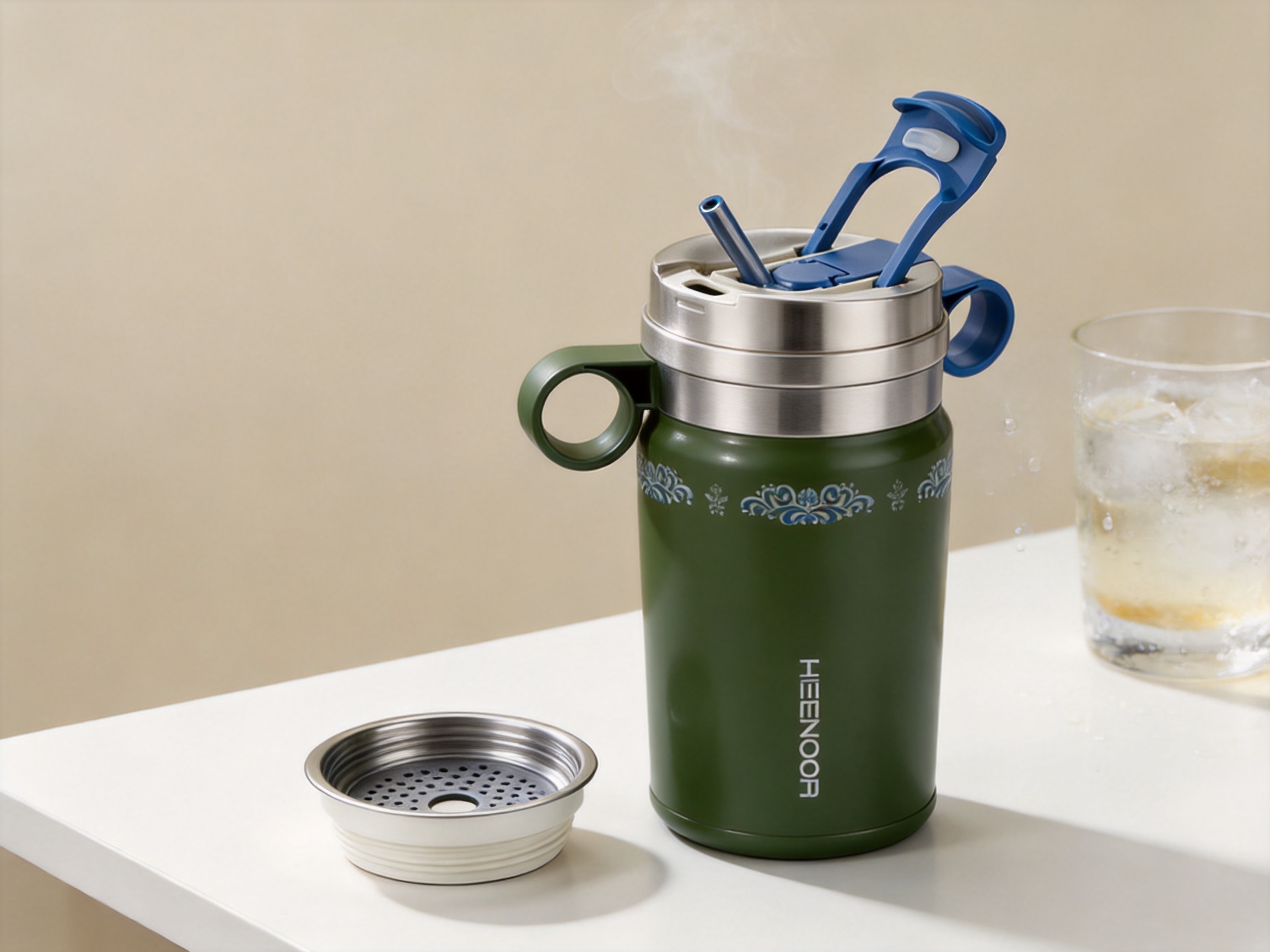
The defining design feature is the dual-drink lid. Instead of requiring the user to choose between a conventional opening and a straw-based opening during product selection, the lid provides both functions within one compact structure. The user can sip directly through the primary opening or drink more gently through the straw opening.
The direct opening is suitable for users who prefer the familiar experience of drinking from the vessel itself. It can be useful for tea, water, coffee, and other beverages that are best enjoyed with a broader flow. It may also be preferred when the user wants to drink quickly or when no straw is required.
The straw opening offers a different experience. It can support controlled sipping while driving, working, reading, studying, or attending a meeting. A straw opening may also be useful for users who prefer smaller sips or who want to reduce the need to tilt the tumbler repeatedly.
This two-mode design gives the tumbler an advantage over conventional bottles with only one drinking method. A standard screw-top bottle may require full removal of the cap. A simple straw tumbler may be less suitable for hot tea or direct drinking. A conventional travel mug may offer a sipping aperture but lack the flexibility of a separate straw route. The dual-drink lid brings these use cases together in a single product.
Versatility does not need to mean visual complexity. The value of the lid comes from making the user’s choice immediate and intuitive. In a commuting environment, the user can choose the drinking method that best suits the moment. At a desk, direct drinking may be convenient. During vehicle travel, a straw opening may allow more controlled consumption. During outdoor activity, the preferred mode can change according to movement and temperature.
The lid is also described as having a built-in sealing ring. This ring helps create a barrier between the lid and the bottle body, reducing the possibility of leakage when the tumbler is inverted. Leak resistance is essential for any drinkware product carried in bags or placed near electronic equipment. It also improves confidence when the tumbler is moved between locations during the day.
As with all reusable drinkware, users should ensure that the lid is properly closed, the sealing ring is correctly seated, and the product is used according to the manufacturer’s care guidance. A sealing system performs best when it is clean, undamaged, and correctly assembled.
HEENOOR Xinyao Series Dual-drink Coffee Tumbler
Removable Tea Strainer and Beverage Flexibility
The removable tea strainer extends the product beyond the conventional coffee tumbler category. It allows users to prepare loose-leaf tea, herbal infusions, fruit water, and beverages containing small pieces without allowing all of the ingredients to enter the drinking flow.
Tea preparation often creates a conflict between flavor and convenience. Loose leaves can provide a richer experience than many pre-portioned products, but they can also make a drink difficult to consume while commuting or working. A removable strainer helps separate the leaves from the finished beverage. Users can remove the strainer when the desired strength is reached or leave it in place for gradual infusion, depending on the beverage and personal preference.
The strainer can also support fruit-infused drinks. Lemon slices, berries, mint leaves, citrus peel, and other ingredients can add flavor to water, although users should follow suitable cleaning practices after using acidic or strongly flavored ingredients. The ability to remove the strainer makes it easier to rinse the component thoroughly and prepare the tumbler for the next beverage.
In competitive terms, this feature distinguishes the product from basic insulated bottles designed primarily for plain water. It also gives the tumbler broader appeal across consumer groups. Tea enthusiasts can use it as a portable tea vessel; coffee drinkers can use the main compartment without the strainer; and users who prefer fruit water can adapt the product to their daily routine.
Removability is important because fixed filters can complicate cleaning. A component that cannot be separated may trap leaves, pulp, or residue in narrow spaces. A removable strainer is easier to inspect and wash, which supports better hygiene and longer-term product satisfaction.
Ergonomic Design and Everyday Portability
A drinkware product can have excellent materials and insulation but still perform poorly if it is uncomfortable to carry. The Xinyao Series tumbler addresses portability through its lightweight 380-milliliter format and non-slip handle. The handle allows the user to pick up the product with one hand and move it between a desk, vehicle, kitchen, classroom, or outdoor location.
The handle is particularly useful for people who are already carrying a phone, bag, notebook, laptop, or other personal items. It can also provide an additional gripping point when the tumbler contains a hot beverage. A non-slip design may improve confidence during repeated handling, although users should always exercise care with hot drinks.
The compact capacity supports portability without making the tumbler feel oversized. Large bottles can be valuable for extended outdoor activity, but they may occupy more space and add considerable weight when filled. A 380-milliliter tumbler is better matched with short commutes, office use, study sessions, meetings, and daily errands.
The color selection contributes to the product’s universal positioning. Ivy Green or Vine Green offers a natural, calm, and contemporary appearance without being limited to a narrowly defined gender or age group. The color can fit professional settings while remaining suitable for personal use, gifting, and casual outdoor activities.
The smooth PP lid is described as easy to clean. PP is widely used in food-contact applications and can provide a practical combination of light weight, impact resistance, and moldability. Its use in the lid allows designers to create the dual-opening structure and integrate sealing features without adding excessive mass.
Ergonomics also involves how the product is opened, closed, cleaned, and stored. A good design should minimize unnecessary steps while keeping the drinking openings protected. The product’s dual-drink system, removable strainer, and sealing ring address these functional points in a compact format.
Use Cases Across Different Environments
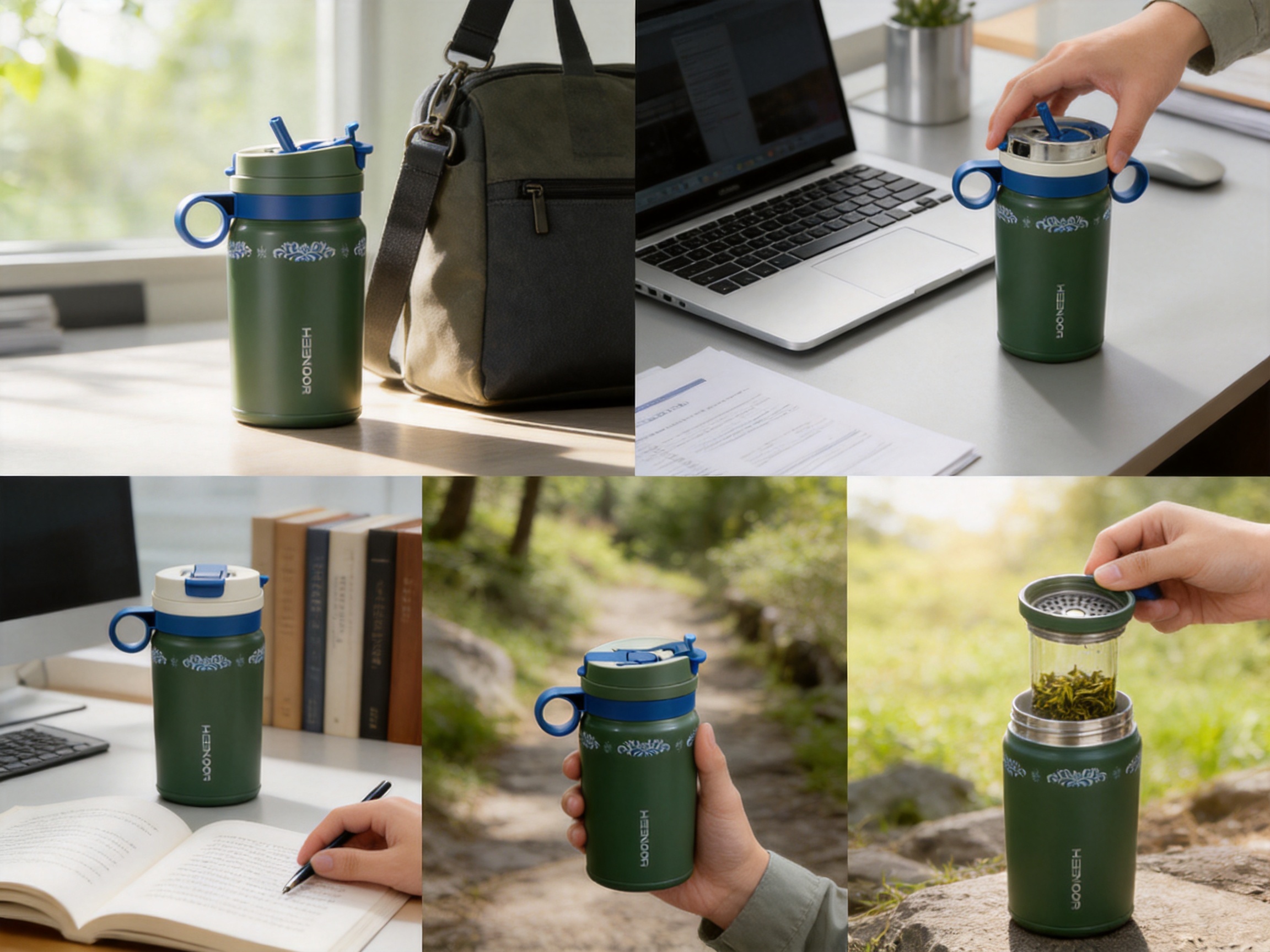
Commuting
During a commute, users often need a beverage container that is easy to carry, resistant to leakage, and simple to drink from. The handle supports quick pickup, while the sealing ring helps protect against accidental spills when the tumbler is properly closed. The straw opening may be useful when the user needs controlled sipping, while the direct opening provides a more traditional option when conditions are stable.
Office Work
In an office, temperature retention can help a drink remain enjoyable throughout a work period. The compact shape is suitable for desks with limited space, and the insulated body can reduce condensation around computers, documents, and stationery. The appearance is polished enough for professional environments, while the green finish adds a subtle design element.
Driving
A drinkware product used in a vehicle should support controlled handling and minimize distractions. The dual-drink lid can allow the user to choose a straw-based drinking method, although safe driving practices must always take priority. The handle may also make it easier to lift the tumbler from a nearby holder or storage position when the vehicle is stationary.
Study and Dormitory Use
Students often require products that combine limited-space storage with multiple functions. A 380-milliliter tumbler can fit on a study desk, bedside table, or shared kitchen area. The ability to prepare tea, coffee, water, or fruit-infused drinks makes it more versatile than a single-purpose cup. Gift-box packaging also makes it suitable for student gifts and practical welcome packages.
Outdoor Hiking and Leisure
The product is appropriate for light outdoor activities, short hikes, park visits, and casual travel where a compact insulated drink container is preferred. It is not intended to replace a high-capacity hydration reservoir for long-distance expeditions, but its manageable size, handle, and insulation make it useful for moderate outings.
Gifting
The gift-box presentation supports use as a personal gift for friends, colleagues, elders, students, or family members. Drinkware is a practical gift category because it can be used regularly rather than stored as a decorative object. The neutral green color and broad beverage compatibility help the product appeal to a wide range of recipients.
Advantages Over Conventional Competitor Designs
The reusable drinkware market includes many product types, and competition can come from multiple directions. The Xinyao Series tumbler’s advantage is not based on one isolated feature. Instead, it comes from the combination of several features in a compact, coherent design.
Compared with single-wall metal cups, the vacuum-insulated structure offers stronger support for temperature retention and greater protection against external heat transfer. Single-wall products may be less expensive, but they can become hot on the outside with hot drinks and may develop condensation with cold beverages.
Compared with ordinary plastic bottles, the stainless steel inner liner offers a more durable and premium construction. Stainless steel is less likely to absorb beverage odors than some plastic materials and can provide a more stable surface for repeated use. The 316L specification further supports a corrosion-resistant positioning for beverage applications.
Compared with glass bottles, the tumbler provides a more impact-tolerant format for commuting, outdoor use, and everyday portability. Glass can provide visual clarity and a neutral taste, but it may be heavier and more vulnerable to breakage. The stainless steel body offers a different balance of durability, insulation, and convenience.
Compared with standard screw-top bottles, the dual-drink lid reduces the need to remove the entire lid for every sip. This can make the experience more convenient in work, study, and travel settings. It also gives users a choice between direct drinking and straw-based sipping.
Compared with fixed-filter tea bottles, the removable strainer is easier to adapt and clean. Users can take it out when drinking plain water or coffee, then reinstall it for tea or fruit-infused beverages. This flexibility helps prevent the product from being limited to one beverage category.
Compared with large-capacity sports bottles, the 380-milliliter size is more portable and less imposing. It can be a better option for consumers who prioritize convenience, controlled portions, and daily carry rather than maximum hydration volume.
Compared with overly complicated multifunctional tumblers, the product maintains a relatively clear use logic. Its main features are directly related to drinking: temperature retention, two drinking openings, straining, sealing, and carrying. This functional focus can be attractive to buyers who want useful innovation without unnecessary accessories.
Manufacturing Integration as a Competitive Strength
Product performance is strongly influenced by the manufacturer’s ability to control the entire development and production chain. Heenoor Co., Ltd. was founded in 1999 and has developed experience in product development and industrial manufacturing. The company integrates product design, engineering validation, tooling development, standardized production, and quality management.
This integrated approach can benefit drinkware programs in several ways. First, design decisions can be reviewed from a manufacturing perspective before mass production begins. A feature that looks attractive in a concept drawing may create problems during forming, sealing, assembly, cleaning, or inspection. Early engineering review helps identify these issues before they become expensive production changes.
Second, in-house or closely coordinated tooling development can improve consistency between product design and production equipment. Drinkware components often require accurate forming dies, molds, fixtures, and assembly aids. The relationship between tooling accuracy and finished-product quality is especially important for lids, threads, sealing interfaces, handles, and nested metal components.
Third, standardized production helps reduce variation across large batches. Brands and procurement teams generally need repeatable dimensions, consistent surface appearance, reliable lid fit, and stable insulation performance. Standard operating procedures, documented process parameters, trained operators, and inspection checkpoints all contribute to batch consistency.
Fourth, quality management provides a structured method for identifying and correcting problems. A responsible system can include incoming material checks, in-process inspections, leak tests, appearance reviews, dimensional verification, assembly checks, and finished-product sampling. The exact testing program should be established according to the product specification, customer requirements, and applicable market regulations.
Heenoor’s experience with stainless steel, titanium, plastic, and glass drinkware provides a broad technical base. Different materials require different forming, joining, finishing, molding, and inspection methods. Experience across these categories can support more informed material selection and more practical product engineering.
For a brand developing a custom drinkware program, a manufacturing partner with these capabilities can reduce communication gaps. Instead of transferring a design between unrelated design, tooling, and production companies, the project can be managed through a more coordinated workflow. This can improve development efficiency and help maintain the original design intent during commercialization.
Advanced Product Development Workflow
Concept and Requirement Definition
A successful tumbler project begins with clearly defined requirements. These may include capacity, target market, beverage type, thermal performance, lid operation, color, packaging, dimensions, expected order volume, and regulatory expectations. The dual-drink concept must be translated into specific functional requirements, such as opening size, straw compatibility, closure behavior, cleaning access, and sealing performance.
Industrial Design
Industrial design establishes the product’s overall appearance, proportions, grip, visual identity, and interaction points. For the Xinyao Series tumbler, the green color, compact format, handle, and dual-opening lid contribute to an approachable and contemporary visual language. Good industrial design also considers how users will hold the product, open the lid, remove the strainer, and clean each part.
Engineering Validation
Engineering validation examines whether the design can meet its intended performance requirements. Relevant considerations include the wall structure, vacuum space, metal thickness, lid alignment, seal compression, handle strength, strainer fit, and resistance to repeated use. Prototype testing can reveal interference, leakage, uncomfortable edges, unstable components, or cleaning difficulties before tooling is finalized.
Tooling Development
Tooling development converts the approved design into repeatable production capability. Metal forming tools must support accurate body geometry, while plastic molds must produce consistent lid features and sealing interfaces. Fixtures may be needed to maintain alignment during assembly, welding, inspection, or testing.
Standardized Production
Once tooling and process parameters are established, standardized production helps ensure that each unit follows the same sequence. This may include stainless steel forming, component joining, surface treatment, cleaning, vacuum creation, lid molding, seal installation, final assembly, and inspection. The exact sequence depends on the product architecture and factory process design.
Quality Management
Quality management connects customer requirements with measurable production controls. A drinkware manufacturer should be able to identify critical characteristics, define inspection methods, record results, manage nonconforming units, and support corrective actions. This approach is more reliable than depending only on visual inspection at the end of the line.
Metal Body Production and Vacuum Technology
The stainless steel body of a vacuum tumbler typically requires careful forming and joining of inner and outer components. The inner liner must maintain the appropriate shape and surface condition for beverage contact, while the outer shell must provide structural protection and support the product’s visual finish.
Forming operations must balance dimensional accuracy with material integrity. Excessive deformation can create thinning, wrinkling, or stress concentration. Insufficient forming control can lead to inconsistent dimensions and assembly problems. Experienced production teams use suitable tooling, lubrication, forming parameters, and inspection methods to manage these risks.
Joining operations are also important. Welded areas must be stable and compatible with the intended vacuum structure. Poorly controlled joints can create leakage paths, surface defects, or reduced durability. Welding quality may be evaluated through visual inspection, dimensional checks, leak testing, and other methods appropriate to the product design.
After the metal components are joined, the vacuum layer must be created and maintained. The process requires suitable equipment and control because the insulation performance depends on the integrity of the vacuum space. A product that looks correct externally may still perform poorly if the vacuum structure is compromised. This is why vacuum-related inspection and thermal-performance verification are important parts of responsible drinkware manufacturing.
Surface treatment and cleaning are equally significant. The internal surface should be properly cleaned after manufacturing so that residues from forming, welding, polishing, or handling are removed. The outer surface must also meet the intended appearance standard, particularly when the product is sold as a premium or giftable item.
Plastic Lid Molding and Component Assembly
The PP lid is a technically important component because it combines several functions in a small area. It must accommodate the direct drinking opening, straw opening, sealing ring, closure mechanism, and potentially the interface with the removable strainer. Each feature must be molded with suitable accuracy to support smooth assembly and reliable use.
Plastic injection molding parameters can influence dimensions, surface quality, strength, and fit. Temperature, pressure, cooling, mold condition, and material handling all need to be managed according to the selected PP grade and product design. Inconsistent molding can result in warpage, flash, short shots, visible defects, or poor sealing performance.
Assembly requires careful attention to the installation of the sealing ring and other removable components. A seal that is twisted, stretched, contaminated, or incorrectly positioned may compromise leak resistance. Standardized assembly procedures and visual or functional checks can reduce these risks.
The interface between the lid and the stainless steel body must also be controlled. Threads, press-fit areas, snap features, or other connection structures need to align correctly. A good lid should close securely without requiring excessive force, while still maintaining the intended seal during normal handling.
The removable tea strainer introduces another assembly consideration. It must be secure enough to remain in position during use but easy enough to remove for cleaning. Dimensional control, material selection, and component testing can help achieve this balance.
Quality Control for Reliable Drinkware Programs
For procurement teams, quality control should be evaluated as a complete system rather than a single final inspection. A dependable supplier should demonstrate how materials, processes, components, and finished products are managed throughout production.
Incoming material control verifies that stainless steel, PP, sealing rings, packaging materials, and other components meet the approved specifications. Material identification and traceability can be especially useful for programs that require defined stainless steel grades or customer-specific documentation.
In-process inspection can monitor critical dimensions and assembly conditions before defects move to later stages. Examples may include body diameter, lid fit, opening alignment, handle attachment, strainer position, and sealing-ring placement. Early detection generally reduces rework and prevents large quantities of nonconforming products.
Leak testing is central to the performance of a portable tumbler. The test method should reflect the intended closure and usage conditions. Units may be checked in an upright position, inverted position, or under movement conditions, depending on the customer’s requirements. The product description specifically emphasizes leak prevention when inverted, making this a particularly relevant performance area.
Thermal testing can help confirm whether the vacuum structure meets the agreed retention target. Test conditions should be documented because results can vary according to ambient temperature, initial fill temperature, beverage volume, and measurement intervals. Clear test methods make supplier and customer expectations easier to align.
Appearance inspection is important for products sold through retail, gifting, hospitality, corporate promotion, and premium channels. Color consistency, surface finish, logo placement where applicable, lid appearance, edge quality, and packaging presentation can influence customer perception even when the product’s mechanical performance is sound.
Functional testing should cover the features that make the product distinctive. The two drinking openings should operate correctly, the strainer should be removable, the handle should remain stable, and the lid should close properly. A product with excellent insulation but a difficult or unreliable lid would not deliver the complete experience promised to the buyer.
Quality management should also include corrective-action procedures. When a problem is detected, the manufacturer should investigate the root cause, isolate affected products, implement corrective measures, and verify that the solution is effective. This continuous-improvement approach supports more reliable long-term supply.
Customization and B2B Application Potential
The product can serve as a base platform for brands, distributors, corporate buyers, promotional programs, hospitality organizations, and gift companies. Customization may involve color selection, surface decoration, packaging, product labeling, accessory configuration, or retail presentation, subject to engineering and production feasibility.
Color customization can help a buyer align the tumbler with a brand identity, seasonal campaign, corporate palette, or lifestyle collection. The existing Ivy Green or Vine Green version demonstrates how a natural color can create a calm, contemporary product identity. Other colors may be possible through suitable surface-finishing or coating processes.
Packaging customization is another important opportunity. The product is already described as being packaged in a gift box, which supports direct gifting and premium presentation. For business buyers, the box may be adapted for corporate events, employee recognition, client gifts, promotional campaigns, or retail shelves.
Logo application and surface decoration should be developed with attention to durability, visual positioning, and production repeatability. A manufacturer with integrated engineering and production capabilities can help determine whether a proposed graphic method is appropriate for the selected surface and expected usage conditions.
For high-volume programs, the manufacturer’s ability to support tooling, standardization, and quality management becomes especially valuable. Large orders require stable production schedules, consistent raw materials, clear approval samples, and reliable batch control. Heenoor’s stated focus on large-volume drinkware programs aligns with the needs of organizations seeking long-term supply rather than one-time sourcing.
Customization should not compromise core performance. Any change to the lid, body, coating, handle, or accessory should be reviewed for its effect on insulation, sealing, cleanability, durability, and regulatory compliance. A disciplined supplier can help customers balance appearance and functionality instead of treating them as separate objectives.
Responsible Design and Product Lifecycle Value
A reusable tumbler can support reduced dependence on disposable beverage cups and single-use plastic bottles when it is used consistently over an appropriate service life. The environmental value of a reusable product depends on repeated use, product durability, cleaning practices, material sourcing, transport, and end-of-life handling.
Stainless steel is often selected for reusable drinkware because it can provide a long service life when properly designed and maintained. The product’s corrosion-resistant inner liner, protective outer construction, and replaceable or removable components can contribute to continued usability. Long-term use is important because a reusable product delivers greater practical value when it remains functional for many beverage cycles.
Designing for cleaning also supports lifecycle value. The smooth PP lid, removable strainer, and accessible components can make routine maintenance easier. Users should wash the product according to the manufacturer’s instructions, pay attention to the sealing ring, and allow components to dry thoroughly before storage.
Responsible manufacturing also involves reducing avoidable waste through process control. Accurate tooling, standardized production, and quality management can reduce rejected components, rework, and material loss. A manufacturer that integrates product development and industrial production is better positioned to identify design changes that improve manufacturability and resource efficiency.
Care and Maintenance Considerations
Regular cleaning is necessary for any reusable drinkware product, especially when it is used for coffee, tea, milk-based drinks, fruit-infused water, or beverages containing sweeteners. Residue can accumulate in the lid, openings, strainer, or sealing ring if these areas are not cleaned thoroughly.
The removable tea strainer should be taken out and rinsed after use. Tea leaves, fruit pulp, and small particles should not be allowed to dry in the mesh or surrounding structures. The sealing ring should also be inspected periodically for residue, deformation, or damage.
The lid should be cleaned around both drinking openings. Narrow passages and interfaces can retain moisture, so components should be allowed to dry before the tumbler is closed for extended storage. Proper maintenance helps preserve taste neutrality and supports reliable sealing.
Users should also avoid treating a compact tumbler as a pressure vessel. Carbonated beverages, very hot liquids, or beverages that expand may require special care and should only be used if permitted by the product instructions. The lid should be opened carefully when the beverage is hot, and users should avoid placing the product where accidental opening could cause injury or damage.
Although the tumbler is designed for portability, it should not be subjected to unnecessary impact, crushing, or misuse. A damaged lid, body, or sealing ring may affect performance. Replacing a worn component, where replacement parts are available, can extend the practical life of the product.
Why Supplier Capability Matters to Buyers
When buyers compare drinkware suppliers, they often begin with price, minimum order quantity, and catalog selection. These factors are important, but they do not fully represent the total cost or risk of a product program. Supplier capability also includes communication, engineering support, material knowledge, production consistency, quality documentation, packaging coordination, and after-sales responsiveness.
A low initial price may become less attractive if a supplier cannot maintain color consistency, meet delivery schedules, control lid leakage, or repeat the approved sample. For products with multiple components and functional features, manufacturing discipline can have a direct effect on commercial success.
Heenoor’s long operating history and integrated approach offer a foundation for customers seeking a stable manufacturing relationship. The company’s stated experience with stainless steel, titanium, plastic, and glass drinkware allows it to support different product concepts and material strategies. Its focus on design, engineering validation, tooling, standardized production, and quality management is relevant to both catalog products and customized programs.
International buyers may also value clear technical communication. Product specifications should be documented in a way that enables accurate quotation, sample approval, production planning, inspection, and shipment. A manufacturer that understands these stages can help reduce misunderstandings between concept, sample, and final production.
For professional procurement, the ideal supplier is not merely a factory that can produce a vessel. It is a partner capable of translating a market requirement into a manufacturable, testable, repeatable, and commercially presentable product. The Xinyao Series tumbler demonstrates how product design and manufacturing capability can reinforce one another.
Frequently Asked Questions
What is the capacity of the dual-drink tumbler?
The stated capacity is 380 milliliters. This size is intended for compact daily use, including commuting, office work, studying, driving, short outdoor activities, and personal gifting.
What material is used for the inner liner?
The product information identifies a 316L stainless steel inner liner. The product description also refers to a combination of 304 stainless steel and 316L stainless steel in the inner construction.
Can the tumbler hold both hot and cold drinks?
Yes. The vacuum insulation structure is designed for both hot and cold beverages. The stated retention period is up to six hours, although actual performance depends on starting temperature, ambient conditions, fill volume, opening frequency, and other usage factors.
What makes the lid different from a standard tumbler lid?
The lid provides two drinking options. Users can drink directly through one opening or use the straw opening for controlled sipping. This allows the product to adapt to different settings and personal preferences.
Does the product include a tea strainer?
Yes. The design includes a removable tea strainer that can separate tea leaves or fruit pieces from the beverage. It can be removed for cleaning or when the user is drinking plain water, coffee, or another beverage that does not require filtering.
Is the tumbler designed to resist leakage?
The lid includes a built-in sealing ring intended to help prevent leakage when the tumbler is inverted. For best performance, the lid must be fully closed, the seal must be clean and correctly positioned, and the product should be maintained according to the care instructions.
Why is 316L stainless steel suitable for drinkware?
316L stainless steel is valued for its corrosion resistance and low-carbon composition. It is suitable for applications requiring a durable, food-contact-oriented metal surface. The specific suitability of any product also depends on material quality, manufacturing controls, cleaning, and compliance with applicable requirements.
Can the tumbler be used for tea and acidic drinks?
The product description states that its stainless steel construction is suitable for tea or acidic drinks. Users should still clean the tumbler promptly after use, particularly when beverages contain fruit, acids, sugar, dairy, or strong flavoring ingredients.
Is the product suitable for office and meeting environments?
Yes. Its compact size, handle, insulated body, and two drinking modes are suited to office work, meetings, study, and work-from-home environments. The straw opening may be convenient for controlled sipping, while the direct opening supports conventional drinking.
Is the product suitable for long-distance hiking?
The tumbler can support light outdoor activities and short hikes, but its 380-milliliter capacity is not intended to replace a high-capacity hydration system for extended expeditions. Buyers should select capacity according to the expected duration and intensity of use.
What color is available?
The listed color is Ivy Green, also identified in the product information as Vine Green. It is a versatile color intended to suit a broad range of users and gifting occasions.
Is the tumbler available for customization?
Customization may be possible for business and brand programs, depending on the required changes. Potential areas may include color, decoration, packaging, labeling, and accessory configuration. Each modification should be reviewed for engineering feasibility, quality, cost, and minimum order requirements.
What manufacturing capabilities support this product?
Heenoor Co., Ltd. states that it integrates product design, engineering validation, tooling development, standardized production, and quality management. The company also has experience with stainless steel, titanium, plastic, and glass drinkware.
Why should buyers evaluate manufacturing processes when selecting a tumbler?
Manufacturing processes influence insulation, sealing, dimensional consistency, surface quality, durability, cleanability, and delivery reliability. A supplier with structured engineering and quality systems is better positioned to reproduce an approved design consistently across large production batches.
Conclusion
The Xinyao Series Dual-drink Coffee Tumbler brings together several practical features in a compact stainless steel vacuum flask. Its 380-milliliter capacity supports daily portability, while the vacuum insulation structure is designed to retain hot or cold temperatures for up to six hours under suitable conditions. The 316L stainless steel inner liner supports a durable, corrosion-resistant, flavor-neutral beverage surface.
The dual-drink lid is the product’s clearest competitive distinction. Direct drinking and straw-based sipping allow the same tumbler to adapt to commuting, driving, meetings, desk work, studying, and leisure. The removable tea strainer adds further flexibility for loose-leaf tea, fruit-infused water, and other beverages containing small ingredients.
The non-slip handle, smooth PP lid, leak-reducing sealing ring, compact size, green finish, and gift-box packaging strengthen the product’s appeal across personal, retail, promotional, and corporate gifting channels. Rather than focusing on a single narrow use case, the tumbler is designed as a versatile everyday drinkware solution.
Its commercial value is also connected to the manufacturing capabilities behind it. Heenoor Co., Ltd.’s experience since 1999, combined with product design, engineering validation, tooling development, standardized production, and quality management, provides a foundation for consistent drinkware programs. For brands and procurement teams, this integrated capability can be as important as the product’s visible features.
In a competitive drinkware market, successful products must combine attractive design, practical functions, material reliability, and repeatable manufacturing. This tumbler demonstrates how a carefully coordinated product architecture can deliver value to users while giving business buyers a credible platform for dependable, scalable drinkware sourcing.
References
1. Product specification materials for the Xinyao Series Dual-drink Coffee Tumbler, model XN-806Y-1.
2. Manufacturer-provided information regarding stainless steel, titanium, plastic, and glass drinkware development and production.
3. Manufacturer-provided company information concerning product design, engineering validation, tooling development, standardized production, and quality management.
4. General technical principles of vacuum insulation, including the reduction of heat transfer through convection and conduction.
5. General material references concerning 304 stainless steel, 316L stainless steel, polypropylene, food-contact applications, and corrosion resistance.
6. General quality-management practices for reusable drinkware, including material inspection, leak testing, thermal-performance testing, dimensional control, assembly verification, and finished-product inspection.
Product: HEENOOR Xinyao Series Dual-drink Coffee Tumbler

You may also like…
Copyright © 2025 Heenoor Co., Ltd. All Rights Reserved.
 Custom Stainless Steel Drinkware Manufacturers
BACK TOP